Jiayuguan Pass Barbican
⭐ 3.50
Chengguan Town, Jiayuguan City, Gansu Province, China
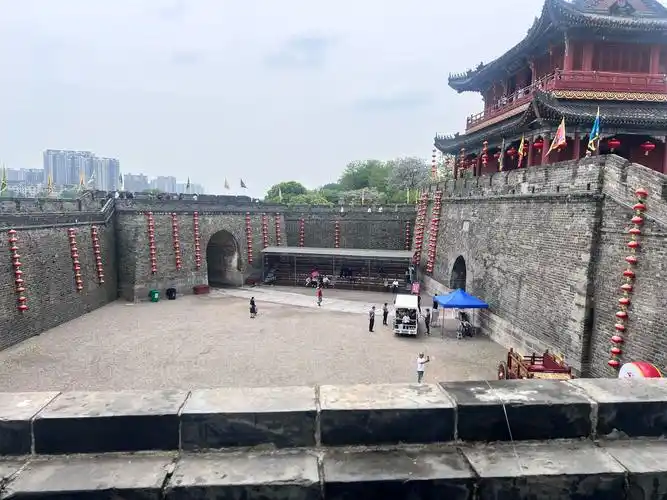 Jiayuguan marks the dramatic western anchor of the Ming Great Wall, much as Hadrian's Wall defined the northern frontier of Roman Britain. While Hadrian's Wall has crumbled to suggestive ruins, Jiayuguan's fortress remains remarkably intact, making it the best-preserved example of a fully functioning medieval frontier citadel anywhere along the Silk Road. The barbican system here protected the critical gateway through which Silk Road caravans, tribute missions, and invading armies alike had to pass. Compared to the barbicans of Carcassonne in France or the Tower of London's outer defenses, Jiayuguan's version is more compact yet arguably more lethal, designed specifically against the massive siege engines favored by Mongol and Oirat forces.
The architectural genius lies in the sideways-opening gates that force any attacker to make a sharp ninety-degree turn upon entry. In military terms, this single design choice neutralizes the heavy battering rams and wheeled siege towers that dominated medieval warfare across Eurasia. With less than five meters of straight approach, a fifty-ton ram becomes virtually harmless, losing over ninety percent of its striking power. Visitors will notice the walls rise to the same formidable height as the main fortress, creating an enclosed killing ground roughly twelve meters by eight meters where crossbowmen on both flanks had uninterrupted firing angles. The concept parallels the "murder holes" and dog-leg passages of European castle gatehouses but applies it at urban scale.
The inscriptions above the two barbican gates carry deep political symbolism from the Ming court. The east gate bears the characters "朝宗" (Chaozong), meaning "tributaries flowing toward the emperor," while the west gate reads "会极" (Huiji), signifying "the convergence of all western lands meeting at court." Together with the outer enceinte and the gate tower, these phrases reminded every passing envoy, merchant, or soldier that they were entering the sacred precincts of the Son of Heaven. For visitors interested in how architecture served imperial ideology, the barbican gates are essentially propaganda carved in stone.
A complete circuit of the fortress complex, encompassing both barbicans, the famous Gate Tower, corner turrets, and the Guerrilla General's Residence, requires approximately two hours. The barbicans themselves warrant twenty to thirty minutes, but only with proper interpretation. Hiring an official guide or renting the electronic audio tour is strongly advised, as the subtle genius of the dog-leg passages and compressed spaces is otherwise easily overlooked. Entry tickets cover the entire fortress with no separate fee for the barbicans.
The recommended route begins at the East闸门 (East Flood Gate), proceeding through the outer walls, the east barbican, the inner city, the west barbican, and finally ascending the Gate Tower itself. From this elevated perch, the snow-capped Qilian Mountains rise dramatically to the south while the endless Gobi Desert stretches northward, offering the same breathtaking panorama that Ming generals surveyed. Behind the west barbican's Huiji gate, visitors can search for the legendary "Dingcheng Brick," a single brick supposedly placed by a cunning architect to hold the entire wall together, a charming folk tale that adds whimsy to the otherwise austere military atmosphere. Given the harsh desert climate with extreme temperature swings and intense UV exposure, sun protection, windproof layers, and sturdy non-slip footwear are essential for a comfortable visit.
Jiayuguan marks the dramatic western anchor of the Ming Great Wall, much as Hadrian's Wall defined the northern frontier of Roman Britain. While Hadrian's Wall has crumbled to suggestive ruins, Jiayuguan's fortress remains remarkably intact, making it the best-preserved example of a fully functioning medieval frontier citadel anywhere along the Silk Road. The barbican system here protected the critical gateway through which Silk Road caravans, tribute missions, and invading armies alike had to pass. Compared to the barbicans of Carcassonne in France or the Tower of London's outer defenses, Jiayuguan's version is more compact yet arguably more lethal, designed specifically against the massive siege engines favored by Mongol and Oirat forces.
The architectural genius lies in the sideways-opening gates that force any attacker to make a sharp ninety-degree turn upon entry. In military terms, this single design choice neutralizes the heavy battering rams and wheeled siege towers that dominated medieval warfare across Eurasia. With less than five meters of straight approach, a fifty-ton ram becomes virtually harmless, losing over ninety percent of its striking power. Visitors will notice the walls rise to the same formidable height as the main fortress, creating an enclosed killing ground roughly twelve meters by eight meters where crossbowmen on both flanks had uninterrupted firing angles. The concept parallels the "murder holes" and dog-leg passages of European castle gatehouses but applies it at urban scale.
The inscriptions above the two barbican gates carry deep political symbolism from the Ming court. The east gate bears the characters "朝宗" (Chaozong), meaning "tributaries flowing toward the emperor," while the west gate reads "会极" (Huiji), signifying "the convergence of all western lands meeting at court." Together with the outer enceinte and the gate tower, these phrases reminded every passing envoy, merchant, or soldier that they were entering the sacred precincts of the Son of Heaven. For visitors interested in how architecture served imperial ideology, the barbican gates are essentially propaganda carved in stone.
A complete circuit of the fortress complex, encompassing both barbicans, the famous Gate Tower, corner turrets, and the Guerrilla General's Residence, requires approximately two hours. The barbicans themselves warrant twenty to thirty minutes, but only with proper interpretation. Hiring an official guide or renting the electronic audio tour is strongly advised, as the subtle genius of the dog-leg passages and compressed spaces is otherwise easily overlooked. Entry tickets cover the entire fortress with no separate fee for the barbicans.
The recommended route begins at the East闸门 (East Flood Gate), proceeding through the outer walls, the east barbican, the inner city, the west barbican, and finally ascending the Gate Tower itself. From this elevated perch, the snow-capped Qilian Mountains rise dramatically to the south while the endless Gobi Desert stretches northward, offering the same breathtaking panorama that Ming generals surveyed. Behind the west barbican's Huiji gate, visitors can search for the legendary "Dingcheng Brick," a single brick supposedly placed by a cunning architect to hold the entire wall together, a charming folk tale that adds whimsy to the otherwise austere military atmosphere. Given the harsh desert climate with extreme temperature swings and intense UV exposure, sun protection, windproof layers, and sturdy non-slip footwear are essential for a comfortable visit.