Jiayuguan Folk Culture Street
⭐ 3.80
Jiayuguan Folk Culture Street, Xiongguan Street, Jiayuguan City, Gansu Province, China
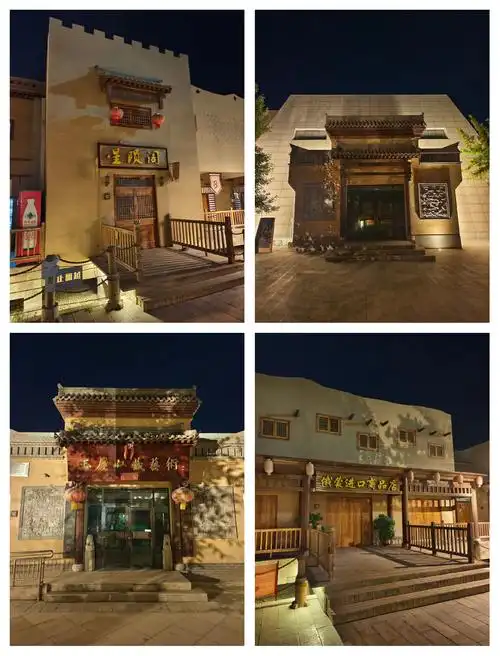 The Silk Road Style Street is part of the Bailucang cultural tourism project, which reimagines the historic corridor where caravans once carried silk, spices, and ideas between Chang'an and Rome. While the district itself is a modern recreation rather than an authentic relic, it draws on the same romantic vision that inspired European travelers like Marco Polo, evoking the cosmopolitan trade hubs of medieval Central Asia. Set just east of the UNESCO-listed Jiayuguan Fort—the dramatic western terminus of the Ming Great Wall—it serves as a vibrant companion experience to one of China's most iconic frontier landmarks.
The architecture faithfully channels Ming and Qing market-town aesthetics, with upturned eaves, grey brick walls, wooden archways, mortise-and-tenon construction, and flagstone lanes reminiscent of Beijing's older hutong districts or a small-scale Forbidden City approach to vernacular design. Stone paifang gates and pavilions punctuate the streetscape, while Silk Road motifs adorn the facades. Photographers, particularly those in hanfu attire, find the lantern-lit evenings especially evocative, when the entire avenue glows like a film set from a wuxia epic.
Cultural programming is the heart of the experience. Throughout the day, costumed performers present Qinqiang opera, martial arts, acrobatics, and Western Regions dance. More than a dozen roving "NPCs"—dressed as Silk Road merchants and Ming garrison soldiers—engage visitors with interactive missions, a touch familiar to anyone who has toured European medieval festivals like Oberammergau or Carcassonne's summer spectacles. The undisputed highlight occurs around 8:00 PM, when master craftsmen perform the intangible heritage art of "iron flower" forging, hurling molten metal into the air to create cascading golden sparks—a visceral pyrotechnic tradition comparable to Catalonia's correfoc fire runs.
The food court celebrates the flavors of Gansu and Xinjiang, with red willow kebabs, roasted lamb ribs, freshly baked naan, camel meat banquets, and the refreshing apricot-skin drink beloved by locals. Families will appreciate the handicraft workshops where visitors can try lacquer fan-making and other folk arts, similar to the artisan demonstrations found in Tuscany or Provence. It is genuinely a one-stop district for eating, shopping, and entertainment.
Practical planning is straightforward. Entry is free and the district sits just east of Jiayuguan Fort, north of the Heritage Park along Shuangyong Road. Visitors are strongly advised to arrive after 4:00 PM to enjoy the cooler evening air, watch the street shows, and stay through the iron flower finale. Carry your passport for the adjacent ticketed fortress, wear comfortable shoes, bring a power bank, and allow half a day to a full day. Summer temperatures are intense, so sunscreen and water are essential, and those seeking authentic Ming-era atmosphere should remember this is a polished modern recreation rather than a centuries-old bazaar.
The Silk Road Style Street is part of the Bailucang cultural tourism project, which reimagines the historic corridor where caravans once carried silk, spices, and ideas between Chang'an and Rome. While the district itself is a modern recreation rather than an authentic relic, it draws on the same romantic vision that inspired European travelers like Marco Polo, evoking the cosmopolitan trade hubs of medieval Central Asia. Set just east of the UNESCO-listed Jiayuguan Fort—the dramatic western terminus of the Ming Great Wall—it serves as a vibrant companion experience to one of China's most iconic frontier landmarks.
The architecture faithfully channels Ming and Qing market-town aesthetics, with upturned eaves, grey brick walls, wooden archways, mortise-and-tenon construction, and flagstone lanes reminiscent of Beijing's older hutong districts or a small-scale Forbidden City approach to vernacular design. Stone paifang gates and pavilions punctuate the streetscape, while Silk Road motifs adorn the facades. Photographers, particularly those in hanfu attire, find the lantern-lit evenings especially evocative, when the entire avenue glows like a film set from a wuxia epic.
Cultural programming is the heart of the experience. Throughout the day, costumed performers present Qinqiang opera, martial arts, acrobatics, and Western Regions dance. More than a dozen roving "NPCs"—dressed as Silk Road merchants and Ming garrison soldiers—engage visitors with interactive missions, a touch familiar to anyone who has toured European medieval festivals like Oberammergau or Carcassonne's summer spectacles. The undisputed highlight occurs around 8:00 PM, when master craftsmen perform the intangible heritage art of "iron flower" forging, hurling molten metal into the air to create cascading golden sparks—a visceral pyrotechnic tradition comparable to Catalonia's correfoc fire runs.
The food court celebrates the flavors of Gansu and Xinjiang, with red willow kebabs, roasted lamb ribs, freshly baked naan, camel meat banquets, and the refreshing apricot-skin drink beloved by locals. Families will appreciate the handicraft workshops where visitors can try lacquer fan-making and other folk arts, similar to the artisan demonstrations found in Tuscany or Provence. It is genuinely a one-stop district for eating, shopping, and entertainment.
Practical planning is straightforward. Entry is free and the district sits just east of Jiayuguan Fort, north of the Heritage Park along Shuangyong Road. Visitors are strongly advised to arrive after 4:00 PM to enjoy the cooler evening air, watch the street shows, and stay through the iron flower finale. Carry your passport for the adjacent ticketed fortress, wear comfortable shoes, bring a power bank, and allow half a day to a full day. Summer temperatures are intense, so sunscreen and water are essential, and those seeking authentic Ming-era atmosphere should remember this is a polished modern recreation rather than a centuries-old bazaar.