Jiayuguan Pass Tower
⭐ 4.20
Xiongguan Street, Jiayuguan City, Gansu Province, China
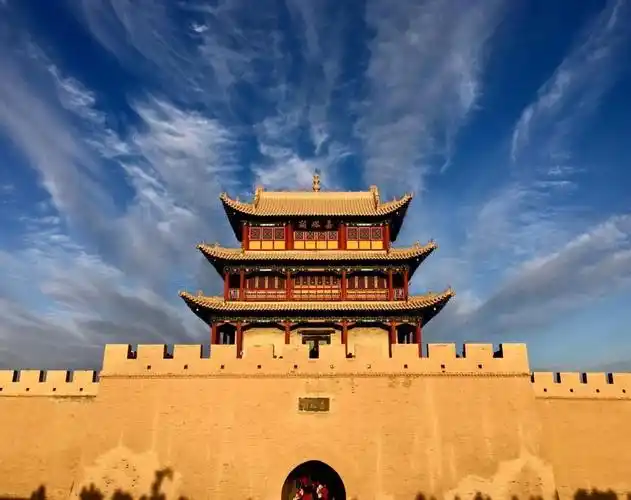 Begun in the fifth year of the Ming Hongwu reign (1372)—when Petrarch was writing sonnets in Avignon and the Black Death still haunted Europe—and completed after 168 years of construction, Jiayuguan was the linchpin of imperial China's northwestern frontier. While castles like Scotland's Stirling or France's Carcassonne defended single kingdoms, Jiayuguan shielded an entire civilization from rival powers and nomadic incursions. Designated a national priority protected site in 1961, it joined the UNESCO World Heritage list in 1987 as part of the Great Wall. Often called the "encyclopedia of the Great Wall," it remains the best-preserved integrated military fortress of the Ming dynasty.
The fortress follows a fascinating "city within a city" layout spanning roughly 25,000–35,000 square meters, comparable in ambition to the concentric defenses of medieval Krak des Chevaliers in Syria or the bastioned citadels of Renaissance Italy. Three principal gate towers serve distinct symbolic functions: Guanghua Tower to the south, Rouyuan Tower to the north, and the towering central Jiayuguan Tower, flanked by Qing-era additions including a patrol commander residence, a temple to the god of literature, and a shrine to the god of war. Encircling barbicans, watchtowers, and corner turrets together form what scholars consider a living textbook of Ming defensive architecture.
Beyond its martial role, Jiayuguan was a cosmopolitan Silk Road checkpoint where Persian merchants, Tibetan lamas, and Han officials converged. The on-site Great Wall Museum and Patrol General's Mansion illuminate the sophisticated military bureaucracy and frontier culture of the era. Folk legends—such as the romantic tale of "the last brick," supposedly added by a worker's lover to save her beloved from execution—infuse the ancient stones with human warmth. At sunset, the Qilian peaks blaze gold above the gray Gobi, creating a photographer's dream that rivals the visual drama of any desert citadel from Samarkand to Morocco.
Practical planning is essential. The site is a 5A-rated scenic area open 8:30–18:00 in peak season (May 1–October 31) and 9:00–17:30 in winter, with tower entry typically closing one hour before closing time. Visitors should arrive after 4 PM to avoid the harsh midday sun and to catch the golden-hour light on the mountains. A combined ticket covering the fortress, the dramatic cliff-clinging Hanging Wall section, and the First Pier of the Great Wall costs 110 yuan in peak season and allows a satisfying 3–4 hour circuit. Hiring a licensed guide or renting an audio device is strongly recommended, as the strategic genius behind the ramparts is invisible without expert interpretation.
A spectacular evening light show titled "Magnificent Jiayuguan" is offered separately for those wishing to see the fortress theatrically illuminated. Contact the site at 0937-6396110 for current programming. Travelers approaching from Dunhuang or Zhangye should allow at least half a day; the fortress deserves its place alongside Petra, the Alhambra, and Rome's Aurelian Walls as one of the world's truly irreplaceable monuments to the meeting point of empire and frontier.
Begun in the fifth year of the Ming Hongwu reign (1372)—when Petrarch was writing sonnets in Avignon and the Black Death still haunted Europe—and completed after 168 years of construction, Jiayuguan was the linchpin of imperial China's northwestern frontier. While castles like Scotland's Stirling or France's Carcassonne defended single kingdoms, Jiayuguan shielded an entire civilization from rival powers and nomadic incursions. Designated a national priority protected site in 1961, it joined the UNESCO World Heritage list in 1987 as part of the Great Wall. Often called the "encyclopedia of the Great Wall," it remains the best-preserved integrated military fortress of the Ming dynasty.
The fortress follows a fascinating "city within a city" layout spanning roughly 25,000–35,000 square meters, comparable in ambition to the concentric defenses of medieval Krak des Chevaliers in Syria or the bastioned citadels of Renaissance Italy. Three principal gate towers serve distinct symbolic functions: Guanghua Tower to the south, Rouyuan Tower to the north, and the towering central Jiayuguan Tower, flanked by Qing-era additions including a patrol commander residence, a temple to the god of literature, and a shrine to the god of war. Encircling barbicans, watchtowers, and corner turrets together form what scholars consider a living textbook of Ming defensive architecture.
Beyond its martial role, Jiayuguan was a cosmopolitan Silk Road checkpoint where Persian merchants, Tibetan lamas, and Han officials converged. The on-site Great Wall Museum and Patrol General's Mansion illuminate the sophisticated military bureaucracy and frontier culture of the era. Folk legends—such as the romantic tale of "the last brick," supposedly added by a worker's lover to save her beloved from execution—infuse the ancient stones with human warmth. At sunset, the Qilian peaks blaze gold above the gray Gobi, creating a photographer's dream that rivals the visual drama of any desert citadel from Samarkand to Morocco.
Practical planning is essential. The site is a 5A-rated scenic area open 8:30–18:00 in peak season (May 1–October 31) and 9:00–17:30 in winter, with tower entry typically closing one hour before closing time. Visitors should arrive after 4 PM to avoid the harsh midday sun and to catch the golden-hour light on the mountains. A combined ticket covering the fortress, the dramatic cliff-clinging Hanging Wall section, and the First Pier of the Great Wall costs 110 yuan in peak season and allows a satisfying 3–4 hour circuit. Hiring a licensed guide or renting an audio device is strongly recommended, as the strategic genius behind the ramparts is invisible without expert interpretation.
A spectacular evening light show titled "Magnificent Jiayuguan" is offered separately for those wishing to see the fortress theatrically illuminated. Contact the site at 0937-6396110 for current programming. Travelers approaching from Dunhuang or Zhangye should allow at least half a day; the fortress deserves its place alongside Petra, the Alhambra, and Rome's Aurelian Walls as one of the world's truly irreplaceable monuments to the meeting point of empire and frontier.