Hanging Great Wall
⭐ 4.50
Hanging Great Wall, Chengguan Town, Jiayuguan City, Gansu Province, China
 Constructed in 1539 during the reign of Emperor Jiajing—contemporary with Henry VIII's break from Rome and Michelangelo's final works in Rome—this 7.5-kilometer barrier formed the northern "hidden arm" of Jiayuguan's sophisticated defense network. Where Hadrian's Wall marked Rome's northern frontier in Britain, the Ming Wall defined the Chinese empire's western boundary, protecting the vital Silk Road that carried goods, ideas, and travelers like Marco Polo between East and West. Much of the original structure has been lost to time, though a 750-meter section was carefully restored in 1987 following Ming architectural specifications.
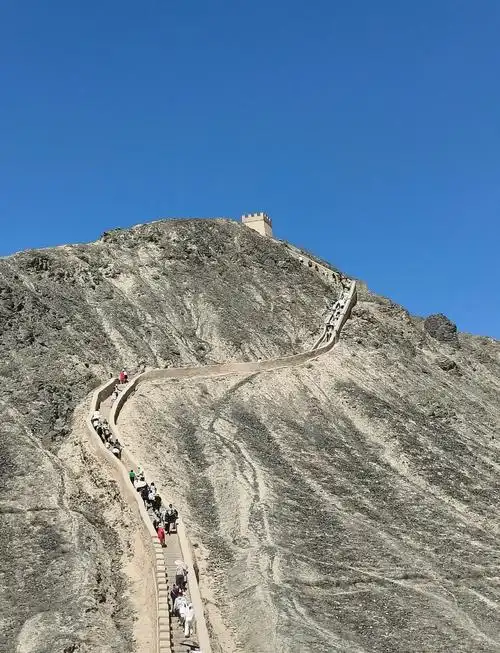
The wall demonstrates remarkably practical adaptation to hostile terrain: builders used locally quarried gravel and rammed earth in alternating layers, allowing the structure to follow the mountain's natural contours rather than imposing a straight line. Three watchtowers punctuate the ridge, while parapets and a sloped walkway trace the spine of the cliff. The most dramatic stretch—231 meters—appears to dangle in mid-air at a near-45-degree angle, earning the site its evocative name. It shares the spirit of Europe's clifftop citadels at Salzburg or the vertiginous fortifications of the Italian Dolomites.
At the mountain's base, a sculpture garden honors Silk Road luminaries including Zhang Qian, the Han Dynasty explorer who opened the westward route in the 2nd century BC, and the monk Xuanzang, whose 7th-century pilgrimage to India inspired the classic novel "Journey to the West." A display of ancient weaponry connects the site's military function to its role as a cultural crossroads. Together with Jiayuguan Fortress and the First Pier of the Great Wall, the Hanging Wall completes one of history's most ambitious defensive systems, often called "the First Pass Under Heaven."
The site lies 11 kilometers from Jiayuguan city and is best reached by taxi, ride-hailing app, or the scenic shuttle from the main fortress. Open hours run 08:00–20:00 from May through October and 08:00–18:00 in winter. Combined tickets covering all three Jiayuguan heritage sites offer the best value. Climbers should allow 40–60 minutes for the full ascent and wear sturdy non-slip shoes, bring 1–1.5 liters of water per person, and prepare for strong sun and sudden desert winds. Late afternoon entries (after 16:00) capture the most flattering light and avoid midday heat.
This is one of China's most photogenic Great Wall sections, combining genuine physical adventure with profound historical resonance. The panoramic reward at the summit—a sweeping tapestry of desert, distant snow peaks, and even the surprising inclusion of modern industrial scenery—reveals the vast scale of the landscapes that protected Silk Road caravans for centuries. Families with elderly visitors or young children can climb to the mid-point observation deck for excellent views without completing the full ascent, making this dramatic frontier accessible to most travelers willing to tackle a few hundred steps.
Constructed in 1539 during the reign of Emperor Jiajing—contemporary with Henry VIII's break from Rome and Michelangelo's final works in Rome—this 7.5-kilometer barrier formed the northern "hidden arm" of Jiayuguan's sophisticated defense network. Where Hadrian's Wall marked Rome's northern frontier in Britain, the Ming Wall defined the Chinese empire's western boundary, protecting the vital Silk Road that carried goods, ideas, and travelers like Marco Polo between East and West. Much of the original structure has been lost to time, though a 750-meter section was carefully restored in 1987 following Ming architectural specifications.
The wall demonstrates remarkably practical adaptation to hostile terrain: builders used locally quarried gravel and rammed earth in alternating layers, allowing the structure to follow the mountain's natural contours rather than imposing a straight line. Three watchtowers punctuate the ridge, while parapets and a sloped walkway trace the spine of the cliff. The most dramatic stretch—231 meters—appears to dangle in mid-air at a near-45-degree angle, earning the site its evocative name. It shares the spirit of Europe's clifftop citadels at Salzburg or the vertiginous fortifications of the Italian Dolomites.
At the mountain's base, a sculpture garden honors Silk Road luminaries including Zhang Qian, the Han Dynasty explorer who opened the westward route in the 2nd century BC, and the monk Xuanzang, whose 7th-century pilgrimage to India inspired the classic novel "Journey to the West." A display of ancient weaponry connects the site's military function to its role as a cultural crossroads. Together with Jiayuguan Fortress and the First Pier of the Great Wall, the Hanging Wall completes one of history's most ambitious defensive systems, often called "the First Pass Under Heaven."
The site lies 11 kilometers from Jiayuguan city and is best reached by taxi, ride-hailing app, or the scenic shuttle from the main fortress. Open hours run 08:00–20:00 from May through October and 08:00–18:00 in winter. Combined tickets covering all three Jiayuguan heritage sites offer the best value. Climbers should allow 40–60 minutes for the full ascent and wear sturdy non-slip shoes, bring 1–1.5 liters of water per person, and prepare for strong sun and sudden desert winds. Late afternoon entries (after 16:00) capture the most flattering light and avoid midday heat.
This is one of China's most photogenic Great Wall sections, combining genuine physical adventure with profound historical resonance. The panoramic reward at the summit—a sweeping tapestry of desert, distant snow peaks, and even the surprising inclusion of modern industrial scenery—reveals the vast scale of the landscapes that protected Silk Road caravans for centuries. Families with elderly visitors or young children can climb to the mid-point observation deck for excellent views without completing the full ascent, making this dramatic frontier accessible to most travelers willing to tackle a few hundred steps.