Taklamakan Desert
⭐ 4.20
Kashgar Prefecture, Xinjiang Uyghur Autonomous Region, China
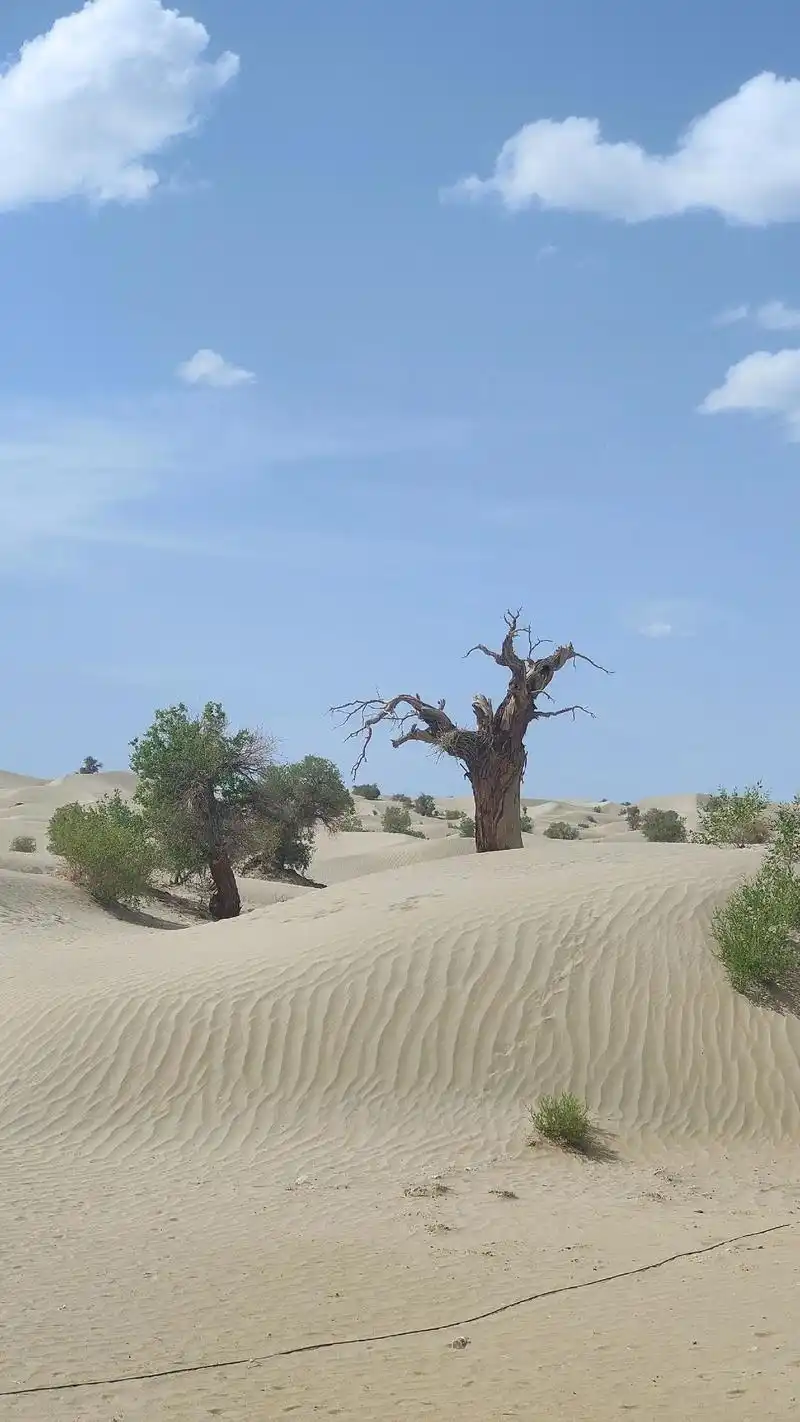 The Taklamakan sprawls across the Tarim Basin, its Uyghur name meaning "once you go in, you don't come out." For over two millennia, this fearsome sea of sand served as the middle route of the Silk Road, the vital artery connecting Chang'an to Rome. The pilgrim Xuanzang trudged these dunes on his 7th-century quest for Indian sutras; the lost cities of Niya and Khotan rose and fell within its embrace. Like the Sahara's caravan corridors or Arabia's Rub' al Khali, it shaped civilizations through the merchants, monks, and missionaries who dared to cross it.
The landscape is dominated by golden dunes rising over a hundred meters, their crests rippling like frozen ocean swells toward the horizon. On still afternoons, mirages flicker into view; after sundown, the Milky Way arches overhead in a brilliance rarely matched outside the Atacama or Namib. Compared to the Sahara's vast ergs or Australia's red center, the Taklamakan offers a uniquely luminous palette—sand so fine it seems to glow under the high-altitude sun. These shifting dunes, sculpted by relentless winds, serve as a living laboratory for studying extreme arid climates.
Within Kashgar Prefecture, the Maigaiti N39° Desert Adventure Base—designated a national AAAA scenic area—provides the only large-scale, professionally managed desert tourism destination in the jurisdiction. The base features desert-themed hotels and star-gazing camps, alongside activities such as off-road dune bashing, camel treks, sandboarding, and bonfire evenings infused with the rhythms of Dolan Muqam, a UNESCO-recognized Uyghur musical tradition. Think of it as China's answer to Namibia's Sossusvlei Lodge: comfortable access to one of the planet's most inhospitable landscapes without sacrificing safety or comfort.
Adventurous travelers can drive or charter a 4x4 along the G217 Desert Highway for the legendary 500-kilometer "sand-sea voyage" from Hotan through Minfeng to Aral. Along the route, sand-fixing straw checkerboards give way to wild poplar forests and migrating dunes; in autumn, the poplars blaze gold, transforming the highway into a corridor of fire comparable to a Tuscan drive in October. September through early November offers the finest weather, while May through August brings scorching 60°C surfaces and spring unleashes frequent sandstorms that can halt travel entirely.
Plan two to three days for the desert experience, ideally combining it with the Pamir Plateau and Kashgar's Old City to capture southern Xinjiang's full splendor—much as travelers pair Marrakech with a Sahara excursion. Stay outdoors at dawn and dusk when light is golden and temperatures merciful, avoid midday exposure, and pack ample water, sun protection, and wind-proof gear. Combine the trip with side visits to Lop Nor village settlements or the ancient Daryabuyi oasis for deeper cultural immersion into communities that have survived here for generations.
Kashgar and its surrounding oases lie within a predominantly Muslim Uyghur region—respect halal dining customs, refrain from photographing women without permission, and follow local etiquette. Always book through licensed operators with professional guides, satellite communication, and proper emergency supplies; never venture into the deep desert alone. For those who prepare thoughtfully, the Taklamakan offers a rare communion with one of Earth's last great wilderness frontiers—an experience rivaling the Sahara's silent majesty or the salt flats of Bolivia in its otherworldly grandeur.
The Taklamakan sprawls across the Tarim Basin, its Uyghur name meaning "once you go in, you don't come out." For over two millennia, this fearsome sea of sand served as the middle route of the Silk Road, the vital artery connecting Chang'an to Rome. The pilgrim Xuanzang trudged these dunes on his 7th-century quest for Indian sutras; the lost cities of Niya and Khotan rose and fell within its embrace. Like the Sahara's caravan corridors or Arabia's Rub' al Khali, it shaped civilizations through the merchants, monks, and missionaries who dared to cross it.
The landscape is dominated by golden dunes rising over a hundred meters, their crests rippling like frozen ocean swells toward the horizon. On still afternoons, mirages flicker into view; after sundown, the Milky Way arches overhead in a brilliance rarely matched outside the Atacama or Namib. Compared to the Sahara's vast ergs or Australia's red center, the Taklamakan offers a uniquely luminous palette—sand so fine it seems to glow under the high-altitude sun. These shifting dunes, sculpted by relentless winds, serve as a living laboratory for studying extreme arid climates.
Within Kashgar Prefecture, the Maigaiti N39° Desert Adventure Base—designated a national AAAA scenic area—provides the only large-scale, professionally managed desert tourism destination in the jurisdiction. The base features desert-themed hotels and star-gazing camps, alongside activities such as off-road dune bashing, camel treks, sandboarding, and bonfire evenings infused with the rhythms of Dolan Muqam, a UNESCO-recognized Uyghur musical tradition. Think of it as China's answer to Namibia's Sossusvlei Lodge: comfortable access to one of the planet's most inhospitable landscapes without sacrificing safety or comfort.
Adventurous travelers can drive or charter a 4x4 along the G217 Desert Highway for the legendary 500-kilometer "sand-sea voyage" from Hotan through Minfeng to Aral. Along the route, sand-fixing straw checkerboards give way to wild poplar forests and migrating dunes; in autumn, the poplars blaze gold, transforming the highway into a corridor of fire comparable to a Tuscan drive in October. September through early November offers the finest weather, while May through August brings scorching 60°C surfaces and spring unleashes frequent sandstorms that can halt travel entirely.
Plan two to three days for the desert experience, ideally combining it with the Pamir Plateau and Kashgar's Old City to capture southern Xinjiang's full splendor—much as travelers pair Marrakech with a Sahara excursion. Stay outdoors at dawn and dusk when light is golden and temperatures merciful, avoid midday exposure, and pack ample water, sun protection, and wind-proof gear. Combine the trip with side visits to Lop Nor village settlements or the ancient Daryabuyi oasis for deeper cultural immersion into communities that have survived here for generations.
Kashgar and its surrounding oases lie within a predominantly Muslim Uyghur region—respect halal dining customs, refrain from photographing women without permission, and follow local etiquette. Always book through licensed operators with professional guides, satellite communication, and proper emergency supplies; never venture into the deep desert alone. For those who prepare thoughtfully, the Taklamakan offers a rare communion with one of Earth's last great wilderness frontiers—an experience rivaling the Sahara's silent majesty or the salt flats of Bolivia in its otherworldly grandeur.