Kashgar Dinosaur Geological Park
⭐ 3.50
Kashgar Dinosaur Geological Park, Kashgar City, Kashgar Prefecture, Xinjiang Uyghur Autonomous Region, China
 **Setting the Scene:** Tucked into the southeastern rim of the Junggar Basin at the foot of the northern Tian Shan range, Qitai County's Jiangjun Gobi lies near the ancient Silk Road corridor that once carried caravans between China and Central Asia. At roughly 800 metres elevation, this temperate desert preserves a Jurassic landscape from around 160 million years ago, when vast lakes and swamps supported lush conifer forests and towering sauropods. Think of it as China's answer to Utah's Morrison Formation or Wyoming's Como Bluff, yet far less frequented.
**The Petrified Forest:** The park hosts Asia's most extensive silicified wood assemblage, with nearly a thousand fossilised trunks scattered across the barren plain. The largest specimen measures an astonishing 2.8 metres in diameter and 26 metres long, its bark patterns still crisply visible. Comparable in scale to Arizona's Petrified Forest, this collection offers a tangible glimpse into ecosystems that flourished long before flowering plants or mammals dominated the land.
**The Dinosaur Legacy:** The nearby Dinosaur Gully (Konglong Gou) yielded the celebrated Sino-Canadian Mamenchisaurus, a 35-metre-long sauropod excavated in the 1980s that ranks among the most complete giant dinosaur skeletons in the world. Designated a National Geopark in 2004, the site functions as an open-air laboratory for studying ancient climates, ecosystems, and continental drift, much like Canada's Dinosaur Provincial Park, though without the visitor infrastructure.
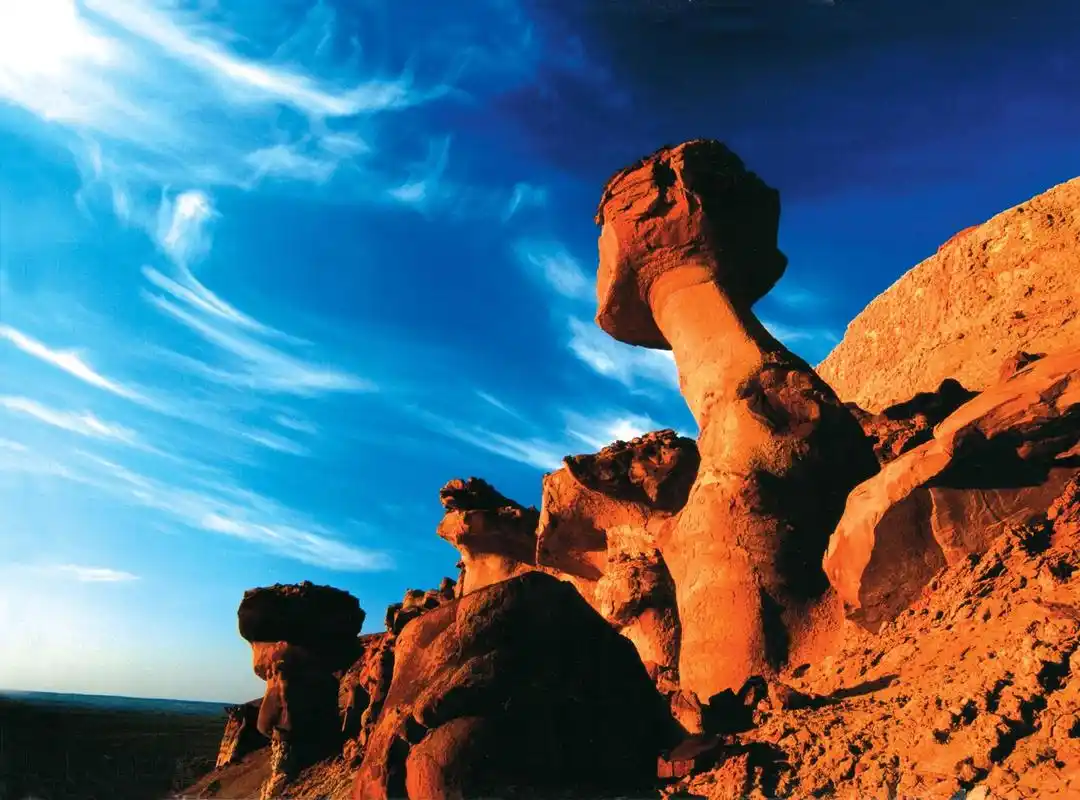
**A Multi-Layered Landscape:** Beyond fossils, the park encompasses dramatic yardang formations resembling a miniature Devil's City, striking burnt-rock cliffs created by ancient underground coal fires, and the Stone-Coin Beach marine fossil beds. Together these features form a stratigraphic cross-section of Earth's history spanning hundreds of millions of years, rewarding visitors with sweeping, otherworldly vistas.
**Practical Visitor Information:** Adult tickets run roughly 60-80 yuan, and reaching the site requires a self-drive or chartered vehicle from Qitai town, approximately 155 kilometres away on partly unpaved roads. Navigate to "Qitai Silicified Wood Garden" or "Konglong Gou." Facilities are minimal, so bring ample water, food, sun protection, and sturdy hiking boots. Plan to visit at dawn or dusk to escape the fierce desert sun, and allow a full day for proper exploration.
**Planning Your Trip:** The optimal season runs from May through September, when temperatures are tolerable though防晒 remains essential. Spring and autumn bring strong winds and blowing sand, requiring windproof gear. Travellers based in Kashgar should enjoy the city's Uyghur heritage, the Pamir highlands, and the Taklamakan Desert instead, since no dinosaur sites exist nearby. To reach the geopark, fly from Kashgar to Urumqi (about 1.5 hours), then transfer to Changji or Qitai, allowing two to three days minimum. Always verify current opening status via the Xinjiang Department of Culture and Tourism website or the 12301 hotline before departure.
**Setting the Scene:** Tucked into the southeastern rim of the Junggar Basin at the foot of the northern Tian Shan range, Qitai County's Jiangjun Gobi lies near the ancient Silk Road corridor that once carried caravans between China and Central Asia. At roughly 800 metres elevation, this temperate desert preserves a Jurassic landscape from around 160 million years ago, when vast lakes and swamps supported lush conifer forests and towering sauropods. Think of it as China's answer to Utah's Morrison Formation or Wyoming's Como Bluff, yet far less frequented.
**The Petrified Forest:** The park hosts Asia's most extensive silicified wood assemblage, with nearly a thousand fossilised trunks scattered across the barren plain. The largest specimen measures an astonishing 2.8 metres in diameter and 26 metres long, its bark patterns still crisply visible. Comparable in scale to Arizona's Petrified Forest, this collection offers a tangible glimpse into ecosystems that flourished long before flowering plants or mammals dominated the land.
**The Dinosaur Legacy:** The nearby Dinosaur Gully (Konglong Gou) yielded the celebrated Sino-Canadian Mamenchisaurus, a 35-metre-long sauropod excavated in the 1980s that ranks among the most complete giant dinosaur skeletons in the world. Designated a National Geopark in 2004, the site functions as an open-air laboratory for studying ancient climates, ecosystems, and continental drift, much like Canada's Dinosaur Provincial Park, though without the visitor infrastructure.
**A Multi-Layered Landscape:** Beyond fossils, the park encompasses dramatic yardang formations resembling a miniature Devil's City, striking burnt-rock cliffs created by ancient underground coal fires, and the Stone-Coin Beach marine fossil beds. Together these features form a stratigraphic cross-section of Earth's history spanning hundreds of millions of years, rewarding visitors with sweeping, otherworldly vistas.
**Practical Visitor Information:** Adult tickets run roughly 60-80 yuan, and reaching the site requires a self-drive or chartered vehicle from Qitai town, approximately 155 kilometres away on partly unpaved roads. Navigate to "Qitai Silicified Wood Garden" or "Konglong Gou." Facilities are minimal, so bring ample water, food, sun protection, and sturdy hiking boots. Plan to visit at dawn or dusk to escape the fierce desert sun, and allow a full day for proper exploration.
**Planning Your Trip:** The optimal season runs from May through September, when temperatures are tolerable though防晒 remains essential. Spring and autumn bring strong winds and blowing sand, requiring windproof gear. Travellers based in Kashgar should enjoy the city's Uyghur heritage, the Pamir highlands, and the Taklamakan Desert instead, since no dinosaur sites exist nearby. To reach the geopark, fly from Kashgar to Urumqi (about 1.5 hours), then transfer to Changji or Qitai, allowing two to three days minimum. Always verify current opening status via the Xinjiang Department of Culture and Tourism website or the 12301 hotline before departure.