Kashgar Folk Custom Museum
⭐ 4.20
Kashgar Prefecture, Xinjiang, China
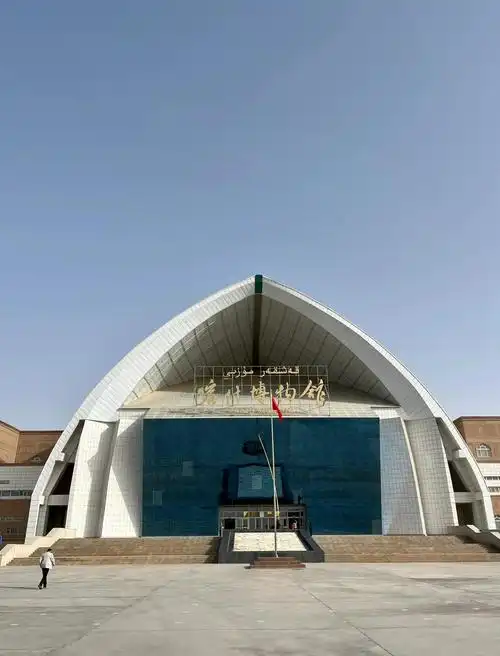 **Historical context** – Standing where caravans once linked Rome to Chang'an, Kashgar ranks among the most evocative Silk Road waypoints in Asia—comparable in significance to Samarkand or the medieval trading ports of Venice and Genoa. The Kashi Regional Museum, rebuilt and reopened in 2020, now safeguards more than 5,300 artifacts spanning from the pre-Qin era to modern times: bronze vessels, Tang-dynasty sculpture, Northern Dynasties pottery, and Silk Road textiles that whisper of Byzantine silk weavers and Sogdian merchants. Its folk-exhibition halls trace the migrations of Turkic peoples across the Pamirs and Taklamakan, paralleling the great nomadic movements that reshaped medieval Europe's Hungarian plains.
**Architecture** – The Regional Museum at 19 Tawuguzhi Road embraces a contemporary silhouette softened by the warm earthen ochre tones and geometric ornament of traditional Uyghur courtyard houses—a deliberate echo of the mud-brick architecture that surrounds it. Inside, modern exhibition design replaces glass cases with immersive displays. The Kashgar Folk Museum, tucked inside the great bazaar beside Id Kah Mosque, takes the opposite approach: a modest 1,500-square-meter space furnished as a living dwelling, wedding chamber, and artisan workshop, with no interpretive distance between visitor and object.
**Cultural significance** – The Regional Museum's flagship exhibition, "Kunlun Echoes, Treasures of the Ancient Road," reassembles Kashgar's identity as a meeting point where Buddhist pilgrims, Nestorian monks, Manichaean traders, and later Sufi mystics once shared teahouses. Tang sculptures stand alongside Sogdian-style textiles that recall the embroidered hangings described by Byzantine historians. The Folk Museum complements this grand narrative with intimate material culture: Uyghur long-sleeved robes, rawap lutes whose ancestors reached Andalusia via Cordoba, and the felt yurts of Kyrgyz shepherds whose kin once rode the Eurasian steppes toward the Carpathians.
**Practical information** – The Regional Museum is free but requires advance reservation; guided tours begin charging fees from March 2026. Hours are Tuesday through Sunday, 10:00–19:00 (last entry 18:30), with Monday closures. The Kashgar Folk Museum's opening hours are irregular—confirm on arrival—and it sits directly beside Id Kah Mosque inside the old-city bazaar, easily combined with a wander through the surrounding lanes.
**Why visit** – Visitors with time to spare should pair both venues: begin at the Regional Museum for chronological context, then walk to the old-city Folk Museum to feel how those centuries survive in today's courtyards. Solo travelers with limited time will find the Regional Museum more substantial, while the Folk Museum rewards a 30-minute detour during any wander through the old quarter. Hiring a guide is strongly recommended—the stories behind a single Tang figurine or a Tajik embroidered hat unfold Silk Road history more vividly than any guidebook.
**Historical context** – Standing where caravans once linked Rome to Chang'an, Kashgar ranks among the most evocative Silk Road waypoints in Asia—comparable in significance to Samarkand or the medieval trading ports of Venice and Genoa. The Kashi Regional Museum, rebuilt and reopened in 2020, now safeguards more than 5,300 artifacts spanning from the pre-Qin era to modern times: bronze vessels, Tang-dynasty sculpture, Northern Dynasties pottery, and Silk Road textiles that whisper of Byzantine silk weavers and Sogdian merchants. Its folk-exhibition halls trace the migrations of Turkic peoples across the Pamirs and Taklamakan, paralleling the great nomadic movements that reshaped medieval Europe's Hungarian plains.
**Architecture** – The Regional Museum at 19 Tawuguzhi Road embraces a contemporary silhouette softened by the warm earthen ochre tones and geometric ornament of traditional Uyghur courtyard houses—a deliberate echo of the mud-brick architecture that surrounds it. Inside, modern exhibition design replaces glass cases with immersive displays. The Kashgar Folk Museum, tucked inside the great bazaar beside Id Kah Mosque, takes the opposite approach: a modest 1,500-square-meter space furnished as a living dwelling, wedding chamber, and artisan workshop, with no interpretive distance between visitor and object.
**Cultural significance** – The Regional Museum's flagship exhibition, "Kunlun Echoes, Treasures of the Ancient Road," reassembles Kashgar's identity as a meeting point where Buddhist pilgrims, Nestorian monks, Manichaean traders, and later Sufi mystics once shared teahouses. Tang sculptures stand alongside Sogdian-style textiles that recall the embroidered hangings described by Byzantine historians. The Folk Museum complements this grand narrative with intimate material culture: Uyghur long-sleeved robes, rawap lutes whose ancestors reached Andalusia via Cordoba, and the felt yurts of Kyrgyz shepherds whose kin once rode the Eurasian steppes toward the Carpathians.
**Practical information** – The Regional Museum is free but requires advance reservation; guided tours begin charging fees from March 2026. Hours are Tuesday through Sunday, 10:00–19:00 (last entry 18:30), with Monday closures. The Kashgar Folk Museum's opening hours are irregular—confirm on arrival—and it sits directly beside Id Kah Mosque inside the old-city bazaar, easily combined with a wander through the surrounding lanes.
**Why visit** – Visitors with time to spare should pair both venues: begin at the Regional Museum for chronological context, then walk to the old-city Folk Museum to feel how those centuries survive in today's courtyards. Solo travelers with limited time will find the Regional Museum more substantial, while the Folk Museum rewards a 30-minute detour during any wander through the old quarter. Hiring a guide is strongly recommended—the stories behind a single Tang figurine or a Tajik embroidered hat unfold Silk Road history more vividly than any guidebook.