Id Kah Mosque
⭐ 4.00
Id Kah Mosque, Kashgar City, Kashgar Prefecture, Xinjiang Uyghur Autonomous Region, China
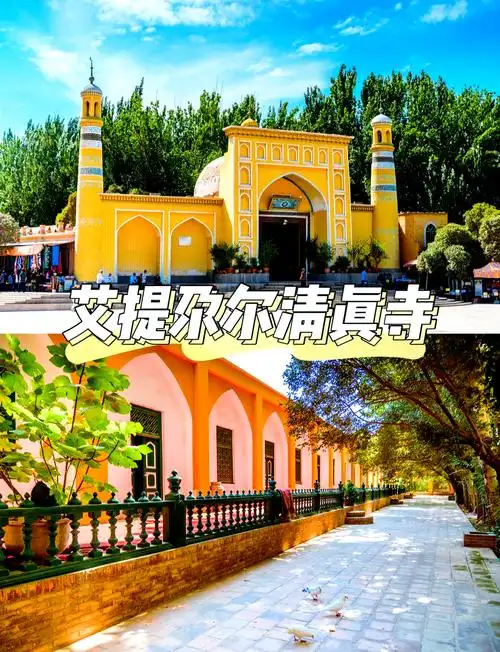 Founded in 1442 during the Ming Dynasty's Zhengtong era, Id Kah Mosque predates the fall of Constantinople by a mere eleven years and was built when Kashgar rivaled Samarkand and Bukhara as Silk Road powerhouses. While European cathedrals like Notre-Dame were still being completed, this mosque was already welcoming merchants, pilgrims, and scholars along the southern branch of the trans-Asian trade routes. Designated a national key cultural relic, it testifies to Kashgar's role as a crossroads where Persian poetry, Uyghur craftsmanship, and Chinese imperial culture converged for centuries, making it an essential stop for anyone tracing the historic exchange between East and West.
Architecturally, the complex spans about 16,800 square meters in a rigorously symmetrical west-facing layout that fuses Persian Islamic traditions with Uyghur artistry. The signature gateway rises 12 to 17 meters, flanked by twin minarets reaching 18 meters, crowned with crescent moons that catch the desert sun. A Persian-style arched niche above the entrance, intricate tilework, and elaborate brick and wood carvings create an aesthetic that recalls Isfahan's mosques while remaining distinctly Central Asian. The yellow-and-green color palette, accented with delicate floral motifs, rewards photographers with details that feel both ancient and alive.
Inside the prayer hall, the visual centerpiece is a forest of 140 carved wooden columns painted in vivid blue-green tones. Each pillar bears a unique pattern, their colors still radiant after centuries, demonstrating the exceptional skill of Uyghur woodcarvers. Hanging among them is a prized wool tapestry depicting 56 pomegranate blossoms, a modern emblem of the unity among China's recognized ethnic groups, often called the mosque's "treasure." Together these elements make the interior less a museum piece than a working sanctuary where artistry and devotion have coexisted for generations.
Beyond architecture, the mosque pulses with living faith, as worshippers gather five times daily, while major occasions like Eid al-Adha draw crowds of over 20,000 Muslims in scenes as stirring as any pilgrimage site in Istanbul or Fez. The broad square outside, simply called Id Kah Square, functions as Kashgar's urban heart, filled with Uyghur musicians, dancers, and market vendors. Strolling here offers a sensory immersion into southern Xinjiang's distinctive rhythm, where Islamic tradition blends seamlessly with the sounds, scents, and colors of Uyghur daily life.
For practical planning, aim to visit between 10 a.m. and 2 p.m. or 4 to 7 p.m., avoiding the five daily prayer sessions and especially the Friday Jumu'ah noon service when the area is most crowded. Dress modestly with shoulders and knees covered; women should carry a scarf. Shoes must be removed before entering the prayer hall. Admission runs roughly 30 yuan, often including a guide service, and hiring a docent is highly recommended to decode the symbolism of the tapestry and columns. The square itself offers the best panoramic shots capturing both the architecture and the local atmosphere, and pairing the visit with nearby Kashgar Old City creates a complete immersion into this remarkable Silk Road crossroads.
Founded in 1442 during the Ming Dynasty's Zhengtong era, Id Kah Mosque predates the fall of Constantinople by a mere eleven years and was built when Kashgar rivaled Samarkand and Bukhara as Silk Road powerhouses. While European cathedrals like Notre-Dame were still being completed, this mosque was already welcoming merchants, pilgrims, and scholars along the southern branch of the trans-Asian trade routes. Designated a national key cultural relic, it testifies to Kashgar's role as a crossroads where Persian poetry, Uyghur craftsmanship, and Chinese imperial culture converged for centuries, making it an essential stop for anyone tracing the historic exchange between East and West.
Architecturally, the complex spans about 16,800 square meters in a rigorously symmetrical west-facing layout that fuses Persian Islamic traditions with Uyghur artistry. The signature gateway rises 12 to 17 meters, flanked by twin minarets reaching 18 meters, crowned with crescent moons that catch the desert sun. A Persian-style arched niche above the entrance, intricate tilework, and elaborate brick and wood carvings create an aesthetic that recalls Isfahan's mosques while remaining distinctly Central Asian. The yellow-and-green color palette, accented with delicate floral motifs, rewards photographers with details that feel both ancient and alive.
Inside the prayer hall, the visual centerpiece is a forest of 140 carved wooden columns painted in vivid blue-green tones. Each pillar bears a unique pattern, their colors still radiant after centuries, demonstrating the exceptional skill of Uyghur woodcarvers. Hanging among them is a prized wool tapestry depicting 56 pomegranate blossoms, a modern emblem of the unity among China's recognized ethnic groups, often called the mosque's "treasure." Together these elements make the interior less a museum piece than a working sanctuary where artistry and devotion have coexisted for generations.
Beyond architecture, the mosque pulses with living faith, as worshippers gather five times daily, while major occasions like Eid al-Adha draw crowds of over 20,000 Muslims in scenes as stirring as any pilgrimage site in Istanbul or Fez. The broad square outside, simply called Id Kah Square, functions as Kashgar's urban heart, filled with Uyghur musicians, dancers, and market vendors. Strolling here offers a sensory immersion into southern Xinjiang's distinctive rhythm, where Islamic tradition blends seamlessly with the sounds, scents, and colors of Uyghur daily life.
For practical planning, aim to visit between 10 a.m. and 2 p.m. or 4 to 7 p.m., avoiding the five daily prayer sessions and especially the Friday Jumu'ah noon service when the area is most crowded. Dress modestly with shoulders and knees covered; women should carry a scarf. Shoes must be removed before entering the prayer hall. Admission runs roughly 30 yuan, often including a guide service, and hiring a docent is highly recommended to decode the symbolism of the tapestry and columns. The square itself offers the best panoramic shots capturing both the architecture and the local atmosphere, and pairing the visit with nearby Kashgar Old City creates a complete immersion into this remarkable Silk Road crossroads.