Yellow River Old Course Forest Park
⭐ 3.20
Xinxiang City, Henan Province, China
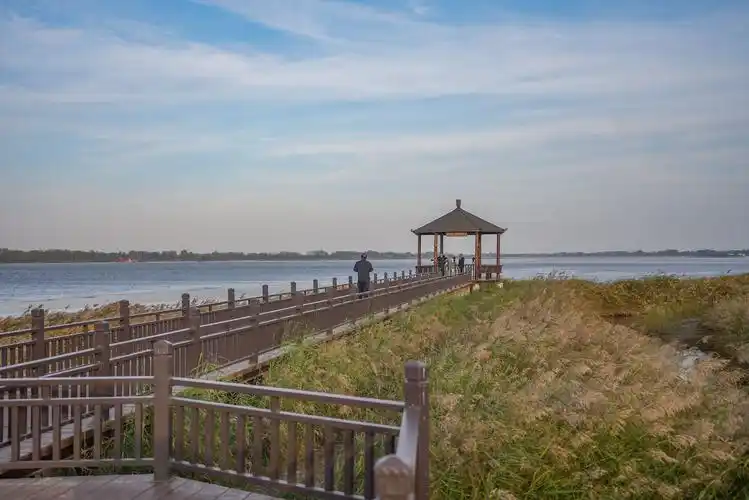 The park traces its origins to 1993, when authorities designated this stretch of the Yellow River's abandoned channel as protected land, opening to visitors in 2006 and earning AAA scenic status by 2010. The Yellow River itself, often called the cradle of Chinese civilization, has shifted course repeatedly over millennia—much like the historical meanders of Europe's Rhine or Danube—leaving behind elevated floodplains that locals harnessed into shelterbelts. These hardy windbreak forests gradually evolved into the integrated ecological park you see today, serving as a living archive of the river's restless geological legacy.
The park's signature feature is its vast locust woodland, a rare expanse of black locust trees on the North China Plain that recalls the managed forest landscapes of Germany's Bavarian Forest or Poland's Białowieża edge zones. From late April into May, cascading clusters of creamy white blossoms perfume the air like a natural eau de toilette, while autumn strips the canopy back to stark, sculptural trunks. Visitors are advised to stick to marked trails; the flat terrain makes for effortless hiking and photography.
Complementing the woodland is a 500-mu Hundred Fruits Garden, where more than a hundred apple, pear, persimmon, and stone-fruit varieties ripen from July through October, inviting pick-your-own experiences comparable to a French cider-farm outing. Nearby, the Hundred Flower Garden showcases over 300 tree species around a small artificial lake crossed by arched bridges, where crimson maples in autumn rival the color displays of New England's celebrated fall forests or Japan's Kyoto temple gardens.
The park also shelters a nationally protected wetland bird sanctuary, one of northern Henan's most important waterfowl habitats—think of it as a miniature version of Spain's Coto Doñana or France's Camargue, set against a forest backdrop. Migratory storks, egrets, and herons appear seasonally, rewarding patient birders with excellent viewing. Scattered throughout are archaeological traces such as the ancient Wuqi City site and Jici settlement remnants, linking the landscape to centuries of regional history along this once-mighty waterway.
Practicalities are refreshingly simple: the park is open year-round (roughly 8 a.m. to 7 p.m. in peak season, closing earlier in winter), with free or nominal admission. Driving from Xinxiang takes about 30 minutes; public buses run infrequently, so a taxi or rented car is wise. There are no internal shuttles, so plan on walking or cycling, and bring water, snacks, mosquito repellent, and sturdy shoes. Allow half to a full day, timing your visit for late spring blossoms or autumn fruit harvests to experience this peaceful corner of Henan at its finest.
The park traces its origins to 1993, when authorities designated this stretch of the Yellow River's abandoned channel as protected land, opening to visitors in 2006 and earning AAA scenic status by 2010. The Yellow River itself, often called the cradle of Chinese civilization, has shifted course repeatedly over millennia—much like the historical meanders of Europe's Rhine or Danube—leaving behind elevated floodplains that locals harnessed into shelterbelts. These hardy windbreak forests gradually evolved into the integrated ecological park you see today, serving as a living archive of the river's restless geological legacy.
The park's signature feature is its vast locust woodland, a rare expanse of black locust trees on the North China Plain that recalls the managed forest landscapes of Germany's Bavarian Forest or Poland's Białowieża edge zones. From late April into May, cascading clusters of creamy white blossoms perfume the air like a natural eau de toilette, while autumn strips the canopy back to stark, sculptural trunks. Visitors are advised to stick to marked trails; the flat terrain makes for effortless hiking and photography.
Complementing the woodland is a 500-mu Hundred Fruits Garden, where more than a hundred apple, pear, persimmon, and stone-fruit varieties ripen from July through October, inviting pick-your-own experiences comparable to a French cider-farm outing. Nearby, the Hundred Flower Garden showcases over 300 tree species around a small artificial lake crossed by arched bridges, where crimson maples in autumn rival the color displays of New England's celebrated fall forests or Japan's Kyoto temple gardens.
The park also shelters a nationally protected wetland bird sanctuary, one of northern Henan's most important waterfowl habitats—think of it as a miniature version of Spain's Coto Doñana or France's Camargue, set against a forest backdrop. Migratory storks, egrets, and herons appear seasonally, rewarding patient birders with excellent viewing. Scattered throughout are archaeological traces such as the ancient Wuqi City site and Jici settlement remnants, linking the landscape to centuries of regional history along this once-mighty waterway.
Practicalities are refreshingly simple: the park is open year-round (roughly 8 a.m. to 7 p.m. in peak season, closing earlier in winter), with free or nominal admission. Driving from Xinxiang takes about 30 minutes; public buses run infrequently, so a taxi or rented car is wise. There are no internal shuttles, so plan on walking or cycling, and bring water, snacks, mosquito repellent, and sturdy shoes. Allow half to a full day, timing your visit for late spring blossoms or autumn fruit harvests to experience this peaceful corner of Henan at its finest.