Yingtian Academy
⭐ 3.50
Yingtian Academy, Yingtian Street, Suiyang District, Shangqiu City, Henan Province, China
 Yingtian Academy traces its origins to the 940s, when scholars first gathered to study beside what is now Shangqiu's South Lake during the Later Jin period. The Song imperial court granted it official recognition in 1016, and in 1043—at the height of the dynasty's cultural flowering—the site was promoted to the dynasty's highest institute of learning, the Nanjing National Academy. Among China's famed Four Great Academies of the Northern Song, which also include Yuelu in Hunan, White Deer Grotto in Jiangxi, and Songyang in Henan, it holds the singular distinction of being the only one elevated directly from a private school to imperial status. Chronologically, it is a contemporary of Europe's first universities: Bologna had organized its scholars by 1088, and Oxford was already attracting students by the late eleventh century.
The academy's defining legacy is Fan Zhongyan (989–1052), the reformer-poet who spent five formative childhood years studying here and three more as a teacher before launching his career in government. His celebrated declaration, "Let me be the first to worry about the world's troubles and the last to share its joys," took shape within these courtyards before reaching its final form in the "Memorial to Yueyang Tower" of 1046—often paired with the public-spirited ideal of Cicero's De Officiis or the Christian notion of servant leadership familiar to Western readers. The memorial hall honoring him, the Fan Wenzheng Memorial Hall, forms the ceremonial climax of the rebuilt complex, where his life and calligraphy are displayed in side galleries.
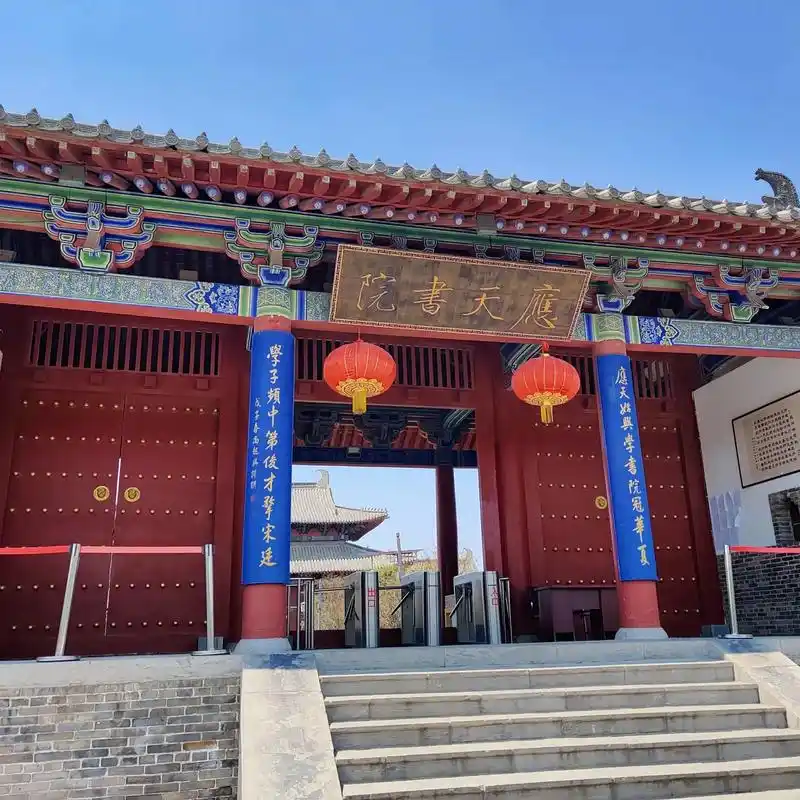
The present buildings are careful 2007-to-2009 reconstructions on the historical Song-dynasty footprint, arranged along a north–south ceremonial axis in classic imperial-academy style. Visitors pass through a spirit screen, the main gate, the Hall of Reverence for the Sages, a Confucius Memorial Hall, Fan's memorial hall, the Minglun (Clarifying Principles) Hall, and a crescent-shaped reflecting pool. The sweeping tiled roofs with their distinctive upward-curving eaves are unmistakably Song in manner—a style that later reached Japan as temple architecture and that flourished contemporaneously with Europe's Romanesque and emerging Gothic churches. Lacking original Song fabric, the complex is best understood as a thoughtful cultural tribute rather than an archaeological site.
Located in Shangqiu's Suiyang District on the southern shore of the ancient city's moat, near Huancheng South Road, the academy is compact and easy to cover in thirty to forty-five minutes. Admission is around twenty yuan, with a combined thirty-five-yuan ticket also covering the Zhang Xun Shrine and the South Gate. Opening hours typically run from 08:00 to 17:30, extended to 18:00 in summer; calling ahead is wise, as schedules occasionally shift. Almost all signage and exhibition text is in Chinese only, so a translation app and some pre-reading on Fan Zhongyan's biography and Song educational history will noticeably deepen the experience.
For travelers interested in China's intellectual heritage, Yingtian offers a rare opportunity to walk in the lecture courts that helped shape the moral vocabulary of imperial China—without the crowds of larger destinations such as Yuelu Academy or the historic centers of Kaifeng. Pairing the visit with the adjacent ancient city walls and Zhang Xun Shrine creates a satisfying half-day itinerary through Shangqiu's old quarter. The reward here is not monumental scale but atmosphere: an unhurried lakeside site where Northern Song scholarship, perhaps more than anywhere else in China, still feels close at hand.
Yingtian Academy traces its origins to the 940s, when scholars first gathered to study beside what is now Shangqiu's South Lake during the Later Jin period. The Song imperial court granted it official recognition in 1016, and in 1043—at the height of the dynasty's cultural flowering—the site was promoted to the dynasty's highest institute of learning, the Nanjing National Academy. Among China's famed Four Great Academies of the Northern Song, which also include Yuelu in Hunan, White Deer Grotto in Jiangxi, and Songyang in Henan, it holds the singular distinction of being the only one elevated directly from a private school to imperial status. Chronologically, it is a contemporary of Europe's first universities: Bologna had organized its scholars by 1088, and Oxford was already attracting students by the late eleventh century.
The academy's defining legacy is Fan Zhongyan (989–1052), the reformer-poet who spent five formative childhood years studying here and three more as a teacher before launching his career in government. His celebrated declaration, "Let me be the first to worry about the world's troubles and the last to share its joys," took shape within these courtyards before reaching its final form in the "Memorial to Yueyang Tower" of 1046—often paired with the public-spirited ideal of Cicero's De Officiis or the Christian notion of servant leadership familiar to Western readers. The memorial hall honoring him, the Fan Wenzheng Memorial Hall, forms the ceremonial climax of the rebuilt complex, where his life and calligraphy are displayed in side galleries.
The present buildings are careful 2007-to-2009 reconstructions on the historical Song-dynasty footprint, arranged along a north–south ceremonial axis in classic imperial-academy style. Visitors pass through a spirit screen, the main gate, the Hall of Reverence for the Sages, a Confucius Memorial Hall, Fan's memorial hall, the Minglun (Clarifying Principles) Hall, and a crescent-shaped reflecting pool. The sweeping tiled roofs with their distinctive upward-curving eaves are unmistakably Song in manner—a style that later reached Japan as temple architecture and that flourished contemporaneously with Europe's Romanesque and emerging Gothic churches. Lacking original Song fabric, the complex is best understood as a thoughtful cultural tribute rather than an archaeological site.
Located in Shangqiu's Suiyang District on the southern shore of the ancient city's moat, near Huancheng South Road, the academy is compact and easy to cover in thirty to forty-five minutes. Admission is around twenty yuan, with a combined thirty-five-yuan ticket also covering the Zhang Xun Shrine and the South Gate. Opening hours typically run from 08:00 to 17:30, extended to 18:00 in summer; calling ahead is wise, as schedules occasionally shift. Almost all signage and exhibition text is in Chinese only, so a translation app and some pre-reading on Fan Zhongyan's biography and Song educational history will noticeably deepen the experience.
For travelers interested in China's intellectual heritage, Yingtian offers a rare opportunity to walk in the lecture courts that helped shape the moral vocabulary of imperial China—without the crowds of larger destinations such as Yuelu Academy or the historic centers of Kaifeng. Pairing the visit with the adjacent ancient city walls and Zhang Xun Shrine creates a satisfying half-day itinerary through Shangqiu's old quarter. The reward here is not monumental scale but atmosphere: an unhurried lakeside site where Northern Song scholarship, perhaps more than anywhere else in China, still feels close at hand.