Shangqiu Ancient City
⭐ 3.80
Shangqiu Ancient City Scenic Area, Suiyang District, Shangqiu City, Henan Province, China
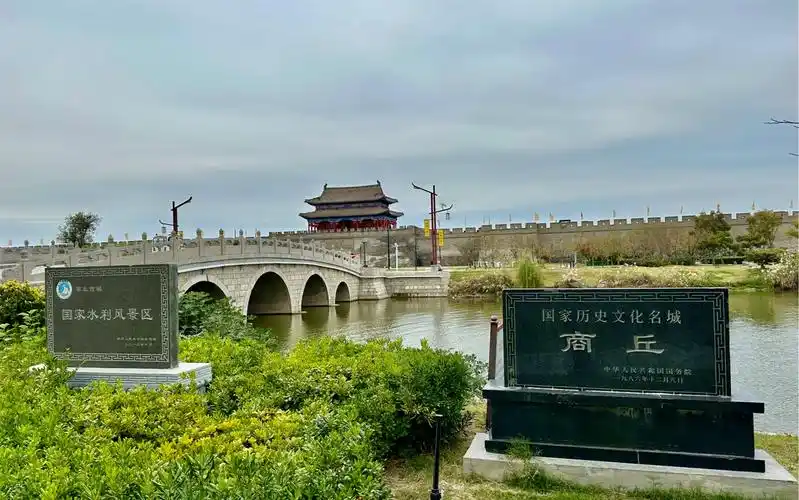 Shangqiu's significance stretches back to the dawn of Chinese civilization. This is the legendary "Source of the Three Shangs," where the mythical Emperor Suiren first struck fire by friction—a milestone roughly contemporaneous with the early Bronze Age cultures of the Mediterranean. The nearby Ebatai Platform is considered one of the world's oldest astronomical observatories, predating Stonehenge's later phases. The city itself was completed in 1511, the same year Michelangelo began work on the Sistine Chapel ceiling, yet beneath its Ming foundations lie six earlier city levels, making it a stratigraphic wonder comparable in scale to Troy or the layered ruins of Rome's Palatine Hill.
The fortification is nearly square, with walls stretching 4,355 meters and rising 6 meters high—dimensions comparable to the medieval walls of Ávila in Spain, though older. Four grand gates (拱阳, 宾阳, 垤泽, 拱辰) pierce the ramparts, while the encircling moat broadens into a lake-like expanse, earning the nickname "City in the Water." Within, 93 ancient lanes crisscross the interior in a grid that subtly follows the cosmic patterns of the Eight Trigrams—a layout no other Chinese city shares. Climbing the wall offers the finest perspective, particularly at sunset when the moat reflects golden light.
The cultural depth here rivals that of any provincial capital. The Yingtian Academy, founded in the Northern Song Dynasty, stood among China's four great academies—alongside institutions that shaped thinkers comparable to Europe's medieval universities. Fan Zhongyan, often likened to a Confucian Voltaire, taught here. Other highlights include Zhang Xun's Shrine, honoring a general whose 757 AD defense of the city against rebels echoes the stand of Thermopylae; the elegant Zhuanghuihall, former home of Ming literary figure Hou Fangyu; and Henan Province's largest Confucian Temple, housing an authentic Yan Zhenqing calligraphy stele from the eighth century—Yan being Tang China's most revered calligrapher.
The walled city itself is free to wander, with individual sites charging modestly: about 30 yuan for wall access, roughly 20 yuan for sites like the academy or temple, and a combined three-site ticket around 35 yuan. Enter through the south gate (拱阳门) for the most scenic approach. Late afternoon wall climbs reward visitors with superb photography as the setting sun gilds the battlements. Comfortable walking shoes are essential—the city is paved in smooth but uneven flagstones worn by centuries of footsteps.
Spring and autumn bring ideal temperatures, while summer visitors should plan early morning or evening excursions to escape midday heat. A thorough exploration takes five to six hours, but pairing the old city with the Shangqiu Museum, the Tomb of Emperor Suiren, and the Huosheng Platform creates a rich one-to-two-day cultural itinerary. The atmosphere remains remarkably tranquil and free of the commercial bustle found at more famous sites like Pingyao or Lijiang.
Shangqiu rewards travelers who value authenticity over spectacle. History enthusiasts, sinologists, architectural scholars, and photographers—especially those drawn to hanfu portraiture—will find an unfiltered window into Ming and Qing urban life. Families seeking theme-park thrills should consider combining the visit with nearby Mangdang Mountain, where cave-tomb reliefs and刘邦's legendary hideout add a dash of adventure to the historical immersion.
[BRIEF]
Shangqiu Ancient City, a national AAAA-rated site in Henan Province, is one of China's most remarkable historical treasures. Built in 1511 during the Ming Dynasty and still encircled by its original defensive walls and moat, it sits atop six superimposed cities from the Sui, Tang, Song, and Yuan eras—creating a unique "city-upon-city" phenomenon. Its distinctive "round outside, square inside" design mirrors the eight trigrams of the I Ching. Visitors can climb the ramparts, stroll cobbled lanes once walked by Confucian scholars, and explore landmarks like the famed Yingtian Academy, where Fan Zhongyan once taught. Free to enter, it offers an authentic, uncrowded glimpse into imperial China.
[DETAILED]
Shangqiu's significance stretches back to the dawn of Chinese civilization. This is the legendary "Source of the Three Shangs," where the mythical Emperor Suiren first struck fire by friction—a milestone roughly contemporaneous with the early Bronze Age cultures of the Mediterranean. The nearby Ebatai Platform is considered one of the world's oldest astronomical observatories, predating Stonehenge's later phases. The city itself was completed in 1511, the same year Michelangelo began work on the Sistine Chapel ceiling, yet beneath its Ming foundations lie six earlier city levels, making it a stratigraphic wonder comparable in scale to Troy or the layered ruins of Rome's Palatine Hill.
The fortification is nearly square, with walls stretching 4,355 meters and rising 6 meters high—dimensions comparable to the medieval walls of Ávila in Spain, though older. Four grand gates (拱阳, 宾阳, 垤泽, 拱辰) pierce the ramparts, while the encircling moat broadens into a lake-like expanse, earning the nickname "City in the Water." Within, 93 ancient lanes crisscross the interior in a grid that subtly follows the cosmic patterns of the Eight Trigrams—a layout no other Chinese city shares. Climbing the wall offers the finest perspective, particularly at sunset when the moat reflects golden light.
The cultural depth here rivals that of any provincial capital. The Yingtian Academy, founded in the Northern Song Dynasty, stood among China's four great academies—alongside institutions that shaped thinkers comparable to Europe's medieval universities. Fan Zhongyan, often likened to a Confucian Voltaire, taught here. Other highlights include Zhang Xun's Shrine, honoring a general whose 757 AD defense of the city against rebels echoes the stand of Thermopylae; the elegant Zhuanghuihall, former home of Ming literary figure Hou Fangyu; and Henan Province's largest Confucian Temple, housing an authentic Yan Zhenqing calligraphy stele from the eighth century—Yan being Tang China's most revered calligrapher.
The walled city itself is free to wander, with individual sites charging modestly: about 30 yuan for wall access, roughly 20 yuan for sites like the academy or temple, and a combined three-site ticket around 35 yuan. Enter through the south gate (拱阳门) for the most scenic approach. Late afternoon wall climbs reward visitors with superb photography as the setting sun gilds the battlements. Comfortable walking shoes are essential—the city is paved in smooth but uneven flagstones worn by centuries of footsteps.
Spring and autumn bring ideal temperatures, while summer visitors should plan early morning or evening excursions to escape midday heat. A thorough exploration takes five to six hours, but pairing the old city with the Shangqiu Museum, the Tomb of Emperor Suiren, and the Huosheng Platform creates a rich one-to-two-day cultural itinerary. The atmosphere remains remarkably tranquil and free of the commercial bustle found at more famous sites like Pingyao or Lijiang.
Shangqiu rewards travelers who value authenticity over spectacle. History enthusiasts, sinologists, architectural scholars, and photographers—especially those drawn to hanfu portraiture—will find an unfiltered window into Ming and Qing urban life. Families seeking theme-park thrills should consider combining the visit with nearby Mangdang Mountain, where cave-tomb reliefs and刘邦's legendary hideout add a dash of adventure to the historical immersion.
Shangqiu's significance stretches back to the dawn of Chinese civilization. This is the legendary "Source of the Three Shangs," where the mythical Emperor Suiren first struck fire by friction—a milestone roughly contemporaneous with the early Bronze Age cultures of the Mediterranean. The nearby Ebatai Platform is considered one of the world's oldest astronomical observatories, predating Stonehenge's later phases. The city itself was completed in 1511, the same year Michelangelo began work on the Sistine Chapel ceiling, yet beneath its Ming foundations lie six earlier city levels, making it a stratigraphic wonder comparable in scale to Troy or the layered ruins of Rome's Palatine Hill.
The fortification is nearly square, with walls stretching 4,355 meters and rising 6 meters high—dimensions comparable to the medieval walls of Ávila in Spain, though older. Four grand gates (拱阳, 宾阳, 垤泽, 拱辰) pierce the ramparts, while the encircling moat broadens into a lake-like expanse, earning the nickname "City in the Water." Within, 93 ancient lanes crisscross the interior in a grid that subtly follows the cosmic patterns of the Eight Trigrams—a layout no other Chinese city shares. Climbing the wall offers the finest perspective, particularly at sunset when the moat reflects golden light.
The cultural depth here rivals that of any provincial capital. The Yingtian Academy, founded in the Northern Song Dynasty, stood among China's four great academies—alongside institutions that shaped thinkers comparable to Europe's medieval universities. Fan Zhongyan, often likened to a Confucian Voltaire, taught here. Other highlights include Zhang Xun's Shrine, honoring a general whose 757 AD defense of the city against rebels echoes the stand of Thermopylae; the elegant Zhuanghuihall, former home of Ming literary figure Hou Fangyu; and Henan Province's largest Confucian Temple, housing an authentic Yan Zhenqing calligraphy stele from the eighth century—Yan being Tang China's most revered calligrapher.
The walled city itself is free to wander, with individual sites charging modestly: about 30 yuan for wall access, roughly 20 yuan for sites like the academy or temple, and a combined three-site ticket around 35 yuan. Enter through the south gate (拱阳门) for the most scenic approach. Late afternoon wall climbs reward visitors with superb photography as the setting sun gilds the battlements. Comfortable walking shoes are essential—the city is paved in smooth but uneven flagstones worn by centuries of footsteps.
Spring and autumn bring ideal temperatures, while summer visitors should plan early morning or evening excursions to escape midday heat. A thorough exploration takes five to six hours, but pairing the old city with the Shangqiu Museum, the Tomb of Emperor Suiren, and the Huosheng Platform creates a rich one-to-two-day cultural itinerary. The atmosphere remains remarkably tranquil and free of the commercial bustle found at more famous sites like Pingyao or Lijiang.
Shangqiu rewards travelers who value authenticity over spectacle. History enthusiasts, sinologists, architectural scholars, and photographers—especially those drawn to hanfu portraiture—will find an unfiltered window into Ming and Qing urban life. Families seeking theme-park thrills should consider combining the visit with nearby Mangdang Mountain, where cave-tomb reliefs and刘邦's legendary hideout add a dash of adventure to the historical immersion.
[BRIEF]
Shangqiu Ancient City, a national AAAA-rated site in Henan Province, is one of China's most remarkable historical treasures. Built in 1511 during the Ming Dynasty and still encircled by its original defensive walls and moat, it sits atop six superimposed cities from the Sui, Tang, Song, and Yuan eras—creating a unique "city-upon-city" phenomenon. Its distinctive "round outside, square inside" design mirrors the eight trigrams of the I Ching. Visitors can climb the ramparts, stroll cobbled lanes once walked by Confucian scholars, and explore landmarks like the famed Yingtian Academy, where Fan Zhongyan once taught. Free to enter, it offers an authentic, uncrowded glimpse into imperial China.
[DETAILED]
Shangqiu's significance stretches back to the dawn of Chinese civilization. This is the legendary "Source of the Three Shangs," where the mythical Emperor Suiren first struck fire by friction—a milestone roughly contemporaneous with the early Bronze Age cultures of the Mediterranean. The nearby Ebatai Platform is considered one of the world's oldest astronomical observatories, predating Stonehenge's later phases. The city itself was completed in 1511, the same year Michelangelo began work on the Sistine Chapel ceiling, yet beneath its Ming foundations lie six earlier city levels, making it a stratigraphic wonder comparable in scale to Troy or the layered ruins of Rome's Palatine Hill.
The fortification is nearly square, with walls stretching 4,355 meters and rising 6 meters high—dimensions comparable to the medieval walls of Ávila in Spain, though older. Four grand gates (拱阳, 宾阳, 垤泽, 拱辰) pierce the ramparts, while the encircling moat broadens into a lake-like expanse, earning the nickname "City in the Water." Within, 93 ancient lanes crisscross the interior in a grid that subtly follows the cosmic patterns of the Eight Trigrams—a layout no other Chinese city shares. Climbing the wall offers the finest perspective, particularly at sunset when the moat reflects golden light.
The cultural depth here rivals that of any provincial capital. The Yingtian Academy, founded in the Northern Song Dynasty, stood among China's four great academies—alongside institutions that shaped thinkers comparable to Europe's medieval universities. Fan Zhongyan, often likened to a Confucian Voltaire, taught here. Other highlights include Zhang Xun's Shrine, honoring a general whose 757 AD defense of the city against rebels echoes the stand of Thermopylae; the elegant Zhuanghuihall, former home of Ming literary figure Hou Fangyu; and Henan Province's largest Confucian Temple, housing an authentic Yan Zhenqing calligraphy stele from the eighth century—Yan being Tang China's most revered calligrapher.
The walled city itself is free to wander, with individual sites charging modestly: about 30 yuan for wall access, roughly 20 yuan for sites like the academy or temple, and a combined three-site ticket around 35 yuan. Enter through the south gate (拱阳门) for the most scenic approach. Late afternoon wall climbs reward visitors with superb photography as the setting sun gilds the battlements. Comfortable walking shoes are essential—the city is paved in smooth but uneven flagstones worn by centuries of footsteps.
Spring and autumn bring ideal temperatures, while summer visitors should plan early morning or evening excursions to escape midday heat. A thorough exploration takes five to six hours, but pairing the old city with the Shangqiu Museum, the Tomb of Emperor Suiren, and the Huosheng Platform creates a rich one-to-two-day cultural itinerary. The atmosphere remains remarkably tranquil and free of the commercial bustle found at more famous sites like Pingyao or Lijiang.
Shangqiu rewards travelers who value authenticity over spectacle. History enthusiasts, sinologists, architectural scholars, and photographers—especially those drawn to hanfu portraiture—will find an unfiltered window into Ming and Qing urban life. Families seeking theme-park thrills should consider combining the visit with nearby Mangdang Mountain, where cave-tomb reliefs and刘邦's legendary hideout add a dash of adventure to the historical immersion.