Erguna Wetland
⭐ 4.60
Erguna Wetland Scenic Area, Hulunbuir City, Inner Mongolia Autonomous Region, China
 **A Wetland on the World Stage**
Erguna Wetland ranks among the largest and best-preserved natural marshlands in Asia, a distinction that places it alongside the Camargue in southern France and the Danube Delta in Romania on any shortlist of the continent's great wetland treasures. Designated a national AAAA tourist site, the protected zone records more than 288 wild plant species and over 260 animal species, including six that hold China's highest conservation status—most famously the red-crowned crane and the golden eagle. As a critical node on the East Asian–Australasian Flyway, it hosts tens of thousands of migratory birds each spring and autumn, an ecological role comparable to that of Germany's Wadden Sea.
**The Landscape from Above**
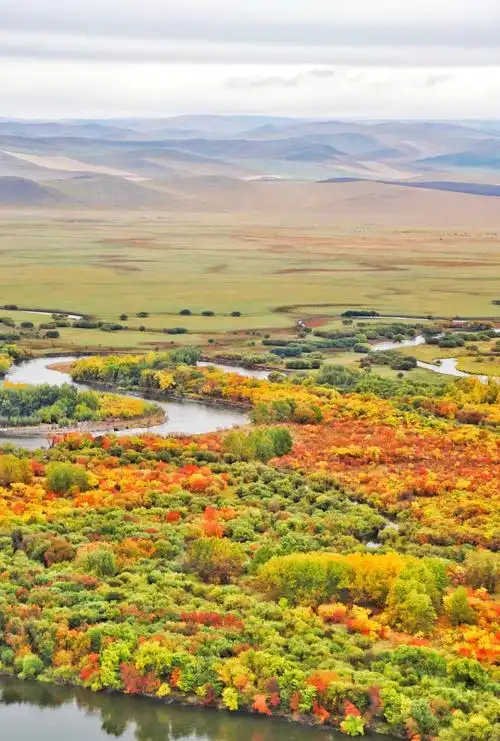
The wetland's signature view unfolds from a hilltop observation deck reached by shuttle bus. From this vantage point the Genhe River traces a sinuous silver S through the meadowland, encircling Horseshoe Island and concentric-ringed Tongxin Island—formations shaped over millennia by the slow, patient work of alluvial deposits. A 3-kilometer elevated wooden boardwalk lets visitors descend into the marsh without disturbing the fragile mat of sedges and grasses beneath their feet, while interpretive signage explains how the floodplain filters water and sequesters carbon at rates that rival tropical rainforests.
**Learning in the Field Centers**
Two on-site museums transform the visit into a hands-on lesson. The Wetland Museum and the Ecological Experience Center use high-resolution photography, immersive VR simulations, and wraparound cinema to illustrate everything from waterfowl migration to permafrost dynamics. Families traveling with children will find these exhibits especially rewarding—they distill complex ecological science into accessible, visually striking storytelling that rivals the interactive galleries of London's Natural History Museum.
**Planning Your Visit**
Tickets cost about 65–80 yuan (roughly 9–11 USD), typically including the shuttle ride to the summit. Reach the wetland by a short 3-kilometer transfer from central Erguna, then walk through a small commercial street before boarding the connecting bus to the lookout. Aim for early morning (7:30–9:30) or the two hours before sunset, when mist drifts across the meanders and the low light turns the grasslands into a painter's palette. August days are pleasantly warm at 20–22°C, but nights can drop to 10°C, so pack a windproof layer and high-SPF sunscreen.
**Border Zone Etiquette**
Erguna sits within China's regulated border region, so foreign visitors should double-check that their visa permits travel to this area and carry their passports at all times. Within the park, drones are prohibited everywhere, walking off the boardwalk onto the marsh is forbidden, and feeding wildlife is strictly banned—rules that echo the Leave No Trace ethics familiar to hikers in America's national parks. The guiding principle is simple: take only photographs, leave only footprints.
**Why It Belongs on Your Itinerary**
Few places on Earth offer such an accessible encounter with an intact sub-arctic wetland system. Within a single afternoon you can stand above a continent-scale flyway, watch a golden eagle quarter the sky, and trace the silver ribbon of a river older than recorded history. Pair the wetland with a stay among the reindeer-herding Evenki people of the Greater Khingan Range or a drive across the nearby Hulunbuir grasslands—often called "the world's most beautiful prairie"—for an unforgettable northern China adventure that no European itinerary can replicate.
**A Wetland on the World Stage**
Erguna Wetland ranks among the largest and best-preserved natural marshlands in Asia, a distinction that places it alongside the Camargue in southern France and the Danube Delta in Romania on any shortlist of the continent's great wetland treasures. Designated a national AAAA tourist site, the protected zone records more than 288 wild plant species and over 260 animal species, including six that hold China's highest conservation status—most famously the red-crowned crane and the golden eagle. As a critical node on the East Asian–Australasian Flyway, it hosts tens of thousands of migratory birds each spring and autumn, an ecological role comparable to that of Germany's Wadden Sea.
**The Landscape from Above**
The wetland's signature view unfolds from a hilltop observation deck reached by shuttle bus. From this vantage point the Genhe River traces a sinuous silver S through the meadowland, encircling Horseshoe Island and concentric-ringed Tongxin Island—formations shaped over millennia by the slow, patient work of alluvial deposits. A 3-kilometer elevated wooden boardwalk lets visitors descend into the marsh without disturbing the fragile mat of sedges and grasses beneath their feet, while interpretive signage explains how the floodplain filters water and sequesters carbon at rates that rival tropical rainforests.
**Learning in the Field Centers**
Two on-site museums transform the visit into a hands-on lesson. The Wetland Museum and the Ecological Experience Center use high-resolution photography, immersive VR simulations, and wraparound cinema to illustrate everything from waterfowl migration to permafrost dynamics. Families traveling with children will find these exhibits especially rewarding—they distill complex ecological science into accessible, visually striking storytelling that rivals the interactive galleries of London's Natural History Museum.
**Planning Your Visit**
Tickets cost about 65–80 yuan (roughly 9–11 USD), typically including the shuttle ride to the summit. Reach the wetland by a short 3-kilometer transfer from central Erguna, then walk through a small commercial street before boarding the connecting bus to the lookout. Aim for early morning (7:30–9:30) or the two hours before sunset, when mist drifts across the meanders and the low light turns the grasslands into a painter's palette. August days are pleasantly warm at 20–22°C, but nights can drop to 10°C, so pack a windproof layer and high-SPF sunscreen.
**Border Zone Etiquette**
Erguna sits within China's regulated border region, so foreign visitors should double-check that their visa permits travel to this area and carry their passports at all times. Within the park, drones are prohibited everywhere, walking off the boardwalk onto the marsh is forbidden, and feeding wildlife is strictly banned—rules that echo the Leave No Trace ethics familiar to hikers in America's national parks. The guiding principle is simple: take only photographs, leave only footprints.
**Why It Belongs on Your Itinerary**
Few places on Earth offer such an accessible encounter with an intact sub-arctic wetland system. Within a single afternoon you can stand above a continent-scale flyway, watch a golden eagle quarter the sky, and trace the silver ribbon of a river older than recorded history. Pair the wetland with a stay among the reindeer-herding Evenki people of the Greater Khingan Range or a drive across the nearby Hulunbuir grasslands—often called "the world's most beautiful prairie"—for an unforgettable northern China adventure that no European itinerary can replicate.