Flaming Mountains Geopark
⭐ 3.20
Flaming Mountains Geopark, Gaochang District, Turpan City, Xinjiang Uyghur Autonomous Region, China
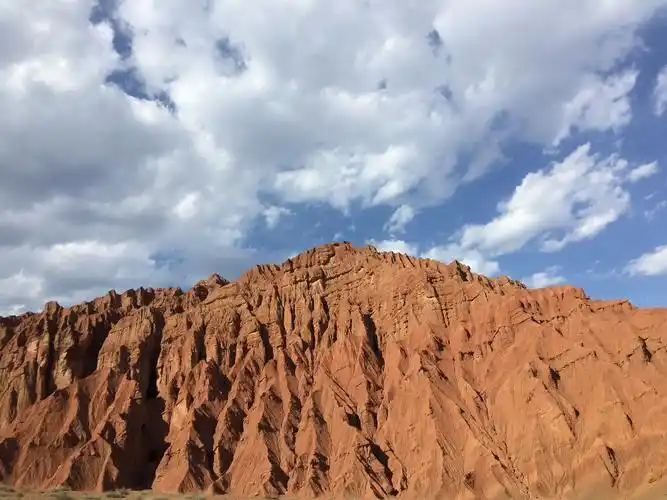 Stretching roughly 100 kilometres east to west across the Turpan Depression—a rift basin that plunges 154 metres below sea level, considerably lower than the shoreline of Europe's Dead Sea—Flaming Mountains is hewn from Cretaceous red sandstone and shale rich in iron oxide. Scorched by relentless sun, the layered cliffs glow in shades of burnt sienna and rust, evoking the rose-red façades of Petra in Jordan. This arid Danxia topography, carved by wind into a labyrinth of gullies, lies along the ancient Silk Road corridor where Han dynasty caravans once trudged toward the western kingdoms.
Flaming Mountains is China's undisputed "Hot Pole." Summer ground temperatures routinely top 70°C, with the absolute record reaching a searing 83.3°C, while shade air temperatures have hit 47.8°C—conditions approaching those measured at California's Death Valley. Standing at the park entrance, a towering "Golden Cudgel" thermometer—modelled on the mythical weapon wielded by Sun Wukong, the Monkey King—broadcasts live readings to passing tour buses, instantly becoming the obligatory photo stop for visitors braving the furnace-like atmosphere just to say they survived it.
The mountains earn their fame less from geology than from Wu Cheng'en's sixteenth-century novel Journey to the West, beloved across Asia in operas, games, and anime. Its fifth chapter describes the monk Xuanzang confronting the Bull Demon King here while his disciple Sun Wukong thrice borrows Princess Iron Fan's magical palm-leaf fan to extinguish the flames. Local Uyghur tradition offers a different origin, claiming the rocks were stained by a slain dragon's blood—hence the Turkic name Kizil Tagh, "Red Mountain." Bronze sculptures of the pilgrims and demonic guardians now dot the site.
Escape the heat in the Underground Palace, a fully air-conditioned interpretive complex burrowed beneath the dunes. Galleries trace the mountains' hundred-million-year geological story, recreate the Silk Road oasis towns of ancient Gaochang, and host a VR "Flight over Flaming Mountains" simulator that lets visitors soar across the ridge in cool comfort. Murals and calligraphy lend the space a monastic hush, making it the intellectual heart of any visit.
Entry runs about 40 yuan (roughly $5.50) per person, with the park typically open from 10 a.m. to 7 p.m. in summer. It sits just 10 to 30 km east of Turpan city, easily reached via the Lianyuo Expressway by rental car or hired minivan. Inside, try a sand-baked egg cooked purely by ground heat, ride a Bactrian camel, or rattle across the gravel in a 4×4 buggy. Light long sleeves, a wide-brimmed hat, sturdy shoes, and electrolyte drinks are essential—never go barefoot on the scorching sand.
Flaming Mountains anchors a perfect day-long loop through Turpan's highlights. Pair the visit with the Qanat (Karez) irrigation system—an underground aqueduct predating Persia's qanats that still waters the famous vineyards of Grape Valley—or with the haunting Buddhist ruins of Jiaohe, a 2,300-year-old cliff-top city abandoned along the Silk Road. Together they evoke the same edge-of-the-world romance as Cappadocia or Egypt's Siwa Oasis, all within a single, unforgettable afternoon.
Stretching roughly 100 kilometres east to west across the Turpan Depression—a rift basin that plunges 154 metres below sea level, considerably lower than the shoreline of Europe's Dead Sea—Flaming Mountains is hewn from Cretaceous red sandstone and shale rich in iron oxide. Scorched by relentless sun, the layered cliffs glow in shades of burnt sienna and rust, evoking the rose-red façades of Petra in Jordan. This arid Danxia topography, carved by wind into a labyrinth of gullies, lies along the ancient Silk Road corridor where Han dynasty caravans once trudged toward the western kingdoms.
Flaming Mountains is China's undisputed "Hot Pole." Summer ground temperatures routinely top 70°C, with the absolute record reaching a searing 83.3°C, while shade air temperatures have hit 47.8°C—conditions approaching those measured at California's Death Valley. Standing at the park entrance, a towering "Golden Cudgel" thermometer—modelled on the mythical weapon wielded by Sun Wukong, the Monkey King—broadcasts live readings to passing tour buses, instantly becoming the obligatory photo stop for visitors braving the furnace-like atmosphere just to say they survived it.
The mountains earn their fame less from geology than from Wu Cheng'en's sixteenth-century novel Journey to the West, beloved across Asia in operas, games, and anime. Its fifth chapter describes the monk Xuanzang confronting the Bull Demon King here while his disciple Sun Wukong thrice borrows Princess Iron Fan's magical palm-leaf fan to extinguish the flames. Local Uyghur tradition offers a different origin, claiming the rocks were stained by a slain dragon's blood—hence the Turkic name Kizil Tagh, "Red Mountain." Bronze sculptures of the pilgrims and demonic guardians now dot the site.
Escape the heat in the Underground Palace, a fully air-conditioned interpretive complex burrowed beneath the dunes. Galleries trace the mountains' hundred-million-year geological story, recreate the Silk Road oasis towns of ancient Gaochang, and host a VR "Flight over Flaming Mountains" simulator that lets visitors soar across the ridge in cool comfort. Murals and calligraphy lend the space a monastic hush, making it the intellectual heart of any visit.
Entry runs about 40 yuan (roughly $5.50) per person, with the park typically open from 10 a.m. to 7 p.m. in summer. It sits just 10 to 30 km east of Turpan city, easily reached via the Lianyuo Expressway by rental car or hired minivan. Inside, try a sand-baked egg cooked purely by ground heat, ride a Bactrian camel, or rattle across the gravel in a 4×4 buggy. Light long sleeves, a wide-brimmed hat, sturdy shoes, and electrolyte drinks are essential—never go barefoot on the scorching sand.
Flaming Mountains anchors a perfect day-long loop through Turpan's highlights. Pair the visit with the Qanat (Karez) irrigation system—an underground aqueduct predating Persia's qanats that still waters the famous vineyards of Grape Valley—or with the haunting Buddhist ruins of Jiaohe, a 2,300-year-old cliff-top city abandoned along the Silk Road. Together they evoke the same edge-of-the-world romance as Cappadocia or Egypt's Siwa Oasis, all within a single, unforgettable afternoon.