Bezeklik Thousand Buddha Caves
⭐ 3.80
Bezeklik Thousand Buddha Caves, Demonstration Zone, Turpan City, Xinjiang Uyghur Autonomous Region, China
 **Historical Context**
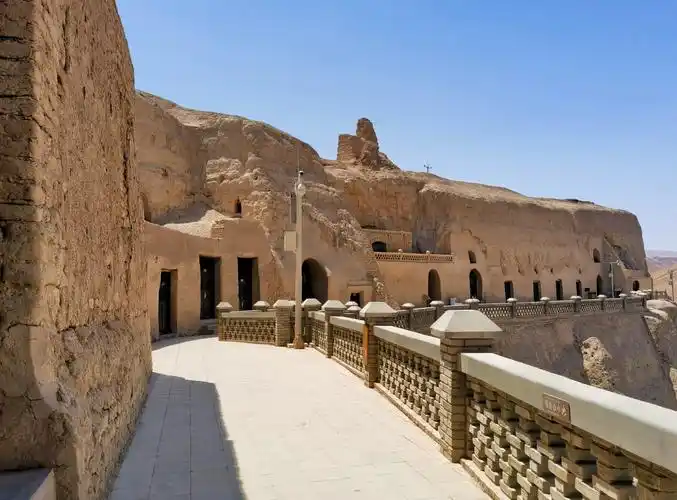
Bezeklik's origins trace to the late Northern and Southern Dynasties period (roughly the 6th century), placing its founding alongside the early medieval flowering of Buddhism across Eurasia—contemporary with the construction of Irish high crosses and the rise of monasteries in the Frankish kingdoms. After the Tang Dynasty administered the region as Xizhou, the site became the exclusive spiritual seat of the Uyghur royal house from the 9th century onward, serving the royal family and court nobles until the Mongol era. At its zenith, the complex boasted 83 caves; today, 57 survive, with 40-plus still bearing their original painted decoration.
**Architecture and Artistic Fusion**
The grottoes display diverse plans—central-pillar, vaulted, and domed layouts—reminiscent of monastic cells in Byzantine Cappadocia or the rock-cut churches of medieval Georgia. The murals are the true marvel: Uyghur-style "vow paintings" depicting donors and their celestial aspirations blend with Tang-era figural conventions, Persian-influenced floral patterns, and even touches of Byzantine iconography brought along the Silk Road by Nestorian Christian and Manichaean merchants.
**Cultural Significance**
Bezeklik stands as the most complete surviving record of Uyghur Buddhist civilization, a culture largely erased by later conversions to Islam. The cave complex parallels Dunhuang's Mogao Caves in scope but offers a uniquely Central Asian aesthetic voice—imagine the frescoes of Ravenna filtered through the visual language of the steppe empires. Much original artwork was controversially removed by German expeditions in the early 20th century and now resides in Berlin's Museum für Asiatische Kunst.
**Practical Visit Information**
The site sits within the Turpan Basin, roughly 2.5 hours by road from Urumqi. Plan for a half-day visit: entrance fees are modest (around 40 RMB), and the on-site museum provides essential historical context. Summer temperatures here routinely exceed 40°C—visiting in spring or autumn is strongly advised. Most tours combine Bezeklik with the nearby Jiaohe ruins and the Astana tombs for a full Silk Road experience.
**Why Visit**
For travelers drawn to the crossroads of civilization, Bezeklik offers something rare: an intimate encounter with a vanished religious world where Buddhist devotion, Persian refinement, and Chinese imperial patronage once coexisted. The dramatic Flaming Mountains backdrop—purplish-red ridges that glow at sunset—transforms a scholarly pilgrimage into a vivid adventure through time.
**Historical Context**
Bezeklik's origins trace to the late Northern and Southern Dynasties period (roughly the 6th century), placing its founding alongside the early medieval flowering of Buddhism across Eurasia—contemporary with the construction of Irish high crosses and the rise of monasteries in the Frankish kingdoms. After the Tang Dynasty administered the region as Xizhou, the site became the exclusive spiritual seat of the Uyghur royal house from the 9th century onward, serving the royal family and court nobles until the Mongol era. At its zenith, the complex boasted 83 caves; today, 57 survive, with 40-plus still bearing their original painted decoration.
**Architecture and Artistic Fusion**
The grottoes display diverse plans—central-pillar, vaulted, and domed layouts—reminiscent of monastic cells in Byzantine Cappadocia or the rock-cut churches of medieval Georgia. The murals are the true marvel: Uyghur-style "vow paintings" depicting donors and their celestial aspirations blend with Tang-era figural conventions, Persian-influenced floral patterns, and even touches of Byzantine iconography brought along the Silk Road by Nestorian Christian and Manichaean merchants.
**Cultural Significance**
Bezeklik stands as the most complete surviving record of Uyghur Buddhist civilization, a culture largely erased by later conversions to Islam. The cave complex parallels Dunhuang's Mogao Caves in scope but offers a uniquely Central Asian aesthetic voice—imagine the frescoes of Ravenna filtered through the visual language of the steppe empires. Much original artwork was controversially removed by German expeditions in the early 20th century and now resides in Berlin's Museum für Asiatische Kunst.
**Practical Visit Information**
The site sits within the Turpan Basin, roughly 2.5 hours by road from Urumqi. Plan for a half-day visit: entrance fees are modest (around 40 RMB), and the on-site museum provides essential historical context. Summer temperatures here routinely exceed 40°C—visiting in spring or autumn is strongly advised. Most tours combine Bezeklik with the nearby Jiaohe ruins and the Astana tombs for a full Silk Road experience.
**Why Visit**
For travelers drawn to the crossroads of civilization, Bezeklik offers something rare: an intimate encounter with a vanished religious world where Buddhist devotion, Persian refinement, and Chinese imperial patronage once coexisted. The dramatic Flaming Mountains backdrop—purplish-red ridges that glow at sunset—transforms a scholarly pilgrimage into a vivid adventure through time.