Jilin Ice and Snow World
⭐ 4.00
Jilin Ice and Snow World, Chuanying District, Jilin City, Jilin Province, China
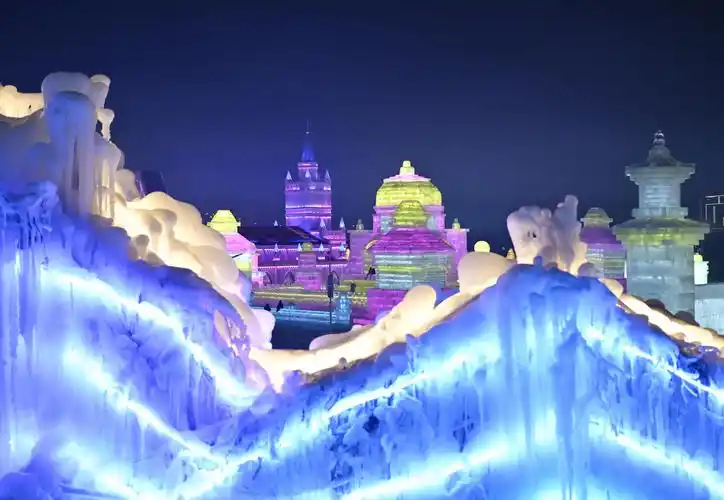 Jilin's Ice and Snow World takes its "Wula City" theme from the Jilin Wula ancient fortress, the historic seat of the Ula Jurchen chieftains who, in the early 17th century, were absorbed into the rising Manchu confederation that would later found the Qing Dynasty in 1644. The park itself stands near the Songhua River, a region long central to Northeast China's tribal and imperial story. Picture a Manchu counterpart to the medieval walled towns of Europe—Rothenburg ob der Tauber translated into ice and colored light—and you approach the cultural ambition behind this seasonal spectacle.
The park's centerpiece is a 40-meter ice lantern tower flanked by walls built to echo an ancient fortress, an ice labyrinth, and figurative sculptures referencing Qing-dynasty motifs. The medieval-walled-town conceit is executed in translucent blocks illuminated from within, recalling Sweden's famed ICEHOTEL in Jukkasjärvi but on a monumental, walk-in scale. Most thrilling for visitors is the 400-meter, five-lane adult ice slide—one of the longest of its kind anywhere—and a gentler 150-meter version for children. Ice bikes, snow tubes, and roaming penguin and "mythical beast" parades round out the recreational mix, while nightly light-and-fireworks displays transform the site into a photographer's fantasyland.
Where Harbin's larger Ice and Snow World leans heavily on Russian baroque and European castle imagery, Jilin's version stakes out a more local identity: rather than fairy-tale chateaux, its facades evoke Manchu bastions and northeastern frontier outposts. The "mythical beast" parade draws on tungusic folklore, and interpretive elements weave in regional place names—a small but meaningful counterweight to the homogenizing trend seen in many Chinese theme parks. By pricing adult entry at roughly 68 RMB, the park remains accessible to local families while still delivering the visual scale international visitors expect. The result is a winter attraction that entertains and quietly teaches regional history at the same time.
The park operates seasonally only, opening in late December and closing by the end of February; in summer there is simply nothing to see. Tickets are available through the city's official tourism WeChat account, along with major platforms such as Ctrip and Meituan, and foreign visitors can purchase entry with a passport. On-site signage is almost entirely in Chinese, so download a translation app beforehand. Plan an evening visit: arrive around 4 p.m. to explore the ice architecture in daylight, then stay for the light show and fireworks after dusk. Queue times average well below those at Harbin's festival, especially on weekday evenings.
Dress as you would for a Siberian winter: wind- and waterproof outer layers, touchscreen gloves, adhesive heat packs, and high-ankle insulated boots with good grip on ice. Outside food and drinks are prohibited—eat before entering or sample the snacks sold inside. For families, prioritize the children's slide zone and the penguin parade, where kids can also learn about cold-climate wildlife. Many travelers pair a half-day here with skiing at Beidahu, one of Asia's top ski resorts, and a dawn visit to the famed rime-frosted trees of Wusong Island, forming a compact three-day winter itinerary through Jilin City.
Jilin's Ice and Snow World takes its "Wula City" theme from the Jilin Wula ancient fortress, the historic seat of the Ula Jurchen chieftains who, in the early 17th century, were absorbed into the rising Manchu confederation that would later found the Qing Dynasty in 1644. The park itself stands near the Songhua River, a region long central to Northeast China's tribal and imperial story. Picture a Manchu counterpart to the medieval walled towns of Europe—Rothenburg ob der Tauber translated into ice and colored light—and you approach the cultural ambition behind this seasonal spectacle.
The park's centerpiece is a 40-meter ice lantern tower flanked by walls built to echo an ancient fortress, an ice labyrinth, and figurative sculptures referencing Qing-dynasty motifs. The medieval-walled-town conceit is executed in translucent blocks illuminated from within, recalling Sweden's famed ICEHOTEL in Jukkasjärvi but on a monumental, walk-in scale. Most thrilling for visitors is the 400-meter, five-lane adult ice slide—one of the longest of its kind anywhere—and a gentler 150-meter version for children. Ice bikes, snow tubes, and roaming penguin and "mythical beast" parades round out the recreational mix, while nightly light-and-fireworks displays transform the site into a photographer's fantasyland.
Where Harbin's larger Ice and Snow World leans heavily on Russian baroque and European castle imagery, Jilin's version stakes out a more local identity: rather than fairy-tale chateaux, its facades evoke Manchu bastions and northeastern frontier outposts. The "mythical beast" parade draws on tungusic folklore, and interpretive elements weave in regional place names—a small but meaningful counterweight to the homogenizing trend seen in many Chinese theme parks. By pricing adult entry at roughly 68 RMB, the park remains accessible to local families while still delivering the visual scale international visitors expect. The result is a winter attraction that entertains and quietly teaches regional history at the same time.
The park operates seasonally only, opening in late December and closing by the end of February; in summer there is simply nothing to see. Tickets are available through the city's official tourism WeChat account, along with major platforms such as Ctrip and Meituan, and foreign visitors can purchase entry with a passport. On-site signage is almost entirely in Chinese, so download a translation app beforehand. Plan an evening visit: arrive around 4 p.m. to explore the ice architecture in daylight, then stay for the light show and fireworks after dusk. Queue times average well below those at Harbin's festival, especially on weekday evenings.
Dress as you would for a Siberian winter: wind- and waterproof outer layers, touchscreen gloves, adhesive heat packs, and high-ankle insulated boots with good grip on ice. Outside food and drinks are prohibited—eat before entering or sample the snacks sold inside. For families, prioritize the children's slide zone and the penguin parade, where kids can also learn about cold-climate wildlife. Many travelers pair a half-day here with skiing at Beidahu, one of Asia's top ski resorts, and a dawn visit to the famed rime-frosted trees of Wusong Island, forming a compact three-day winter itinerary through Jilin City.