Tiananmen Square

⭐ 4.50

Tiananmen Square, Dongcheng District, Beijing, China
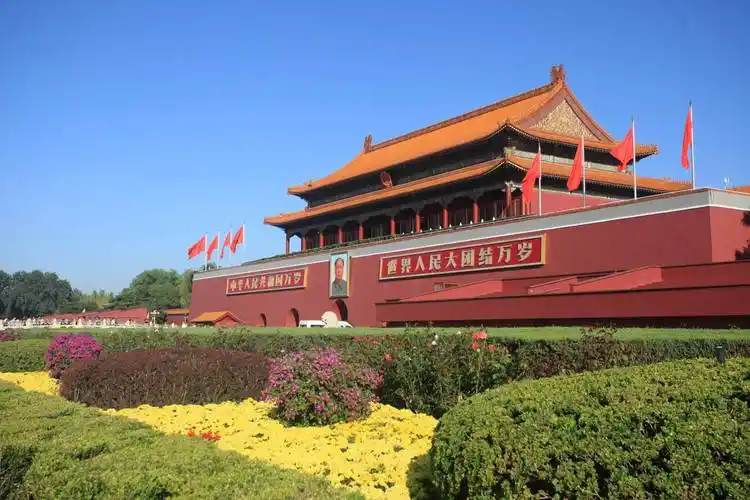
Tiananmen Square
Tiananmen Square traces its origins to 1417, when it served as the imperial courtyard before the main gate of the Ming and Qing dynasties' Forbidden City. After the founding of the People's Republic in 1949, successive enlargements transformed it into today's 440,000-square-meter expanse—comparable in scale to Red Square in Moscow and several times larger than St. Peter's Square in Vatican City. This evolution from dynastic stage to people's forum marks one of the twentieth century's most dramatic urban reinventions, converting the old axis of imperial power into a shared civic axis. The square's architecture unfolds along Beijing's north-south central axis, a layout that echoes the processional geometry of Versailles or the Champs-Élysées in Paris. At its northern end stands the Tiananmen Gate, the surviving imperial entrance, crowned by the portrait of Mao Zedong. Rising 37.94 meters at the center, the granite Monument to the People's Heroes bears Mao's inscription "Eternal Glory to the People's Heroes." Symmetrically arranged on the western and eastern flanks, the Great Hall of the People and the National Museum of China frame the space with mid-century buildings that blend Soviet monumentality with traditional Chinese rooflines. As the symbolic heart of modern China, the square has witnessed every defining moment of the People's Republic—from the founding proclamation of 1949 to the great gatherings of the reform era. It forms a core segment of the Beijing Central Axis, inscribed as a UNESCO World Heritage Site in 2024. The square functions as both a living museum and a stage for national identity, where the precise choreography of the flag ritual—a 46-second ascent timed to sunrise—anchors millions of viewers in a shared sense of continuity. Entry is free but requires real-name reservation through the official "Tiananmen Square Reservation Platform" or its mini-program, available one to nine days in advance across four slots: flag-raising, morning, afternoon, and flag-lowering. Opening hours typically run 05:00–22:30, with last entry at 22:00 and seasonal adjustments. Foreign visitors present their passport at the gate; identification is matched against the booking. Security is strict—lighters, liquids, knives, and drones are prohibited. The Mao Mausoleum requires depositing bags, cameras, and phones before entry. Arriving for the sunrise ceremony is unforgettable, but expect an early queue—confirm the day's sunrise time in advance and dress warmly in winter. The square pairs naturally with the Forbidden City to the north, the Great Hall of the People, or the National Museum, whose reservations often grant direct entry. Subway Line 1 to Tiananmen East or Tiananmen West station is the most convenient arrival point, depositing you within steps of the perimeter. Light, neat attire suits the site's formal character and is recommended for all visitors.

Traveler reviews

Tiananmen Square is truly magnificent. It was my kid's first time in Beijing, so a visit here was an absolute must. I watched the September 3rd military parade on TV...
⭐ 5 · Jamie Cole Expand
Tiananmen Square sits right in the heart of Beijing — 880 meters north to south, 500 meters east to west, covering about 440,000 square meters, making it the largest urban square in the world. To the north you've got the Tiananmen Gate Tower, to the south Zhengyangmen (the front gate of the old city), the National Museum on the east side, and the Great Hall of the People on the west. Right in the center stands the Monument to the People's Heroes, and the Mao Zedong Memorial Hall is just to the south. Back in the Ming and Qing dynastions this was a T-shaped pala...
⭐ 5 · Robin Hayes Expand