Songhua River Scenic Area
⭐ 4.20
Songhua River Scenic Area, Chuanying District, Jilin City, Jilin Province, China
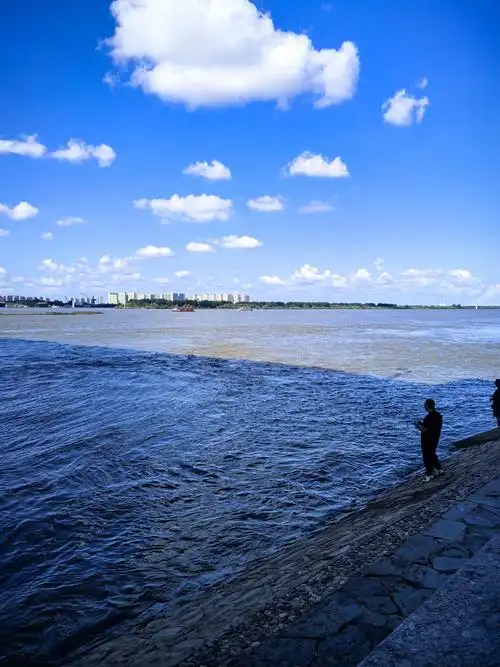 The Songhua River—known historically as the Sungari—has shaped Jilin City since its founding in 1673 as a Manchu garrison town during the Qing dynasty. The city itself takes its name from the Manchu word "Girin-ula," meaning "along the river," making it the only Chinese city named directly after a waterway. The river served as a vital artery for timber rafting and trade throughout imperial times, and later witnessed pivotal moments of twentieth-century history, including the Japanese puppet state of Manchukuo in the 1930s and 1940s.
The urban section unfolds as a twenty-kilometer green corridor linking Jiangbin Park, Windsurf Square, and the Rime Garden, all freely accessible. After dark, choreographed musical fountains, water-screen films, and illuminated embankments create a spectacle reminiscent of Budapest's Danube promenade or Paris's Seine quays. Locals gather here year-round for tai chi, cycling, and evening strolls, while summer night cruises glide past LED-lit bridges and pavilions.
About an hour's drive upstream lies the Songhua River Ecological Tourism Zone, a national AAAA-rated area where emerald waters wind between forested cliffs. Boat tours—aboard sleek speedboats, traditional-style painted barges, or jet skis—thread through three dramatic gorges: Bailong (White Dragon), Luming (Heron Cry), and Renyi (Righteousness). Eighteen named rock formations, including General Rock and Golden Turtle Island, rise from the water in shapes that echo the Rhine Gorge or Scottish lochs, earning the area its "Lijiang of the North" reputation.
Each December through February, the river's thermal waters—warmed by releases from the upstream Fengman Dam—meet air temperatures plunging below minus twenty degrees Celsius, generating the celebrated Jilin rime. This phenomenon ranks alongside Guilin's karst peaks, Yunnan's Stone Forest, and the Yangtze Three Gorges as one of China's "Four Great Natural Wonders." Comparable in visual drama to Lapland's ice forests or a frozen Bavarian winter, the crystalline rime encrusts willow branches into what Chinese poets call "jade trees and crystal flowers," drawing photographers from across Asia.
The urban riverside is entirely free and reachable by bus or taxi to any Jiangbin Park entrance. The upstream gorge zone requires a car or tourist shuttle to Huayuankou Wharf, where boat tickets run roughly 80 to 150 yuan per person. Summer visitors should arrive by dusk for fountains and night cruises; winter travelers must consult weather forecasts and arrive at dawn for optimal rime viewing, dressing in heavy layers as temperatures routinely fall below minus twenty-five degrees. Important: do not confuse this with Songhua Lake, a separate reservoir resort about twenty kilometers southeast that requires its own ticket and offers a very different experience.
The Songhua River—known historically as the Sungari—has shaped Jilin City since its founding in 1673 as a Manchu garrison town during the Qing dynasty. The city itself takes its name from the Manchu word "Girin-ula," meaning "along the river," making it the only Chinese city named directly after a waterway. The river served as a vital artery for timber rafting and trade throughout imperial times, and later witnessed pivotal moments of twentieth-century history, including the Japanese puppet state of Manchukuo in the 1930s and 1940s.
The urban section unfolds as a twenty-kilometer green corridor linking Jiangbin Park, Windsurf Square, and the Rime Garden, all freely accessible. After dark, choreographed musical fountains, water-screen films, and illuminated embankments create a spectacle reminiscent of Budapest's Danube promenade or Paris's Seine quays. Locals gather here year-round for tai chi, cycling, and evening strolls, while summer night cruises glide past LED-lit bridges and pavilions.
About an hour's drive upstream lies the Songhua River Ecological Tourism Zone, a national AAAA-rated area where emerald waters wind between forested cliffs. Boat tours—aboard sleek speedboats, traditional-style painted barges, or jet skis—thread through three dramatic gorges: Bailong (White Dragon), Luming (Heron Cry), and Renyi (Righteousness). Eighteen named rock formations, including General Rock and Golden Turtle Island, rise from the water in shapes that echo the Rhine Gorge or Scottish lochs, earning the area its "Lijiang of the North" reputation.
Each December through February, the river's thermal waters—warmed by releases from the upstream Fengman Dam—meet air temperatures plunging below minus twenty degrees Celsius, generating the celebrated Jilin rime. This phenomenon ranks alongside Guilin's karst peaks, Yunnan's Stone Forest, and the Yangtze Three Gorges as one of China's "Four Great Natural Wonders." Comparable in visual drama to Lapland's ice forests or a frozen Bavarian winter, the crystalline rime encrusts willow branches into what Chinese poets call "jade trees and crystal flowers," drawing photographers from across Asia.
The urban riverside is entirely free and reachable by bus or taxi to any Jiangbin Park entrance. The upstream gorge zone requires a car or tourist shuttle to Huayuankou Wharf, where boat tickets run roughly 80 to 150 yuan per person. Summer visitors should arrive by dusk for fountains and night cruises; winter travelers must consult weather forecasts and arrive at dawn for optimal rime viewing, dressing in heavy layers as temperatures routinely fall below minus twenty-five degrees. Important: do not confuse this with Songhua Lake, a separate reservoir resort about twenty kilometers southeast that requires its own ticket and offers a very different experience.