Jilin Mosque
⭐ 4.50
Intersection of Jiefang Road and Zhengyang Street, Changyi District, Jilin City, Jilin Province, China
 The three mosques of Jilin City form a living timeline of Islam in northeast China. The oldest, Wulajie Mosque, was founded in 1692 during the reign of Emperor Kangxi—just three decades after the Manchu conquest established the Qing Dynasty. The North Mosque followed in 1760 under Emperor Qianlong, an era when Hui Muslim communities had become firmly woven into imperial life along the trade routes linking Beijing to the Siberian frontier. The West Mosque represents the contemporary era, rebuilt in the 1990s as Jilin's Muslims sought architecture matching global Islamic identity. Together, they trace three hundred years of cultural continuity—comparable to studying a Romanesque church, a Renaissance basilica, and a modernist cathedral within one European city.
The North Mosque is the crown jewel of Jilin's Islamic heritage, transplanted to its current Yueshan Road site in 1993. Its plan follows the classic Chinese siheyuan—those enclosed quadrangles familiar from Beijing's old neighborhoods—but the visual vocabulary is unmistakably Arab. Twin minarets (bangke ta) soar to 45.96 meters, echoing the proportions of Cairo's early minarets while matching the skyline ambitions of European Gothic spires. Inside, a Qing-era plaque bearing the four characters "Huai Qing Shou Zhen"—meaning "upholding purity and truth"—hangs beside carved marble steles. The prayer hall's intricate wood and brick carvings illustrate the gradual Sinicization of Islamic religious architecture, a process scholars liken to the evolution of Mudejar style in medieval Spain.
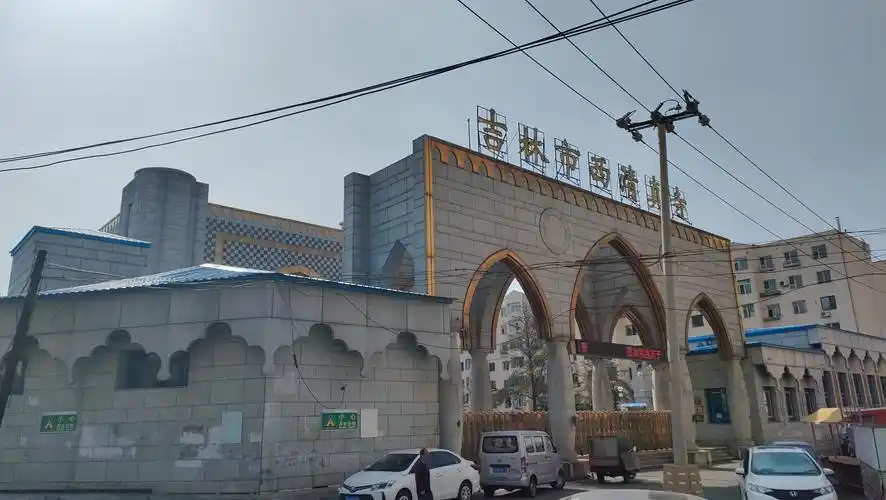
Where the North Mosque is solemn and weighty, the West Mosque is bright and contemporary. Built in the 1990s, it showcases the crisp white geometric lines and bold domes favored in modern mosque architecture from Riyadh to Casablanca. Its most photographed feature is the stained glass, which transforms morning sunlight into jeweled patterns across the prayer hall—a phenomenon visitors compare to the luminous interiors of Sainte-Chapelle in Paris. Outside, the surrounding neighborhood pulses with authentic Hui culinary life: steaming bowls of yangrou paomo (lamb stew with crumbled flatbread), sesame-sprinkled naan pulled fresh from clay ovens, and skewers sizzling over coals. It functions as much as a culinary pilgrimage as an architectural one.
The Wulajie Mosque breaks every expectation of what a mosque should look like. Tucked inside the Manchu town of Wulajie in Longtan District, it rises with single-eaved hip-and-gable roofs, gray brick walls, and blue-gray tiles—the visual language of Confucian temples and imperial audience halls, not Islam's iconic domes. Founded in 1692, it is the sole surviving religious building in Wulajie and forms part of a nationally protected complex including the grand Manchu mansions known as Kuifu, Houfu, and Safu. The fusion here is subtle rather than spectacular: a quiet dialogue between Hui merchants and Manchu bannermen that produced a building easily mistaken for a neighborhood shrine. Pair your visit with the surrounding Manchu heritage quarter to grasp a vanished multicultural frontier society.
All three mosques are free to enter, with no admission fees. The optimal visiting window runs from 10 a.m. to 4 p.m., but you must avoid the five daily prayer times—and especially Friday's jumu'ah congregational service—when worshippers fill the halls. Dress modestly, remain quiet, and leave pork products and alcohol at home. Photography of worshippers in prayer is forbidden; interior shots require permission from staff. Visitors with limited time should prioritize the North Mosque for its grandeur, while photographers will find the West Mosque more rewarding. Those with a half-day to spare should venture to Wulajie, where three-hundred-year-old timbers and weathered tiles reward anyone curious about Islam's quieter chapters on the Manchurian frontier.
This trio rewards travelers tired of identical temple circuits. Few cities in the world let you trace Islamic architecture from Qing-era timber halls to soaring Arab-minaret fusion to sleek contemporary domes—all within a single day's drive. The Jilin mosques offer something rarer still: a chance to see how minority cultures endured and adapted along China's northeastern frontier, far from the well-trodden Silk Road corridors. Whether you come for the minarets, the woodwork, the lamb skewers, or the layers of cultural history, you will leave with a richer understanding of Islam's quiet, persistent presence in a corner of China most travelers overlook.
The three mosques of Jilin City form a living timeline of Islam in northeast China. The oldest, Wulajie Mosque, was founded in 1692 during the reign of Emperor Kangxi—just three decades after the Manchu conquest established the Qing Dynasty. The North Mosque followed in 1760 under Emperor Qianlong, an era when Hui Muslim communities had become firmly woven into imperial life along the trade routes linking Beijing to the Siberian frontier. The West Mosque represents the contemporary era, rebuilt in the 1990s as Jilin's Muslims sought architecture matching global Islamic identity. Together, they trace three hundred years of cultural continuity—comparable to studying a Romanesque church, a Renaissance basilica, and a modernist cathedral within one European city.
The North Mosque is the crown jewel of Jilin's Islamic heritage, transplanted to its current Yueshan Road site in 1993. Its plan follows the classic Chinese siheyuan—those enclosed quadrangles familiar from Beijing's old neighborhoods—but the visual vocabulary is unmistakably Arab. Twin minarets (bangke ta) soar to 45.96 meters, echoing the proportions of Cairo's early minarets while matching the skyline ambitions of European Gothic spires. Inside, a Qing-era plaque bearing the four characters "Huai Qing Shou Zhen"—meaning "upholding purity and truth"—hangs beside carved marble steles. The prayer hall's intricate wood and brick carvings illustrate the gradual Sinicization of Islamic religious architecture, a process scholars liken to the evolution of Mudejar style in medieval Spain.
Where the North Mosque is solemn and weighty, the West Mosque is bright and contemporary. Built in the 1990s, it showcases the crisp white geometric lines and bold domes favored in modern mosque architecture from Riyadh to Casablanca. Its most photographed feature is the stained glass, which transforms morning sunlight into jeweled patterns across the prayer hall—a phenomenon visitors compare to the luminous interiors of Sainte-Chapelle in Paris. Outside, the surrounding neighborhood pulses with authentic Hui culinary life: steaming bowls of yangrou paomo (lamb stew with crumbled flatbread), sesame-sprinkled naan pulled fresh from clay ovens, and skewers sizzling over coals. It functions as much as a culinary pilgrimage as an architectural one.
The Wulajie Mosque breaks every expectation of what a mosque should look like. Tucked inside the Manchu town of Wulajie in Longtan District, it rises with single-eaved hip-and-gable roofs, gray brick walls, and blue-gray tiles—the visual language of Confucian temples and imperial audience halls, not Islam's iconic domes. Founded in 1692, it is the sole surviving religious building in Wulajie and forms part of a nationally protected complex including the grand Manchu mansions known as Kuifu, Houfu, and Safu. The fusion here is subtle rather than spectacular: a quiet dialogue between Hui merchants and Manchu bannermen that produced a building easily mistaken for a neighborhood shrine. Pair your visit with the surrounding Manchu heritage quarter to grasp a vanished multicultural frontier society.
All three mosques are free to enter, with no admission fees. The optimal visiting window runs from 10 a.m. to 4 p.m., but you must avoid the five daily prayer times—and especially Friday's jumu'ah congregational service—when worshippers fill the halls. Dress modestly, remain quiet, and leave pork products and alcohol at home. Photography of worshippers in prayer is forbidden; interior shots require permission from staff. Visitors with limited time should prioritize the North Mosque for its grandeur, while photographers will find the West Mosque more rewarding. Those with a half-day to spare should venture to Wulajie, where three-hundred-year-old timbers and weathered tiles reward anyone curious about Islam's quieter chapters on the Manchurian frontier.
This trio rewards travelers tired of identical temple circuits. Few cities in the world let you trace Islamic architecture from Qing-era timber halls to soaring Arab-minaret fusion to sleek contemporary domes—all within a single day's drive. The Jilin mosques offer something rarer still: a chance to see how minority cultures endured and adapted along China's northeastern frontier, far from the well-trodden Silk Road corridors. Whether you come for the minarets, the woodwork, the lamb skewers, or the layers of cultural history, you will leave with a richer understanding of Islam's quiet, persistent presence in a corner of China most travelers overlook.