Mount Jiuhua Cableway
⭐ 4.80
Jiuhua Mountain Scenic Area, Qingyang County, Chizhou City, Anhui Province, China
 Comparable in spiritual stature to Europe's pilgrimage routes such as Santiago de Compostela or Greece's Mount Athos, Jiuhua Mountain has drawn Buddhist devotees since the Tang Dynasty. Designated a UNESCO Global Geopark and one of China's Four Sacred Mountains, it centers on the cult of Ksitigarbha (known in Chinese as Dizang), the Bodhisattva vowed to save all beings from hell. The mountain's 99 peaks and 110 monasteries create a landscape where nature and devotion intertwine, with the cableway system offering modern pilgrims an "aerial approach" to centuries of religious tradition.
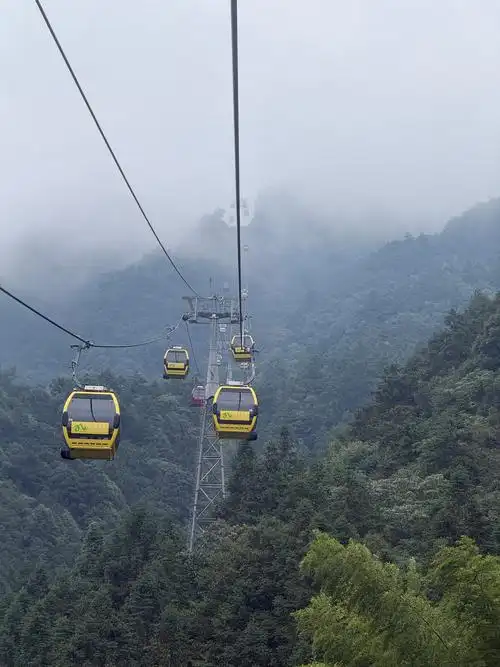
The Huatai Cableway stretches 2,908 meters with a vertical rise of 824 meters, making it both the longest and steepest route on the mountain. Modern 8-passenger gondolas glide above the clouds in approximately 15 minutes, depositing visitors onto a vertiginous cliffside boardwalk. The surrounding landscape of peculiar pines, rocky outcrops, alpine flower meadows, and rolling sea-of-clouds vistas has earned comparisons to Scotland's Isle of Skye or Norway's Trolltunga. As the sole access point for this scenic area, the round-trip fare (160 yuan) is essential, though operations halt in high winds or icy conditions, typically running from 8:00 to 17:00.
The Tiantai Cableway covers 1,244 meters with a 500-meter elevation gain, delivering travelers to the summit in just 10 to 12 minutes. Near the lower station stand the ancient Dajue Temple and the celebrated Phoenix Pine, a gnarled specimen centuries old. At the top, pilgrims pay homage to a stone imprint believed to be Ksitigarbha's footprint and ascend the Penri Pavilion (Sun-Holding Pavilion), where sunrise views rival those from Japan's Mount Fuji. Pricing varies by season (160 yuan peak, 120 yuan off-peak), and this route is widely regarded as the best value for combining religious reverence with sweeping mountain panoramas.
The Baosui Gong Cable Car, though shortest at 452 meters, carries visitors in style within a spacious 39-passenger cabin in only 5 to 6 minutes. Running from 6:30 to 17:00, it links Qiyuan Temple to the Hundred-Year Palace, which enshrines the remarkably preserved mummified body of Monk Wuxia from the Ming Dynasty, a phenomenon that ranks among Buddhism's most extraordinary relics alongside the self-mummified monks of Japan's Mount Yudono. The summit viewpoint offers a fine aerial perspective over Jiuhua Street's temple cluster, though the main draw remains efficient access to this venerated shrine. Round-trip tickets cost 100 yuan.
Practical planning rewards those who combine routes strategically: Huatai for natural spectacle, Tiantai for summit worship, and Baosui Gong for efficient pilgrimage to the Buddha's Holy Body. The peak season entry ticket (160 yuan) plus a mandatory 50-yuan scenic transport pass must be purchased separately from cableway tickets. Cableways generally close between 17:00 and 17:30, so early starts are essential. Mountain weather shifts rapidly, making a light jacket advisable. Visitors can confirm operating status by calling Tiantai (0566-3289022), Huatai (0566-2832188), or Baosui Gong (0566-2831633) before departure, particularly during thunderstorms or windy conditions that trigger temporary suspensions.
Comparable in spiritual stature to Europe's pilgrimage routes such as Santiago de Compostela or Greece's Mount Athos, Jiuhua Mountain has drawn Buddhist devotees since the Tang Dynasty. Designated a UNESCO Global Geopark and one of China's Four Sacred Mountains, it centers on the cult of Ksitigarbha (known in Chinese as Dizang), the Bodhisattva vowed to save all beings from hell. The mountain's 99 peaks and 110 monasteries create a landscape where nature and devotion intertwine, with the cableway system offering modern pilgrims an "aerial approach" to centuries of religious tradition.
The Huatai Cableway stretches 2,908 meters with a vertical rise of 824 meters, making it both the longest and steepest route on the mountain. Modern 8-passenger gondolas glide above the clouds in approximately 15 minutes, depositing visitors onto a vertiginous cliffside boardwalk. The surrounding landscape of peculiar pines, rocky outcrops, alpine flower meadows, and rolling sea-of-clouds vistas has earned comparisons to Scotland's Isle of Skye or Norway's Trolltunga. As the sole access point for this scenic area, the round-trip fare (160 yuan) is essential, though operations halt in high winds or icy conditions, typically running from 8:00 to 17:00.
The Tiantai Cableway covers 1,244 meters with a 500-meter elevation gain, delivering travelers to the summit in just 10 to 12 minutes. Near the lower station stand the ancient Dajue Temple and the celebrated Phoenix Pine, a gnarled specimen centuries old. At the top, pilgrims pay homage to a stone imprint believed to be Ksitigarbha's footprint and ascend the Penri Pavilion (Sun-Holding Pavilion), where sunrise views rival those from Japan's Mount Fuji. Pricing varies by season (160 yuan peak, 120 yuan off-peak), and this route is widely regarded as the best value for combining religious reverence with sweeping mountain panoramas.
The Baosui Gong Cable Car, though shortest at 452 meters, carries visitors in style within a spacious 39-passenger cabin in only 5 to 6 minutes. Running from 6:30 to 17:00, it links Qiyuan Temple to the Hundred-Year Palace, which enshrines the remarkably preserved mummified body of Monk Wuxia from the Ming Dynasty, a phenomenon that ranks among Buddhism's most extraordinary relics alongside the self-mummified monks of Japan's Mount Yudono. The summit viewpoint offers a fine aerial perspective over Jiuhua Street's temple cluster, though the main draw remains efficient access to this venerated shrine. Round-trip tickets cost 100 yuan.
Practical planning rewards those who combine routes strategically: Huatai for natural spectacle, Tiantai for summit worship, and Baosui Gong for efficient pilgrimage to the Buddha's Holy Body. The peak season entry ticket (160 yuan) plus a mandatory 50-yuan scenic transport pass must be purchased separately from cableway tickets. Cableways generally close between 17:00 and 17:30, so early starts are essential. Mountain weather shifts rapidly, making a light jacket advisable. Visitors can confirm operating status by calling Tiantai (0566-3289022), Huatai (0566-2832188), or Baosui Gong (0566-2831633) before departure, particularly during thunderstorms or windy conditions that trigger temporary suspensions.