Roushen Hall
⭐ 4.20
Mount Jiuhua Scenic Area, Qingyang County, Chizhou City, Anhui Province, China
 The hall traces its origins to 794 CE, the same year Charlemagne's empire was reshaping Western Europe. It commemorates Kim Qiaojue, a royal scion of Korea's ancient Silla kingdom who renounced his princely birth to walk the Silk Road into Tang China—mirroring the spiritual journeys of European prince-bishops and pilgrim-monks of the era. After his death at age 99, disciples discovered his body incorrupt three years later and enshrined him in a stone pagoda. This phenomenon of bodily incorruptibility parallels the Catholic tradition of saints' relics venerated in Rome and the Mediterranean world, lending the site its enduring mystique across more than twelve centuries.
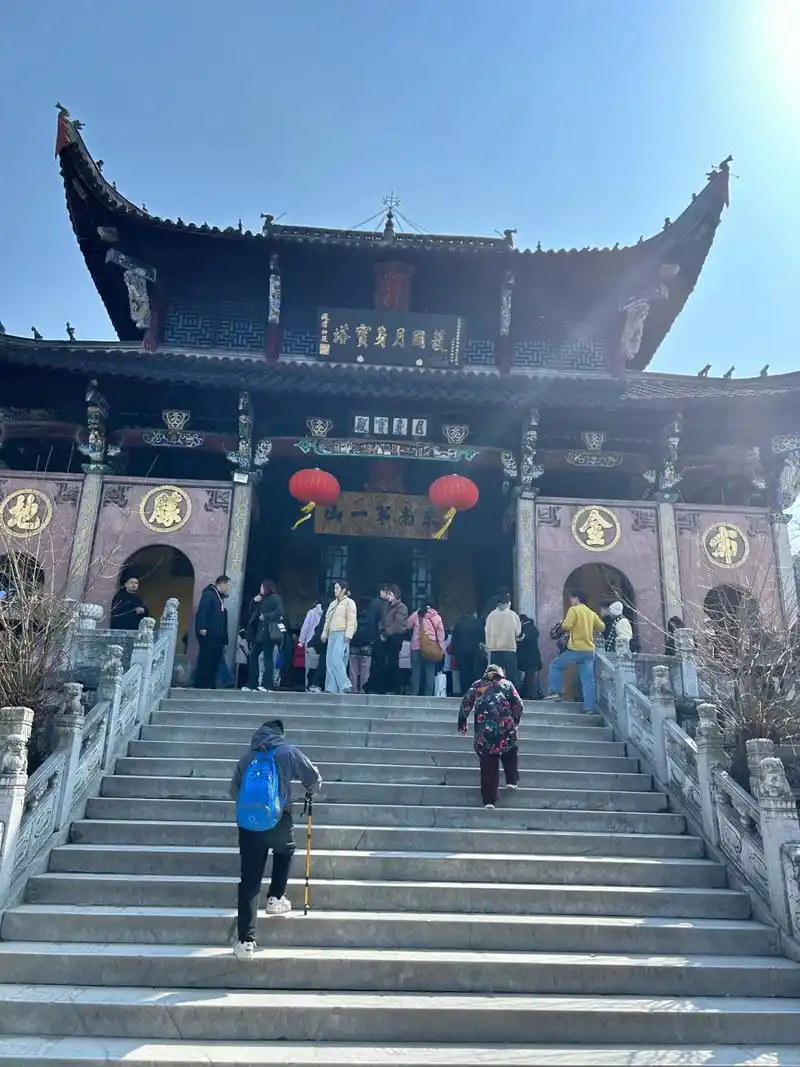
The two-story timber structure is crowned by sweeping flying eaves in the classic xieshan style, recalling the soaring wooden interiors of Norway's medieval stave churches or the elegant timber halls of Horyuji in Japan. Its true marvel lies in the ingenious "temple-within-pagoda" configuration—rare even across Asia's vast Buddhist architectural canon. A seven-tiered octagonal wooden pagoda rises 17 meters inside the hall, housing a stone reliquary urn that contains the sacred remains. White marble forms the pagoda's base, while calligraphic plaques by Republican-era statesman Li Yuanhong adorn both gates.
As the supreme sanctuary of Dizang Bodhisattva—the compassionate savior of souls in hell, often compared to a guardian-saint figure in Western devotion—Mount Jiuhua draws millions of pilgrims each year. The site reaches its spiritual climax on the thirtieth day of the seventh lunar month, when devotees gather for Ksitigarbha's birthday and the founder's commemoration. Tradition promises a sacred "pagoda-washing rain" during the festival, while worshippers circumambulate the tower three times clockwise—a ritual echoing the Hindu pradakshina at Varanasi and Christian processions in Europe's great cathedrals.
The hall opens daily from 6:00 AM to 7:00 PM, with final entry at 6:00 PM. A Mount Jiuhua park ticket is required for entry. Visitors should wear sturdy, non-slip footwear for the 99-step northern staircase or 81-step southern approach. Photography, filming, headwear, and stepping on the wooden threshold are strictly prohibited as signs of respect. Allow roughly one hour, and aim for the 8:30 to 10:30 AM window when crowds thin and soft golden light bathes the courtyard—ideal for exterior photography.
For travelers drawn to living pilgrimage traditions, this is the beating heart of a sacred landscape that has welcomed seekers for over a millennium. Pair a visit with neighboring Huacheng Temple and Tiantai Temple for a half-day immersion into the region's broader Buddhist heritage. Few places on earth allow visitors to stand where Korean, Chinese, and universal Buddhist history converge within a single incense-laden hall—an experience that resonates with travelers familiar with the layered spirituality of Jerusalem, Rome, or Varanasi.
The hall traces its origins to 794 CE, the same year Charlemagne's empire was reshaping Western Europe. It commemorates Kim Qiaojue, a royal scion of Korea's ancient Silla kingdom who renounced his princely birth to walk the Silk Road into Tang China—mirroring the spiritual journeys of European prince-bishops and pilgrim-monks of the era. After his death at age 99, disciples discovered his body incorrupt three years later and enshrined him in a stone pagoda. This phenomenon of bodily incorruptibility parallels the Catholic tradition of saints' relics venerated in Rome and the Mediterranean world, lending the site its enduring mystique across more than twelve centuries.
The two-story timber structure is crowned by sweeping flying eaves in the classic xieshan style, recalling the soaring wooden interiors of Norway's medieval stave churches or the elegant timber halls of Horyuji in Japan. Its true marvel lies in the ingenious "temple-within-pagoda" configuration—rare even across Asia's vast Buddhist architectural canon. A seven-tiered octagonal wooden pagoda rises 17 meters inside the hall, housing a stone reliquary urn that contains the sacred remains. White marble forms the pagoda's base, while calligraphic plaques by Republican-era statesman Li Yuanhong adorn both gates.
As the supreme sanctuary of Dizang Bodhisattva—the compassionate savior of souls in hell, often compared to a guardian-saint figure in Western devotion—Mount Jiuhua draws millions of pilgrims each year. The site reaches its spiritual climax on the thirtieth day of the seventh lunar month, when devotees gather for Ksitigarbha's birthday and the founder's commemoration. Tradition promises a sacred "pagoda-washing rain" during the festival, while worshippers circumambulate the tower three times clockwise—a ritual echoing the Hindu pradakshina at Varanasi and Christian processions in Europe's great cathedrals.
The hall opens daily from 6:00 AM to 7:00 PM, with final entry at 6:00 PM. A Mount Jiuhua park ticket is required for entry. Visitors should wear sturdy, non-slip footwear for the 99-step northern staircase or 81-step southern approach. Photography, filming, headwear, and stepping on the wooden threshold are strictly prohibited as signs of respect. Allow roughly one hour, and aim for the 8:30 to 10:30 AM window when crowds thin and soft golden light bathes the courtyard—ideal for exterior photography.
For travelers drawn to living pilgrimage traditions, this is the beating heart of a sacred landscape that has welcomed seekers for over a millennium. Pair a visit with neighboring Huacheng Temple and Tiantai Temple for a half-day immersion into the region's broader Buddhist heritage. Few places on earth allow visitors to stand where Korean, Chinese, and universal Buddhist history converge within a single incense-laden hall—an experience that resonates with travelers familiar with the layered spirituality of Jerusalem, Rome, or Varanasi.