Huacheng Temple
⭐ 4.20
Mount Jiuhua Scenic Area, Qingyang County, Chizhou City, Anhui Province, China
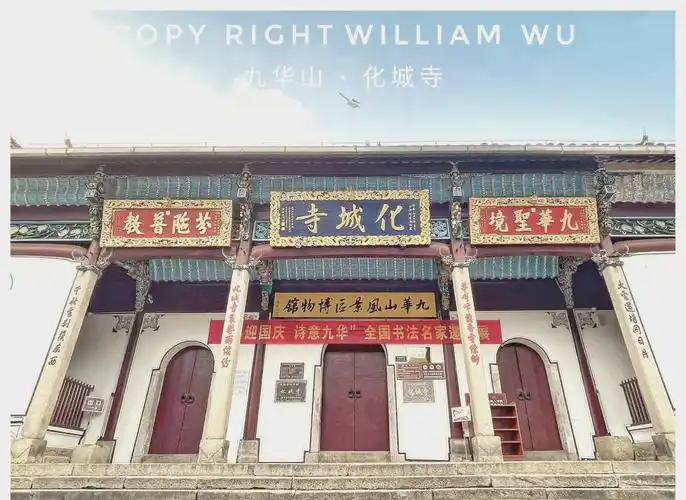 Founded in 401 AD by the Chan master Beidu, Huacheng Temple predates many of Europe's most famous monasteries, including the original construction of Westminster Abbey's predecessor. The name "Huacheng" (Transformation City) derives from a parable in the Lotus Sutra. The temple gained its sacred status as the very place where the Korean monk Kim Qiaojue (known as "Golden Earth Store") began his ascetic practice in the 8th century, establishing Jiuhua Mountain as one of China's Four Sacred Buddhist Mountains dedicated to Ksitigarbha Bodhisattva. It is now a nationally protected cultural heritage site.
The temple is uniquely Jiuhua Mountain's only temple built on a strict north-south symmetrical axis, with four courtyards ascending the hillside: the Lingguan Hall, Heavenly Kings Hall, Great Hero Hall (Main Buddha Hall), and the Sutra Library. This axial design recalls European monastery layouts such as Monte Cassino in Italy. The architecture beautifully blends traditional Buddhist temple elements with the whitewashed walls, black-tiled roofs, and stepped horse-head gables characteristic of southern Anhui vernacular housing—a style UNESCO has recognized in nearby villages. The Great Hero Hall features a stunning carved wooden caisson ceiling depicting nine dragons playing with a pearl, while the Ming-era Sutra Library stands as the highest structure, showcasing remarkable mortise-and-tenon craftsmanship.
Beyond its religious significance, Huacheng Temple serves as the Jiuhua Mountain Historical Museum, displaying 147 nationally designated国宝级 (grade-one) cultural relics. These treasures, including a Ming-dynasty sutra transcribed in blood and a gilded Wanli-era imperial seal, chronicle over 1,600 years of Buddhist artistic and cultural development. Before the main hall, the legendary "Bright-Eye Spring" is said to have flowed where Kim Qiaojue once washed his mother's eyes—a moving testament to filial piety at the heart of Buddhist devotion here.
Practical visiting information is refreshingly simple: no separate ticket is required—your main Jiuhua Mountain scenic area ticket grants access. From the Jiuhua Street area, the temple is a pleasant 5-to-10-minute walk. Foreign visitors should bring their original passports and may request English-language guided tours at the official visitor center. Allow 45 to 60 minutes for your visit. Early morning or late afternoon offers softer light, fewer crowds, and a contemplative atmosphere ideal for photographing architectural details.
Visiting etiquette deserves attention: do not step on door thresholds, refrain from photographing Buddha statues directly, and ensure shoulders and knees are covered. Huacheng Temple pairs wonderfully with nearby Qiyuan Temple and the Hall of the Corpse (Roushen Baodian), allowing visitors to immerse themselves fully in Jiuhua Mountain's profound spiritual ambiance. For Western travelers accustomed to grand European cathedrals and abbeys, this ancient Chinese sanctuary offers a rare window into a living Buddhist tradition that has flourished for sixteen centuries—making it an essential stop for any culturally curious visitor.
Founded in 401 AD by the Chan master Beidu, Huacheng Temple predates many of Europe's most famous monasteries, including the original construction of Westminster Abbey's predecessor. The name "Huacheng" (Transformation City) derives from a parable in the Lotus Sutra. The temple gained its sacred status as the very place where the Korean monk Kim Qiaojue (known as "Golden Earth Store") began his ascetic practice in the 8th century, establishing Jiuhua Mountain as one of China's Four Sacred Buddhist Mountains dedicated to Ksitigarbha Bodhisattva. It is now a nationally protected cultural heritage site.
The temple is uniquely Jiuhua Mountain's only temple built on a strict north-south symmetrical axis, with four courtyards ascending the hillside: the Lingguan Hall, Heavenly Kings Hall, Great Hero Hall (Main Buddha Hall), and the Sutra Library. This axial design recalls European monastery layouts such as Monte Cassino in Italy. The architecture beautifully blends traditional Buddhist temple elements with the whitewashed walls, black-tiled roofs, and stepped horse-head gables characteristic of southern Anhui vernacular housing—a style UNESCO has recognized in nearby villages. The Great Hero Hall features a stunning carved wooden caisson ceiling depicting nine dragons playing with a pearl, while the Ming-era Sutra Library stands as the highest structure, showcasing remarkable mortise-and-tenon craftsmanship.
Beyond its religious significance, Huacheng Temple serves as the Jiuhua Mountain Historical Museum, displaying 147 nationally designated国宝级 (grade-one) cultural relics. These treasures, including a Ming-dynasty sutra transcribed in blood and a gilded Wanli-era imperial seal, chronicle over 1,600 years of Buddhist artistic and cultural development. Before the main hall, the legendary "Bright-Eye Spring" is said to have flowed where Kim Qiaojue once washed his mother's eyes—a moving testament to filial piety at the heart of Buddhist devotion here.
Practical visiting information is refreshingly simple: no separate ticket is required—your main Jiuhua Mountain scenic area ticket grants access. From the Jiuhua Street area, the temple is a pleasant 5-to-10-minute walk. Foreign visitors should bring their original passports and may request English-language guided tours at the official visitor center. Allow 45 to 60 minutes for your visit. Early morning or late afternoon offers softer light, fewer crowds, and a contemplative atmosphere ideal for photographing architectural details.
Visiting etiquette deserves attention: do not step on door thresholds, refrain from photographing Buddha statues directly, and ensure shoulders and knees are covered. Huacheng Temple pairs wonderfully with nearby Qiyuan Temple and the Hall of the Corpse (Roushen Baodian), allowing visitors to immerse themselves fully in Jiuhua Mountain's profound spiritual ambiance. For Western travelers accustomed to grand European cathedrals and abbeys, this ancient Chinese sanctuary offers a rare window into a living Buddhist tradition that has flourished for sixteen centuries—making it an essential stop for any culturally curious visitor.