Mount Jiuhua Scenic Area
⭐ 4.60
Mount Jiuhua Scenic Area, Mount Jiuhua, Chizhou City, Anhui Province, China
 Mount Jiuhua's Buddhist legacy stretches back to the Tang Dynasty, when the Korean monk Kim Qiaojue sailed across the East China Sea to practice here. After his death, he was venerated as the incarnation of Ksitigarbha Bodhisattva—known as Jindizang, the "Golden Ksitigarbha"—just as Mount Athos in Greece became synonymous with Orthodox monasticism. By the Ming and Qing dynasties, the mountain boasted over three hundred temples, earning its place alongside Mount Wutai, Emei, and Putuo among China's great Buddhist ranges.
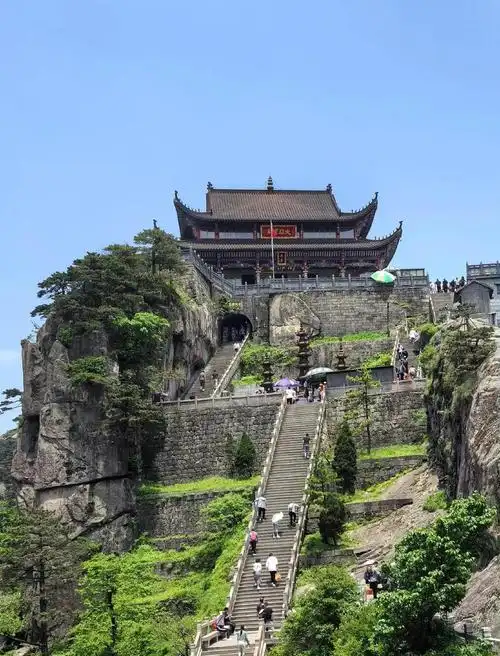
Architecturally, Jiuhua is striking for how its ninety-nine surviving temples integrate Anhui vernacular housing—whitewashed walls and grey-tiled roofs reminiscent of Tuscan hill villages—with formal Buddhist temple design. Huacheng Temple, the founding monastery founded in 758 AD, anchors the mountain's spiritual geography. Nearby, the Hall of the Holy Relic houses the golden pagoda above Kim Qiaojue's tomb, while the hundred-year-old Baisui Palace perches dramatically on a cliff face, where visitors can spot a natural reclining Buddha silhouette in the surrounding ridge—comparable to Christ the Redeemer's dramatic perch over Rio.
The mountain's most distinctive phenomenon is the tradition of "living body Bodhisattvas"—monks whose mummified remains are venerated centuries after death. The most famous is the Ming-era monk Wuxia, whose body has remained intact for over four hundred years, a phenomenon that continues to fascinate researchers and pilgrims. This practice reflects how Chinese Buddhism absorbed Daoist self-cultivation traditions, creating something unique to this sacred landscape.
Practical visits are well-supported. High-season entry is ¥160, off-season ¥140; a mandatory sightseeing bus costs ¥50, and cable cars run about ¥85 one-way. Spring, summer, and autumn offer pleasant weather, though early morning rewards visitors with spectacular cloud seas from Tiantai Peak's 1,300-meter summit. The colossal 99-meter outdoor Ksitigarbha bronze statue at Dayuan Cultural Park ranks among the world's tallest outdoor Buddha figures, surpassing the Statue of Liberty in height.
For a two-day itinerary, start at Dayuan Cultural Park, then ascend to Jiuhua Street for dinner and an evening visit to the illuminated temples. On day two, hike Tiantai Peak for sunrise or take the cable car to Huatai for surreal rock formations, with quiet walks through Mingu Bamboo Forest to round out the experience. Visitors should remember that halls are active places of worship—dress modestly, speak softly, and never photograph the monks or their statues. With its blend of mountain grandeur, living monastic tradition, and accessible infrastructure, Jiuhua offers a deeply memorable window into East Asian spirituality that no Western temple complex quite matches.
Mount Jiuhua's Buddhist legacy stretches back to the Tang Dynasty, when the Korean monk Kim Qiaojue sailed across the East China Sea to practice here. After his death, he was venerated as the incarnation of Ksitigarbha Bodhisattva—known as Jindizang, the "Golden Ksitigarbha"—just as Mount Athos in Greece became synonymous with Orthodox monasticism. By the Ming and Qing dynasties, the mountain boasted over three hundred temples, earning its place alongside Mount Wutai, Emei, and Putuo among China's great Buddhist ranges.
Architecturally, Jiuhua is striking for how its ninety-nine surviving temples integrate Anhui vernacular housing—whitewashed walls and grey-tiled roofs reminiscent of Tuscan hill villages—with formal Buddhist temple design. Huacheng Temple, the founding monastery founded in 758 AD, anchors the mountain's spiritual geography. Nearby, the Hall of the Holy Relic houses the golden pagoda above Kim Qiaojue's tomb, while the hundred-year-old Baisui Palace perches dramatically on a cliff face, where visitors can spot a natural reclining Buddha silhouette in the surrounding ridge—comparable to Christ the Redeemer's dramatic perch over Rio.
The mountain's most distinctive phenomenon is the tradition of "living body Bodhisattvas"—monks whose mummified remains are venerated centuries after death. The most famous is the Ming-era monk Wuxia, whose body has remained intact for over four hundred years, a phenomenon that continues to fascinate researchers and pilgrims. This practice reflects how Chinese Buddhism absorbed Daoist self-cultivation traditions, creating something unique to this sacred landscape.
Practical visits are well-supported. High-season entry is ¥160, off-season ¥140; a mandatory sightseeing bus costs ¥50, and cable cars run about ¥85 one-way. Spring, summer, and autumn offer pleasant weather, though early morning rewards visitors with spectacular cloud seas from Tiantai Peak's 1,300-meter summit. The colossal 99-meter outdoor Ksitigarbha bronze statue at Dayuan Cultural Park ranks among the world's tallest outdoor Buddha figures, surpassing the Statue of Liberty in height.
For a two-day itinerary, start at Dayuan Cultural Park, then ascend to Jiuhua Street for dinner and an evening visit to the illuminated temples. On day two, hike Tiantai Peak for sunrise or take the cable car to Huatai for surreal rock formations, with quiet walks through Mingu Bamboo Forest to round out the experience. Visitors should remember that halls are active places of worship—dress modestly, speak softly, and never photograph the monks or their statues. With its blend of mountain grandeur, living monastic tradition, and accessible infrastructure, Jiuhua offers a deeply memorable window into East Asian spirituality that no Western temple complex quite matches.