Goddess Peak
⭐ 4.20
Mount Sanqing Scenic Area, Wuyuan County, Shangrao City, Jiangxi Province, China
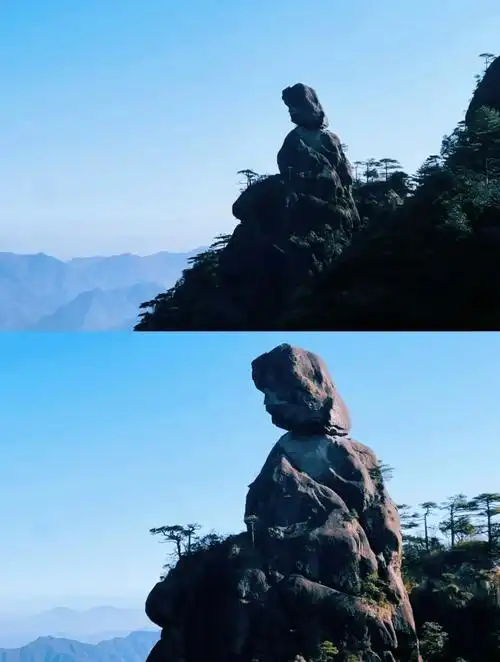 Towering 86 metres above its granite pedestal at 1,180 metres elevation, the Goddess Peak belongs to one of the most ancient granite landscapes on Earth — its parent rock crystallised during the same Proterozoic era that shaped the Scottish Cairngorms and the Dolomites' foundations. The Sanqing range's distinctive peaks, carved by 1.4 billion years of frost, wind, and monsoon rains, were inscribed on the UNESCO World Heritage List in 2008 alongside China's other great granite landscapes, such as Huangshan. Geologists liken the resulting "peak forest" to a petrified wave frozen in mid-crash, rivaling the dramatic spires of Italy's Dolomites or the mythical profiles of Zhangjiajie.
Architecturally, nature alone serves as sculptor: the colossal figure emerges entirely from a single block of weathered granite, its wide forehead, delicate nose, shoulder-length hair, and folded arms holding a pine sprig rendered through subtle erosion patterns. The peak faces,玉京峰 (Yujing Peak), the loftiest summit in the area, and forms a visual dialogue with the neighbouring "Python Emerging from the Mountain" — a 128-metre stone column rising vertically like a serpent about to strike. Together, these two formations create Sanqing's most photographed skyline, often compared to the theatrical silhouettes of Peru's Torres del Paine or Vietnam's Ha Long Bay karsts.
Culturally, the peak is steeped in a poignant legend. Originally known as the "Goddess of Spring," she is identified with 瑶姬, a celestial maiden who descended to Earth and fell in love with a mortal named Meng Long. Punished by heaven for breaking divine law, she was petrified into stone so that eternal spring would remain in the valleys below. This romantic tragedy has transformed the site into a pilgrimage destination for lovers, and the viewing platform at 1,314 metres deliberately echoes the Mandarin phrase "一生一世" — "for a lifetime and beyond" — making it a favoured spot for marriage proposals and vow renewals.
Practical access is straightforward. From Shangrao High-Speed Railway Station, scenic shuttle buses reach the Jinsha Cable Car lower station in roughly 90 minutes. Visitors must purchase both the Sanqing Mountain entrance ticket (around 120 RMB in peak season) and a round-trip cable car ticket (about 125 RMB). The recommended itinerary — Jinsha Cable Car up, Goddess Peak, Python Peak, Yutai, then return — takes 2.5 to 3 hours along mostly flat elevated boardwalks suitable for most fitness levels. Strong winds are common on the ridge, so pack a windproof jacket and non-slip hiking shoes; some platform edges lack railings, so caution is essential. Mobile payment dominates, though a small amount of cash is wise.
Timing greatly affects the experience. Dawn bathes the goddess in golden light before the clouds lift, while post-rain mornings produce spectacular sea-of-cloud formations that swirl around the figure's base, making her appear to float in mid-air. Midday glare flattens the contours, and summer thunderstorms may shroud the peak entirely, so checking the forecast is strongly recommended. Those with extra energy can extend the loop along the Sunshine and West Coast high-altitude walkways, completing a five-to-six-hour traverse of Sanqing's most celebrated ridgelines.
Beyond its scenic grandeur, the Goddess Peak rewards visitors with something rarer than spectacle: a moment of stillness above a churning ocean of cloud, where myth, geology, and human longing converge. Few landmarks in China — or indeed anywhere — manage to be simultaneously a geological marvel, a folkloric shrine, and a romantic stage set, all within a half-day's journey from Shanghai or Hangzhou. For travellers seeking an alternative to the crowds of Huangshan or Zhangjiajie, this corner of Jiangxi offers an equally dramatic, yet far less trodden, alpine experience.
Towering 86 metres above its granite pedestal at 1,180 metres elevation, the Goddess Peak belongs to one of the most ancient granite landscapes on Earth — its parent rock crystallised during the same Proterozoic era that shaped the Scottish Cairngorms and the Dolomites' foundations. The Sanqing range's distinctive peaks, carved by 1.4 billion years of frost, wind, and monsoon rains, were inscribed on the UNESCO World Heritage List in 2008 alongside China's other great granite landscapes, such as Huangshan. Geologists liken the resulting "peak forest" to a petrified wave frozen in mid-crash, rivaling the dramatic spires of Italy's Dolomites or the mythical profiles of Zhangjiajie.
Architecturally, nature alone serves as sculptor: the colossal figure emerges entirely from a single block of weathered granite, its wide forehead, delicate nose, shoulder-length hair, and folded arms holding a pine sprig rendered through subtle erosion patterns. The peak faces,玉京峰 (Yujing Peak), the loftiest summit in the area, and forms a visual dialogue with the neighbouring "Python Emerging from the Mountain" — a 128-metre stone column rising vertically like a serpent about to strike. Together, these two formations create Sanqing's most photographed skyline, often compared to the theatrical silhouettes of Peru's Torres del Paine or Vietnam's Ha Long Bay karsts.
Culturally, the peak is steeped in a poignant legend. Originally known as the "Goddess of Spring," she is identified with 瑶姬, a celestial maiden who descended to Earth and fell in love with a mortal named Meng Long. Punished by heaven for breaking divine law, she was petrified into stone so that eternal spring would remain in the valleys below. This romantic tragedy has transformed the site into a pilgrimage destination for lovers, and the viewing platform at 1,314 metres deliberately echoes the Mandarin phrase "一生一世" — "for a lifetime and beyond" — making it a favoured spot for marriage proposals and vow renewals.
Practical access is straightforward. From Shangrao High-Speed Railway Station, scenic shuttle buses reach the Jinsha Cable Car lower station in roughly 90 minutes. Visitors must purchase both the Sanqing Mountain entrance ticket (around 120 RMB in peak season) and a round-trip cable car ticket (about 125 RMB). The recommended itinerary — Jinsha Cable Car up, Goddess Peak, Python Peak, Yutai, then return — takes 2.5 to 3 hours along mostly flat elevated boardwalks suitable for most fitness levels. Strong winds are common on the ridge, so pack a windproof jacket and non-slip hiking shoes; some platform edges lack railings, so caution is essential. Mobile payment dominates, though a small amount of cash is wise.
Timing greatly affects the experience. Dawn bathes the goddess in golden light before the clouds lift, while post-rain mornings produce spectacular sea-of-cloud formations that swirl around the figure's base, making her appear to float in mid-air. Midday glare flattens the contours, and summer thunderstorms may shroud the peak entirely, so checking the forecast is strongly recommended. Those with extra energy can extend the loop along the Sunshine and West Coast high-altitude walkways, completing a five-to-six-hour traverse of Sanqing's most celebrated ridgelines.
Beyond its scenic grandeur, the Goddess Peak rewards visitors with something rarer than spectacle: a moment of stillness above a churning ocean of cloud, where myth, geology, and human longing converge. Few landmarks in China — or indeed anywhere — manage to be simultaneously a geological marvel, a folkloric shrine, and a romantic stage set, all within a half-day's journey from Shanghai or Hangzhou. For travellers seeking an alternative to the crowds of Huangshan or Zhangjiajie, this corner of Jiangxi offers an equally dramatic, yet far less trodden, alpine experience.