Mount Sanqing Cableway
⭐ 4.60
Mount Sanqing Scenic Area, Wuyuan County, Shangrao City, Jiangxi Province, China
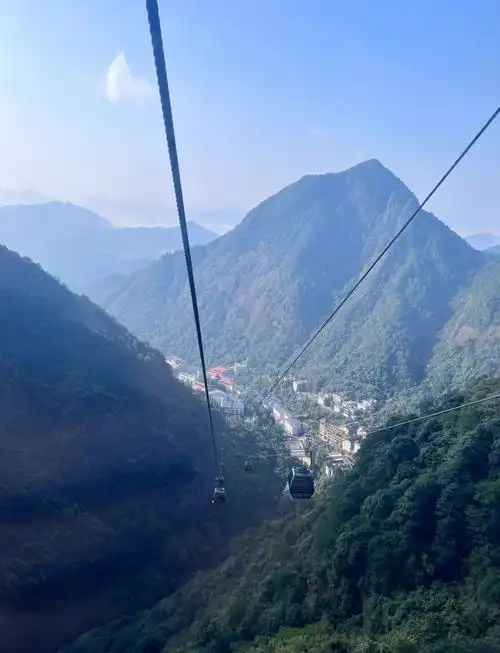 Mount Sanqing takes its name from the Three Pure Ones, the supreme deities of the Daoist pantheon, and has drawn pilgrims and seekers since the Tang dynasty—roughly the same era that saw Charlemagne crowned Emperor of the Romans. The mountain itself was formally consecrated as a Daoist sacred peak in the 16th century, comparable in spiritual stature to Mount Athos in Greece or Tibet's Mount Kailash. The modern cableway system, however, is a contemporary innovation, built across multiple phases to tame this ancient wilderness for mass tourism. The newest line, Gangshou, opened in 2025 using Austrian Doppelmayr engineering, the same firm behind cable cars in the Alps, completing a "south-east-north" network that mirrors the trinity of the mountain's very name.
The architecture of the system is itself an engineering marvel. The flagship Jinsha line stretches 2,670 meters diagonally with a vertical rise of nearly 900 meters—roughly the height of the Eiffel Tower stacked three times—yet covers the journey in just seven and a half minutes. Cabins glide silently through a labyrinth of granite spires that rise like the organ pipes of a colossal cathedral, with the Waishuangxi line crossing particularly dramatic chasms where the views evoke Switzerland's Jungfraujoch, albeit over subtropical forest rather than eternal snow. Glass-floor options and panoramic windows ensure every rider witnesses the mountain's surreal geology up close.
Culturally, the cable cars have democratized access to what was once a grueling pilgrimage. In the past, reaching the summit Daoist sanctuaries required hours of steep climbing on stone staircases worn smooth by centuries of monks. Today, elderly visitors, families with children, and casual travelers can all stand before the "Buddha Appears in the Light" cloud phenomenon and explore the historic Sanqing Palace complex with ease. This accessibility has transformed the mountain from an esoteric spiritual retreat—akin to Spain's Montserrat or Japan's Koyasan—into a living heritage site where Daoist cosmology is shared with a global audience.
Practical planning is essential. Cable cars typically operate from 7:30 a.m. to 5:30 p.m., extending to 6:00 p.m. in peak season. One-way tickets cost 70 yuan uphill and 55 yuan down, with round-trip fares around 125 yuan. During crowded months, expect waits of one to two hours on the popular Jinsha line; arriving before 8:30 a.m. or choosing the quieter Waishuangxi and Gangshou lines saves valuable time. Real-name reservations through official channels should be made three to five days ahead in high season, and a "Jinsha up, Gangshou down" loop is the smartest way to avoid retracing steps.
First-time visitors with limited time should take the Jinsha line for the most iconic rock formations, while photographers will prize the Waishuangxi line for its dramatic, less-crowded angles. Those drawn to Daoist heritage should ride Gangshou directly into the heart of the sacred zone. Whatever the route, practical preparation is crucial: sturdy non-slip hiking shoes are mandatory—no sandals—along with a light raincoat and a thin jacket, since mountain weather shifts rapidly and fog can obscure views within minutes. Cable cars halt during thunderstorms, so monitoring the forecast and descending early prevents being stranded on the peak.
Ultimately, the Mount Sanqing Cableways offer something rare: a journey that is itself the destination. To float above a 1.4-billion-year geological wonderland, where phallic stone pillars pierce the clouds and Daoist immortals are said to dwell, is to glimpse the same awe that inspired Chinese poets for a millennium—now made accessible in a single breathtaking ride that rivals the scenic railways of the Swiss Alps or the aerial tramways of the Dolomites.
Mount Sanqing takes its name from the Three Pure Ones, the supreme deities of the Daoist pantheon, and has drawn pilgrims and seekers since the Tang dynasty—roughly the same era that saw Charlemagne crowned Emperor of the Romans. The mountain itself was formally consecrated as a Daoist sacred peak in the 16th century, comparable in spiritual stature to Mount Athos in Greece or Tibet's Mount Kailash. The modern cableway system, however, is a contemporary innovation, built across multiple phases to tame this ancient wilderness for mass tourism. The newest line, Gangshou, opened in 2025 using Austrian Doppelmayr engineering, the same firm behind cable cars in the Alps, completing a "south-east-north" network that mirrors the trinity of the mountain's very name.
The architecture of the system is itself an engineering marvel. The flagship Jinsha line stretches 2,670 meters diagonally with a vertical rise of nearly 900 meters—roughly the height of the Eiffel Tower stacked three times—yet covers the journey in just seven and a half minutes. Cabins glide silently through a labyrinth of granite spires that rise like the organ pipes of a colossal cathedral, with the Waishuangxi line crossing particularly dramatic chasms where the views evoke Switzerland's Jungfraujoch, albeit over subtropical forest rather than eternal snow. Glass-floor options and panoramic windows ensure every rider witnesses the mountain's surreal geology up close.
Culturally, the cable cars have democratized access to what was once a grueling pilgrimage. In the past, reaching the summit Daoist sanctuaries required hours of steep climbing on stone staircases worn smooth by centuries of monks. Today, elderly visitors, families with children, and casual travelers can all stand before the "Buddha Appears in the Light" cloud phenomenon and explore the historic Sanqing Palace complex with ease. This accessibility has transformed the mountain from an esoteric spiritual retreat—akin to Spain's Montserrat or Japan's Koyasan—into a living heritage site where Daoist cosmology is shared with a global audience.
Practical planning is essential. Cable cars typically operate from 7:30 a.m. to 5:30 p.m., extending to 6:00 p.m. in peak season. One-way tickets cost 70 yuan uphill and 55 yuan down, with round-trip fares around 125 yuan. During crowded months, expect waits of one to two hours on the popular Jinsha line; arriving before 8:30 a.m. or choosing the quieter Waishuangxi and Gangshou lines saves valuable time. Real-name reservations through official channels should be made three to five days ahead in high season, and a "Jinsha up, Gangshou down" loop is the smartest way to avoid retracing steps.
First-time visitors with limited time should take the Jinsha line for the most iconic rock formations, while photographers will prize the Waishuangxi line for its dramatic, less-crowded angles. Those drawn to Daoist heritage should ride Gangshou directly into the heart of the sacred zone. Whatever the route, practical preparation is crucial: sturdy non-slip hiking shoes are mandatory—no sandals—along with a light raincoat and a thin jacket, since mountain weather shifts rapidly and fog can obscure views within minutes. Cable cars halt during thunderstorms, so monitoring the forecast and descending early prevents being stranded on the peak.
Ultimately, the Mount Sanqing Cableways offer something rare: a journey that is itself the destination. To float above a 1.4-billion-year geological wonderland, where phallic stone pillars pierce the clouds and Daoist immortals are said to dwell, is to glimpse the same awe that inspired Chinese poets for a millennium—now made accessible in a single breathtaking ride that rivals the scenic railways of the Swiss Alps or the aerial tramways of the Dolomites.