Sanqing Wonderland
⭐ 4.20
Mount Sanqing Scenic Area, Wuyuan County, Shangrao City, Jiangxi Province, China
 Long before Europe's Alpine monasteries sheltered Benedictine and Carthusian contemplatives, Taoist hermits were already retreating into these misty peaks. The site's sacred history began in the 4th century CE, when the famed alchemist Ge Hong came here to refine elixirs of immortality—roughly contemporary with Saint Augustine's ministry in Hippo. Through the Tang, Song, Yuan, and Ming dynasties, successive waves of practitioners enlarged the sanctuary, making it a major stronghold of the Quanzhen and Jingming Taoist schools. Think of it as a Chinese Mount Athos: a remote theological universe where cosmology, scripture, and stone have conversed for sixteen uninterrupted centuries.
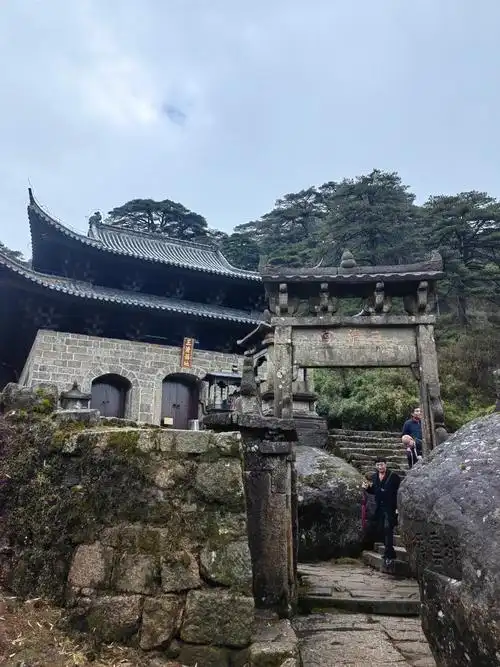
At the center stands the Ming-era Sanqing Palace, around which the entire complex unfolds according to dual Bagua configurations—both the "Earlier Heaven" and "Later Heaven" patterns revered in Taoist metaphysics. The Dragon-Tiger Hall mirrors yin and yang on either flank, while the Wind-Thunder Tower, Cinnabar Well, and Flying Immortal Terrace step down the mountainside in deliberate sequence. Every structure is hewn from locally quarried granite, the rough masonry recalling both the austere Cyclopean walls of Mycenae and the rugged simplicity of medieval Norwegian mountain chapels. There are no nails, no gilded ornament—just stone, sky, and intent.
What makes Sanqing Blessed Land exceptional among world religious sites is its remarkably intact Taoist building ensemble—a complete philosophical diagram made habitable. Stone inscriptions, poetic couplets, and the very orientation of halls encode passages from the Dao De Jing and reflect the Taoist view of cosmic harmony. Scholars liken it to a stone scripture, where every roof ridge and courtyard placement carries doctrinal meaning. For travelers interested in comparative religion, it offers what few Western sanctuaries can: an entire sacred landscape where architecture itself becomes theology, and where one can still sense sixteen centuries of unbroken spiritual practice.
Reaching the site rewards planning. Take a high-speed train to Yushan South Station, then transfer to the Jinsha Visitor Center. The newly opened Fenshui Cable Car (2025) whisks visitors directly to the core area, sparing the punishing three-to-four-hour climb. Tickets must be bundled with Mount Sanqing's main entrance fee and cable car pass. Mountain weather changes quickly—bring waterproof hiking boots and a windbreaker even in summer. Foreign visitors need a passport for real-name registration and should book Chinese or English guided tours three to five days ahead, since most signage is in Chinese only.
The optimal visit falls in early summer mornings or right after rain, when sunrise ignites the cloud sea and rime frosts lace the granite pinnacles with silver. Link Sanqing Blessed Land with the South Qing Garden—whose grotesque rock formations rival Zhangjiajie—and the West Coast Cliff Walk into a rewarding two-day "Seek the Dao, Admire Peaks, Watch Clouds" itinerary. Avoid August's crowded peak hours by arriving before 9 a.m. or after 3:30 p.m. As in any active sanctuary, observe quiet reverence, never step on temple thresholds, and refrain from photographing interior deity statues.
Long before Europe's Alpine monasteries sheltered Benedictine and Carthusian contemplatives, Taoist hermits were already retreating into these misty peaks. The site's sacred history began in the 4th century CE, when the famed alchemist Ge Hong came here to refine elixirs of immortality—roughly contemporary with Saint Augustine's ministry in Hippo. Through the Tang, Song, Yuan, and Ming dynasties, successive waves of practitioners enlarged the sanctuary, making it a major stronghold of the Quanzhen and Jingming Taoist schools. Think of it as a Chinese Mount Athos: a remote theological universe where cosmology, scripture, and stone have conversed for sixteen uninterrupted centuries.
At the center stands the Ming-era Sanqing Palace, around which the entire complex unfolds according to dual Bagua configurations—both the "Earlier Heaven" and "Later Heaven" patterns revered in Taoist metaphysics. The Dragon-Tiger Hall mirrors yin and yang on either flank, while the Wind-Thunder Tower, Cinnabar Well, and Flying Immortal Terrace step down the mountainside in deliberate sequence. Every structure is hewn from locally quarried granite, the rough masonry recalling both the austere Cyclopean walls of Mycenae and the rugged simplicity of medieval Norwegian mountain chapels. There are no nails, no gilded ornament—just stone, sky, and intent.
What makes Sanqing Blessed Land exceptional among world religious sites is its remarkably intact Taoist building ensemble—a complete philosophical diagram made habitable. Stone inscriptions, poetic couplets, and the very orientation of halls encode passages from the Dao De Jing and reflect the Taoist view of cosmic harmony. Scholars liken it to a stone scripture, where every roof ridge and courtyard placement carries doctrinal meaning. For travelers interested in comparative religion, it offers what few Western sanctuaries can: an entire sacred landscape where architecture itself becomes theology, and where one can still sense sixteen centuries of unbroken spiritual practice.
Reaching the site rewards planning. Take a high-speed train to Yushan South Station, then transfer to the Jinsha Visitor Center. The newly opened Fenshui Cable Car (2025) whisks visitors directly to the core area, sparing the punishing three-to-four-hour climb. Tickets must be bundled with Mount Sanqing's main entrance fee and cable car pass. Mountain weather changes quickly—bring waterproof hiking boots and a windbreaker even in summer. Foreign visitors need a passport for real-name registration and should book Chinese or English guided tours three to five days ahead, since most signage is in Chinese only.
The optimal visit falls in early summer mornings or right after rain, when sunrise ignites the cloud sea and rime frosts lace the granite pinnacles with silver. Link Sanqing Blessed Land with the South Qing Garden—whose grotesque rock formations rival Zhangjiajie—and the West Coast Cliff Walk into a rewarding two-day "Seek the Dao, Admire Peaks, Watch Clouds" itinerary. Avoid August's crowded peak hours by arriving before 9 a.m. or after 3:30 p.m. As in any active sanctuary, observe quiet reverence, never step on temple thresholds, and refrain from photographing interior deity statues.