Sanhe Ancient Town
⭐ 3.80
Sanhe Ancient Town, Feixi County, Hefei City, Anhui Province, China
 Sanhe Ancient Town traces its origins to the Spring and Autumn period, roughly contemporary with ancient Athens and the early Roman Republic, making it some 2,500 years old. Strategically sited where the Fengle, Hangbu, and Xiaonan rivers converge before flowing into Chaohu Lake, it long served as a vital trading crossroads; its name simply means "Three Rivers." Its modern fame, however, rests largely on the Battle of Sanhe in 1862, a pivotal engagement during the Taiping Rebellion—one of the deadliest civil conflicts in human history, comparable in scale to Europe's Thirty Years' War. Here, Taiping forces annihilated the elite Xiang Army division of General Li Xubin, leaving battlefield relics that still draw history enthusiasts.
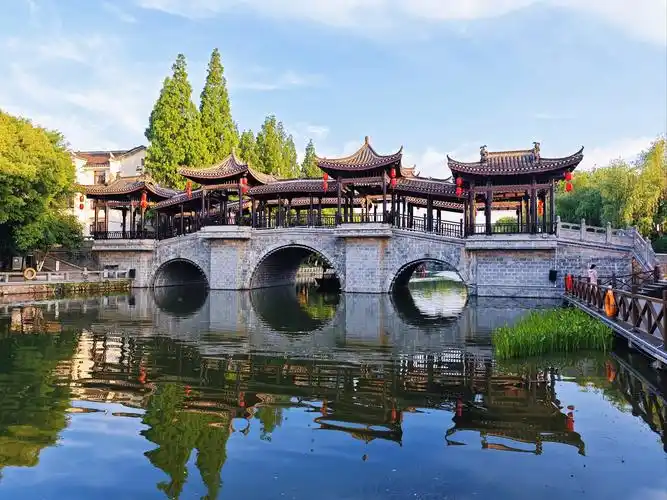
The town's architecture showcases the Hui style, a regional building tradition found across southern Anhui. Whitewashed walls are crowned by distinctive "horse-head" gables—stepped firewall ends designed to slow the spread of fire between timber-roofed homes—a solution as practical as it is elegant. Flagstone lanes along Erlong Street, Guxi Street, and Gunan Street still follow their Ming and Qing layouts, lined with shops whose wares evoke a bygone mercantile era. Stone arch bridges, including the Ming-era Quezhu Covered Bridge and the Qing-era Sanxian Bridge, span the waterways much as medieval humpback bridges cross the canals of Bruges or the streams of rural England.
Sanhe boasts a remarkable roster of former residents. The boyhood home of Yang Zhenning—Nobel Prize-winning physicist and one of the twentieth century's most influential scientists—stands as a modest but evocative stop. Nearby lies the former residence of Sun Liren, the Chinese general who commanded Allied forces in the Burma Campaign against Imperial Japan. The town is also a recognized cradle of Luju opera, a regional theatrical form still performed on the venerable Wannian Stage during festivals. Local specialties such as tea-pressed tofu, crispy rice dumplings fried in glutinous-rice wrappers, and chewy niupi candy are protected as intangible cultural heritage.
After dark, lanterns strung along the riverbanks cast golden reflections on the water, and rowing boats glide past in a scene that photographers cherish. One should note, however, that unlike China's premier water towns—Wuzhen and Zhouzhuang—Sanhe has undergone significant restoration over recent decades, and purists seeking unfiltered authenticity may find its historic fabric somewhat uneven. Still, the everyday rhythms of teahouses and small workshops lend the place a lived-in charm that more polished tourist towns sometimes lack.
Access is refreshingly simple: the streets themselves are free and open around the clock. Individual museums and heritage homes operate on a combined ticket ranging from 45 to 120 RMB, depending on which sites you select. From central Hefei, the drive takes roughly one hour, or visitors can take bus 699 directly to the visitor center just outside the old town. Comfortable non-slip walking shoes are essential, as the smooth flagstones become treacherous when wet—especially during the hot, humid summer monsoon season, when an umbrella should never be left behind.
A half-day suffices to cover the highlights—morning for bridges and old houses, afternoon for the paid museums, and evening for riverside tea and lights—but a full day rewards those who linger. From April 2026, a new electric-boat shuttle along the canals costs just 40 RMB per person, making the night cruise exceptional value. For travelers based in Hefei or passing through Anhui, Sanhe offers a layered glimpse of Chinese history, regional architecture, and riverside life without the crowds of Wuzhen or the remoteness of the deeper Huizhou mountain villages. It is, above all, a place to slow down.
Sanhe Ancient Town traces its origins to the Spring and Autumn period, roughly contemporary with ancient Athens and the early Roman Republic, making it some 2,500 years old. Strategically sited where the Fengle, Hangbu, and Xiaonan rivers converge before flowing into Chaohu Lake, it long served as a vital trading crossroads; its name simply means "Three Rivers." Its modern fame, however, rests largely on the Battle of Sanhe in 1862, a pivotal engagement during the Taiping Rebellion—one of the deadliest civil conflicts in human history, comparable in scale to Europe's Thirty Years' War. Here, Taiping forces annihilated the elite Xiang Army division of General Li Xubin, leaving battlefield relics that still draw history enthusiasts.
The town's architecture showcases the Hui style, a regional building tradition found across southern Anhui. Whitewashed walls are crowned by distinctive "horse-head" gables—stepped firewall ends designed to slow the spread of fire between timber-roofed homes—a solution as practical as it is elegant. Flagstone lanes along Erlong Street, Guxi Street, and Gunan Street still follow their Ming and Qing layouts, lined with shops whose wares evoke a bygone mercantile era. Stone arch bridges, including the Ming-era Quezhu Covered Bridge and the Qing-era Sanxian Bridge, span the waterways much as medieval humpback bridges cross the canals of Bruges or the streams of rural England.
Sanhe boasts a remarkable roster of former residents. The boyhood home of Yang Zhenning—Nobel Prize-winning physicist and one of the twentieth century's most influential scientists—stands as a modest but evocative stop. Nearby lies the former residence of Sun Liren, the Chinese general who commanded Allied forces in the Burma Campaign against Imperial Japan. The town is also a recognized cradle of Luju opera, a regional theatrical form still performed on the venerable Wannian Stage during festivals. Local specialties such as tea-pressed tofu, crispy rice dumplings fried in glutinous-rice wrappers, and chewy niupi candy are protected as intangible cultural heritage.
After dark, lanterns strung along the riverbanks cast golden reflections on the water, and rowing boats glide past in a scene that photographers cherish. One should note, however, that unlike China's premier water towns—Wuzhen and Zhouzhuang—Sanhe has undergone significant restoration over recent decades, and purists seeking unfiltered authenticity may find its historic fabric somewhat uneven. Still, the everyday rhythms of teahouses and small workshops lend the place a lived-in charm that more polished tourist towns sometimes lack.
Access is refreshingly simple: the streets themselves are free and open around the clock. Individual museums and heritage homes operate on a combined ticket ranging from 45 to 120 RMB, depending on which sites you select. From central Hefei, the drive takes roughly one hour, or visitors can take bus 699 directly to the visitor center just outside the old town. Comfortable non-slip walking shoes are essential, as the smooth flagstones become treacherous when wet—especially during the hot, humid summer monsoon season, when an umbrella should never be left behind.
A half-day suffices to cover the highlights—morning for bridges and old houses, afternoon for the paid museums, and evening for riverside tea and lights—but a full day rewards those who linger. From April 2026, a new electric-boat shuttle along the canals costs just 40 RMB per person, making the night cruise exceptional value. For travelers based in Hefei or passing through Anhui, Sanhe offers a layered glimpse of Chinese history, regional architecture, and riverside life without the crowds of Wuzhen or the remoteness of the deeper Huizhou mountain villages. It is, above all, a place to slow down.