Xiaoyaojin Park
⭐ 4.30
Xiaoyaojin Park, Baohe District, Hefei, Anhui Province, China
 Xiaoyaojin Park commemorates one of medieval China's most decisive engagements. In 215 AD, Wei general Zhang Liao, commanding a fraction of the enemy's strength, shattered Sun Quan's 100,000-strong invasion force on the marshy banks of the Fei River crossing. The victory cemented Wei's grip on the Huai region and echoed through Chinese military lore as the quintessential "few against many" triumph—a tactical masterclass historians often place beside Thermopylae and Cannae. The park opened to the public in 1952 as Hefei's first people's park, transforming a blood-soaked battlefield into a green civic sanctuary beloved by generations of local residents.
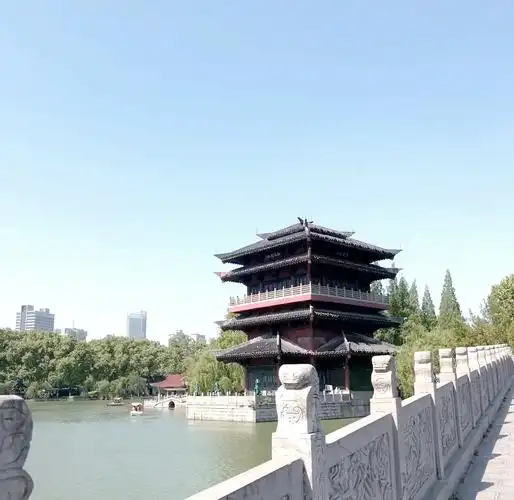
The park's centerpiece is Xiaoyao Pavilion, a 22-meter edifice rising above the lake in sweeping Han-dynasty style with tiered, deep-eaved roofs reminiscent of palace halls in Tang scroll paintings. Inside, a permanent exhibit traces the political tensions and battlefield maneuvers that produced the famous clash. Across the water, the slender Feiqi—"Flying Steed"—Bridge marks the spot where Sun Quan allegedly spurred his horse to escape the slaughter. A dignified bronze of Zhang Liao on horseback anchors the narrative, while a stone-capped cenotaph honors the general who succumbed to illness several years later, far from the battleground that made him immortal.
The lake naturally divides the grounds into two distinct experiences. The eastern half is devoted to family amusements, including a vintage elephant-shaped slide that has charmed Hefei grandparents and children for decades. The western half unfolds as a classical botanical garden with plum-covered hills, peony beds, a bonsai courtyard, and quiet bamboo groves. Sixteen registered heritage trees, some over a century old, shelter understoreys of camellia and magnolia. Seasonal blooms—plum in late winter, peony in spring, lotus in summer, and chrysanthemum in autumn—reward repeat visits and echo the planting traditions of Suzhou's finest scholar gardens.
Three Kingdoms culture pulses through every corner. Each spring the park glows with festival lanterns during Chinese New Year, while the autumn chrysanthemum exhibition draws growers from across Anhui. During the Hui Cuisine Festival, the lakeside fills with sizzling woks and the aroma of stinky mandarin fish, savory eel, and braised pork belly—Hefei's signature dishes. Local enthusiasts of Lu opera, Anhui's regional theatrical form, occasionally perform beside the general's tomb, lending the grounds an unexpectedly intimate folkloric charm.
The park is open daily with no admission charge. Hours run 6:00–22:00 from May through October and 6:30–21:30 from November through April. Reach it via Metro Lines 1 or 2 to Dadongmen Station, Exit H; the South Gate is a 500–800-meter stroll. Buses also serve the "Xiaoyaojin" stop. Some attractions—the Ferris wheel (around 60 yuan), paddle boats (40–50 yuan per hour)—require separate tickets payable by mobile app. Bring WeChat Pay or Alipay; cash is rarely accepted. Exit the West Gate to reach Huaihe Road pedestrian street for dinner.
Few Chinese parks fuse military heritage with such accessible urban leisure. History enthusiasts will find themselves walking across real topography where the Romance of the Three Kingdoms actually played out—comparable in feel to visiting Alesia in France or Thermopylae in Greece, but with a vintage Ferris wheel next door. Families, meanwhile, get a genuinely local slice of Hefei life: paddle boats on the lake, chrysanthemum viewing in autumn, sizzling street food at festival time, and golden-hour strolls along willow-lined paths. It is an ideal half-day stop that rewards both the curious traveler and the casual stroller, and an easy prelude to dinner on nearby Huaihe Road.
Xiaoyaojin Park commemorates one of medieval China's most decisive engagements. In 215 AD, Wei general Zhang Liao, commanding a fraction of the enemy's strength, shattered Sun Quan's 100,000-strong invasion force on the marshy banks of the Fei River crossing. The victory cemented Wei's grip on the Huai region and echoed through Chinese military lore as the quintessential "few against many" triumph—a tactical masterclass historians often place beside Thermopylae and Cannae. The park opened to the public in 1952 as Hefei's first people's park, transforming a blood-soaked battlefield into a green civic sanctuary beloved by generations of local residents.
The park's centerpiece is Xiaoyao Pavilion, a 22-meter edifice rising above the lake in sweeping Han-dynasty style with tiered, deep-eaved roofs reminiscent of palace halls in Tang scroll paintings. Inside, a permanent exhibit traces the political tensions and battlefield maneuvers that produced the famous clash. Across the water, the slender Feiqi—"Flying Steed"—Bridge marks the spot where Sun Quan allegedly spurred his horse to escape the slaughter. A dignified bronze of Zhang Liao on horseback anchors the narrative, while a stone-capped cenotaph honors the general who succumbed to illness several years later, far from the battleground that made him immortal.
The lake naturally divides the grounds into two distinct experiences. The eastern half is devoted to family amusements, including a vintage elephant-shaped slide that has charmed Hefei grandparents and children for decades. The western half unfolds as a classical botanical garden with plum-covered hills, peony beds, a bonsai courtyard, and quiet bamboo groves. Sixteen registered heritage trees, some over a century old, shelter understoreys of camellia and magnolia. Seasonal blooms—plum in late winter, peony in spring, lotus in summer, and chrysanthemum in autumn—reward repeat visits and echo the planting traditions of Suzhou's finest scholar gardens.
Three Kingdoms culture pulses through every corner. Each spring the park glows with festival lanterns during Chinese New Year, while the autumn chrysanthemum exhibition draws growers from across Anhui. During the Hui Cuisine Festival, the lakeside fills with sizzling woks and the aroma of stinky mandarin fish, savory eel, and braised pork belly—Hefei's signature dishes. Local enthusiasts of Lu opera, Anhui's regional theatrical form, occasionally perform beside the general's tomb, lending the grounds an unexpectedly intimate folkloric charm.
The park is open daily with no admission charge. Hours run 6:00–22:00 from May through October and 6:30–21:30 from November through April. Reach it via Metro Lines 1 or 2 to Dadongmen Station, Exit H; the South Gate is a 500–800-meter stroll. Buses also serve the "Xiaoyaojin" stop. Some attractions—the Ferris wheel (around 60 yuan), paddle boats (40–50 yuan per hour)—require separate tickets payable by mobile app. Bring WeChat Pay or Alipay; cash is rarely accepted. Exit the West Gate to reach Huaihe Road pedestrian street for dinner.
Few Chinese parks fuse military heritage with such accessible urban leisure. History enthusiasts will find themselves walking across real topography where the Romance of the Three Kingdoms actually played out—comparable in feel to visiting Alesia in France or Thermopylae in Greece, but with a vintage Ferris wheel next door. Families, meanwhile, get a genuinely local slice of Hefei life: paddle boats on the lake, chrysanthemum viewing in autumn, sizzling street food at festival time, and golden-hour strolls along willow-lined paths. It is an ideal half-day stop that rewards both the curious traveler and the casual stroller, and an easy prelude to dinner on nearby Huaihe Road.