Hefei Li Hongzhang Former Residence Exhibition Hall
⭐ 4.20
Luyang District, Hefei, Anhui Province, China
 Li Hongzhang (1823-1901) ranks among the most consequential Asian statesmen of the nineteenth century, a figure often compared to Otto von Bismarck for his dominant grip on policy during his emperor's reign. A scholar-official who rose through the imperial exams, he built the regional Huai Army that helped crush the Taiping Rebellion, then masterminded the Self-Strengthening Movement - China's first sustained attempt to graft Western technology onto a Confucian state. He founded modern institutions ranging from the China Merchants' Steam Navigation Company to the Jiangnan Arsenal and the Beiyang Fleet, and signed treaties with Russia, Japan and the Western powers that reshaped East Asia. Standing in his family home is, in effect, like walking through the drawing rooms of the men who negotiated with Disraeli's Britain and Meiji Japan.
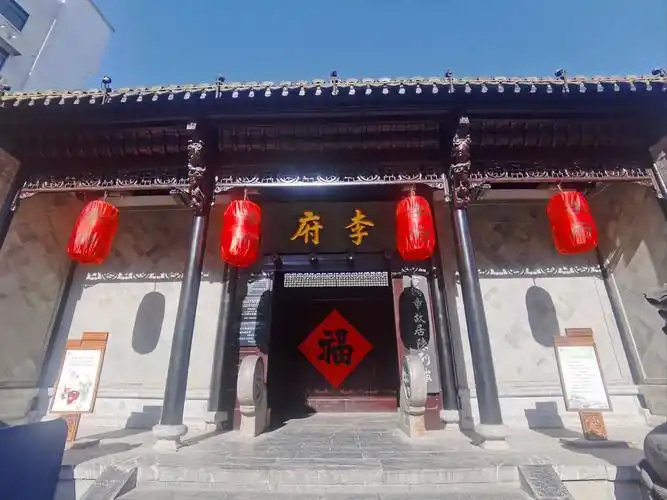
The architecture is the finest surviving example of a late-Qing Jiang-Huai official's residence, blending northern hall construction with southern courtyard intimacy. Five sequential courtyards unfold along a central axis - gate hall, front hall, the lofty Fushou Hall, and the two-storey Zouma corridor gallery - reproducing the strict ceremonial hierarchy of a high-ranking bureaucratic household. Fushou Hall soars nine metres high and is the largest surviving private reception hall of its era in the region, remarkable for its mortise-and-tenon beams assembled entirely without nails. The carved timber galleries, painted in faded reds and greens, are widely regarded as masterpieces of late-Qing woodcraft.
Inside, the permanent exhibitions - "The Life of Li Hongzhang," "Li Hongzhang and the China Merchants' Steamship Company," and "The Huai Army and Modern National Defence" - tackle his career with scholarly frankness, presenting both his modernization achievements and the diplomatic humiliations (including the 1895 Treaty of Shimonoseki after China's defeat by Japan) that have fuelled debate ever since. A rare imperial plaque bestowed by the Guangxu Emperor underscores his standing at court. Bilingual labelling and award-winning guides make the dense material accessible to first-time visitors.
The museum sits at 208 Huaihe Road Pedestrian Street, about 900 metres on foot from Dadongmen Station on Metro Lines 1 and 2. It opens Tuesday to Sunday, 9:00 to 17:00 (last entry 16:30), and is closed on Mondays and Lunar New Year's Eve. Admission is free; foreign visitors should register in advance online or scan a code on site and then present their passport at the staffed entrance. A thorough visit takes roughly ninety minutes, and photography of the exhibits is prohibited, though the courtyards and exterior may be photographed freely.
To savour the experience, plan to arrive shortly after the 9:00 opening or after 15:30 to dodge tour-bus crowds, and allow time afterwards for a stroll down the lantern-lit Huaihe Road pedestrian arcade, famous for its street food, and the adjoining leafy Xiaoyaojin Park - site of a celebrated Three Kingdoms battle - to round out an atmospheric half-day in old Hefei.
This is a refreshingly unsentimental museum that rewards visitors curious about the messy, contested birth of modern China. Where most late-Qing sites either canonize or condemn Li Hongzhang, this one explains him, letting you judge for yourself the man who tried - and partly failed - to drag a four-thousand-year-old empire into the industrial age.
Li Hongzhang (1823-1901) ranks among the most consequential Asian statesmen of the nineteenth century, a figure often compared to Otto von Bismarck for his dominant grip on policy during his emperor's reign. A scholar-official who rose through the imperial exams, he built the regional Huai Army that helped crush the Taiping Rebellion, then masterminded the Self-Strengthening Movement - China's first sustained attempt to graft Western technology onto a Confucian state. He founded modern institutions ranging from the China Merchants' Steam Navigation Company to the Jiangnan Arsenal and the Beiyang Fleet, and signed treaties with Russia, Japan and the Western powers that reshaped East Asia. Standing in his family home is, in effect, like walking through the drawing rooms of the men who negotiated with Disraeli's Britain and Meiji Japan.
The architecture is the finest surviving example of a late-Qing Jiang-Huai official's residence, blending northern hall construction with southern courtyard intimacy. Five sequential courtyards unfold along a central axis - gate hall, front hall, the lofty Fushou Hall, and the two-storey Zouma corridor gallery - reproducing the strict ceremonial hierarchy of a high-ranking bureaucratic household. Fushou Hall soars nine metres high and is the largest surviving private reception hall of its era in the region, remarkable for its mortise-and-tenon beams assembled entirely without nails. The carved timber galleries, painted in faded reds and greens, are widely regarded as masterpieces of late-Qing woodcraft.
Inside, the permanent exhibitions - "The Life of Li Hongzhang," "Li Hongzhang and the China Merchants' Steamship Company," and "The Huai Army and Modern National Defence" - tackle his career with scholarly frankness, presenting both his modernization achievements and the diplomatic humiliations (including the 1895 Treaty of Shimonoseki after China's defeat by Japan) that have fuelled debate ever since. A rare imperial plaque bestowed by the Guangxu Emperor underscores his standing at court. Bilingual labelling and award-winning guides make the dense material accessible to first-time visitors.
The museum sits at 208 Huaihe Road Pedestrian Street, about 900 metres on foot from Dadongmen Station on Metro Lines 1 and 2. It opens Tuesday to Sunday, 9:00 to 17:00 (last entry 16:30), and is closed on Mondays and Lunar New Year's Eve. Admission is free; foreign visitors should register in advance online or scan a code on site and then present their passport at the staffed entrance. A thorough visit takes roughly ninety minutes, and photography of the exhibits is prohibited, though the courtyards and exterior may be photographed freely.
To savour the experience, plan to arrive shortly after the 9:00 opening or after 15:30 to dodge tour-bus crowds, and allow time afterwards for a stroll down the lantern-lit Huaihe Road pedestrian arcade, famous for its street food, and the adjoining leafy Xiaoyaojin Park - site of a celebrated Three Kingdoms battle - to round out an atmospheric half-day in old Hefei.
This is a refreshingly unsentimental museum that rewards visitors curious about the messy, contested birth of modern China. Where most late-Qing sites either canonize or condemn Li Hongzhang, this one explains him, letting you judge for yourself the man who tried - and partly failed - to drag a four-thousand-year-old empire into the industrial age.