Rainbow Village
⭐ 3.80
Rainbow Village, North District, Taichung City, Taiwan Province, China
 Rainbow Village's origins lie in the Cold War era, when Taiwan received substantial US military aid following the 1948 Kuomintang exodus from mainland China. Like post-war housing estates that mushroomed around British and American bases, Taiwan's "jiāncūn" sheltered soldiers and their families. This cluster, "Gancheng Sixth Village," represented a vanishing chapter of twentieth-century military history. When demolition crews arrived in 2008, veteran Huang Yong-fu responded not with protest but with paint. His decision echoes European artivists like Christo, who wrapped the Reichstag, or the naive painters championed by Jean Dubuffet—ordinary people wielding art to defy the bulldozer and preserve living memory.
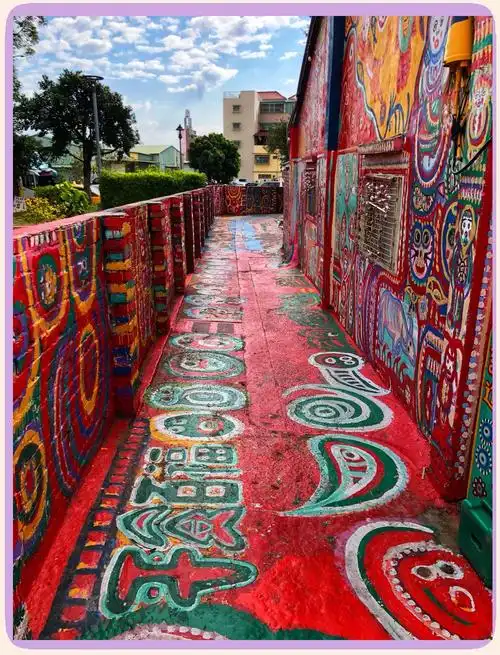
The architectural canvas is modest: a handful of low-slung concrete houses arranged along narrow lanes. What transforms the site is the complete absence of unpainted surface—walls, floors, drain covers, and electrical boxes all become swatches in a saturated tapestry. Stylistically, Rainbow Grandpa's work belongs to the lineage of outsider art: think Grandma Moses' American primitives or Vienna's Hundertwasserhaus, where colorful, slightly crooked lines reject industrial precision in favor of human warmth. Dotted with smiling suns, dragons, and calligraphic characters drawn from Taiwanese folk motifs, the imagery feels closer to a fairy-tale village than a conventional mural park—every corner reveals a fresh tableau.
Rainbow Grandpa died in 2020, but his legacy is maintained through professional conservation and occasional volunteer-led tours. The site has become a touchstone in debates about preservation in rapidly modernizing East Asia, paralleling how Berlin's Wall fragments serve as memorials to a divided past. More than a tourist draw, Rainbow Village demonstrates how grassroots creativity can rewrite urban planning decisions—one elderly man's brushstrokes preserved not just buildings but a way of life. For visitors interested in how individual actions shape collective memory, the village offers a quietly moving case study in the democratic potential of public art.
Rainbow Village sits in Taichung's Nantun District at No. 25, Lane 56, Chun'an Road, a short walk from Lingdong University of Science and Technology. From Taichung Railway Station, bus route 27 drops visitors at the university stop, with the entrance roughly five minutes on foot. Drivers can simply enter "Rainbow Village" into their GPS. Admission is free, and the site is generally accessible daily between 8:00 and 18:00, though some sources suggest Monday closures—checking ahead is wise. The compact core takes only 20 to 40 minutes to explore, making it an easy addition to a Taichung itinerary alongside the National Museum of Natural Science.
To experience Rainbow Village at its photographic best, arrive between 9:00 and 11:00 when morning light softens and crowds thin. Wear white, pastel yellow, or pale blue to harmonize with the painted surfaces. Because the lanes remain partially residential, move quietly, avoid touching artwork, and respect residents' privacy—there is no café or restroom on site. Summer visitors should bring sun protection and water, as shade is limited. Ultimately, Rainbow Village rewards travelers seeking the human story behind the photograph: a testament to how an ordinary retiree, armed with cheap paint and inexhaustible imagination, turned a demolition notice into one of Taiwan's most joyful cultural landmarks.
Rainbow Village's origins lie in the Cold War era, when Taiwan received substantial US military aid following the 1948 Kuomintang exodus from mainland China. Like post-war housing estates that mushroomed around British and American bases, Taiwan's "jiāncūn" sheltered soldiers and their families. This cluster, "Gancheng Sixth Village," represented a vanishing chapter of twentieth-century military history. When demolition crews arrived in 2008, veteran Huang Yong-fu responded not with protest but with paint. His decision echoes European artivists like Christo, who wrapped the Reichstag, or the naive painters championed by Jean Dubuffet—ordinary people wielding art to defy the bulldozer and preserve living memory.
The architectural canvas is modest: a handful of low-slung concrete houses arranged along narrow lanes. What transforms the site is the complete absence of unpainted surface—walls, floors, drain covers, and electrical boxes all become swatches in a saturated tapestry. Stylistically, Rainbow Grandpa's work belongs to the lineage of outsider art: think Grandma Moses' American primitives or Vienna's Hundertwasserhaus, where colorful, slightly crooked lines reject industrial precision in favor of human warmth. Dotted with smiling suns, dragons, and calligraphic characters drawn from Taiwanese folk motifs, the imagery feels closer to a fairy-tale village than a conventional mural park—every corner reveals a fresh tableau.
Rainbow Grandpa died in 2020, but his legacy is maintained through professional conservation and occasional volunteer-led tours. The site has become a touchstone in debates about preservation in rapidly modernizing East Asia, paralleling how Berlin's Wall fragments serve as memorials to a divided past. More than a tourist draw, Rainbow Village demonstrates how grassroots creativity can rewrite urban planning decisions—one elderly man's brushstrokes preserved not just buildings but a way of life. For visitors interested in how individual actions shape collective memory, the village offers a quietly moving case study in the democratic potential of public art.
Rainbow Village sits in Taichung's Nantun District at No. 25, Lane 56, Chun'an Road, a short walk from Lingdong University of Science and Technology. From Taichung Railway Station, bus route 27 drops visitors at the university stop, with the entrance roughly five minutes on foot. Drivers can simply enter "Rainbow Village" into their GPS. Admission is free, and the site is generally accessible daily between 8:00 and 18:00, though some sources suggest Monday closures—checking ahead is wise. The compact core takes only 20 to 40 minutes to explore, making it an easy addition to a Taichung itinerary alongside the National Museum of Natural Science.
To experience Rainbow Village at its photographic best, arrive between 9:00 and 11:00 when morning light softens and crowds thin. Wear white, pastel yellow, or pale blue to harmonize with the painted surfaces. Because the lanes remain partially residential, move quietly, avoid touching artwork, and respect residents' privacy—there is no café or restroom on site. Summer visitors should bring sun protection and water, as shade is limited. Ultimately, Rainbow Village rewards travelers seeking the human story behind the photograph: a testament to how an ordinary retiree, armed with cheap paint and inexhaustible imagination, turned a demolition notice into one of Taiwan's most joyful cultural landmarks.