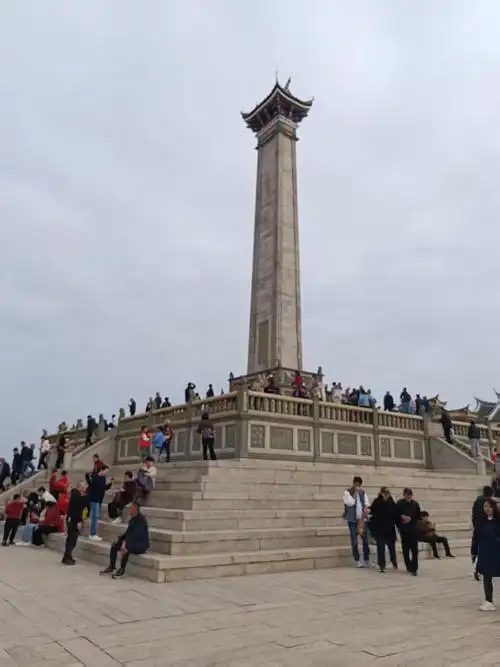
Ao Garden's origins lie in the early 1950s, when Tan Kah Kee—often called the "Rockefeller of Southeast Asia" for his rubber empire and philanthropy—personally selected the site and oversaw a decade of construction. Dedicated to commemorating the liberation of Jimei and honoring his hometown, the complex embodies Tan's lifelong mission of "saving the nation through education," a philosophy he pursued across his 1,000-plus schools from Singapore to Fujian. The result transcends typical garden design, becoming a powerful emblem of overseas Chinese patriotism during the Cold War era.
The architecture's most distinctive feature is the celebrated "Jiageng style"—a visual metaphor often described as "wearing a Western suit with a bamboo hat." Crimson bricks and white granite walls meet green glazed-tile roofs, while European colonnades blend with Nanyang decorative motifs. The 28-meter Liberation Monument features Mao Zedong's calligraphy on its front face and Tan's own commemorative inscription on the reverse, a dual-authorship arrangement virtually unmatched among China's memorial sites. Its bas-reliefs depict moments like the founding of the People's Republic, lending genuine historical gravitas.
The 100-meter stone corridor is the soul of the garden, earning it the nickname "open-air encyclopedia of stone sculpture." Over 650 panels employ techniques ranging from high relief to shadow carving, depicting Chinese mythology, modern history, overseas Chinese life, and portraits of world luminaries from Einstein to Tagore. Nearby, Tan's mausoleum faces the sea in traditional Fujianese turtle-shell form, ringed by 15 reliefs chronicling his journey from impoverished immigrant to industrial titan and education champion—a narrative echoing the self-made philanthropy of Carnegie's Scottish legacy.
Admission is permanently free with no reservation required. Summer hours (June–September) run 08:00–18:00; winter hours 08:00–17:30. A standard visit takes 40–60 minutes, but enthusiasts should budget 1.5–2 hours to absorb the sculptural narratives. From Metro Line 1's Jimei School Village Station, it's a brief walk to the entrance.
For a richer half-day itinerary, combine Ao Garden with the adjacent Tan Kah Kee Memorial Hall, the Dragon Boat Pool, and the historic Jimei School Village—a campus founded by Tan that parallels utopian educational communities like Finland's folk academy tradition. Before visiting, reading briefly on Tan's remarkable life will unlock the deeper meaning behind each carved panel. Summer offers little shade along the seawall, so bring sunscreen and water; weekdays outside Chinese holidays provide the most contemplative experience.