Kunlun Pass Historic Site
⭐ 4.50
Kunlun Pass, Binyang County, Nanning City, Guangxi Zhuang Autonomous Region, China
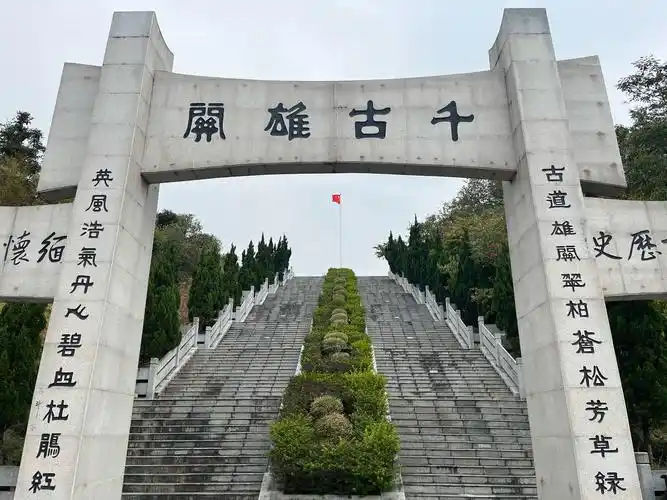 Kunlun Pass has guarded southern China's frontier since the Qin and Han dynasties, earning the nickname "Southern Natural Barrier" much as the Brenner Pass once controlled Alpine crossings between empires. Nine major battles were fought here over the centuries. The most legendary occurred in 1053, when Song Dynasty general Di Qing famously "captured Kunlun in three drumbeats" during the Lantern Festival—a swift victory still celebrated in Chinese literature. The site's most recent and celebrated engagement came in December 1939, when Chinese forces annihilated over 4,000 Japanese troops and killed Major General Nakamura Masao, commander of the Imperial Army's 5th Division. This made Kunlun Pass a Chinese counterpart to Allied victories like Midway or El Alamein—a rare, decisive success in an otherwise devastating war.
The memorial complex divides into a commemorative zone and a battlefield-preservation zone. Crowning the summit stands a granite memorial tower reached by climbing 331 stone steps—each step a physical metaphor for the sacrifices made. The tower bears handwritten inscriptions from Chiang Kai-shek and fourteen other high-ranking military and political officials of the era, an extraordinary concentration of period calligraphy rarely found at any single Chinese monument. Lower slopes feature twin memorial archways, engraved stele pavilions recording battle details, the martyrs' communal tomb, and remnants of the ancient pass fortifications. Together, these elements create a layered pilgrimage route reminiscent of Europe's great military cemeteries such as Verdun or Tyne Cot.
At the heart of the visitor experience lies the Kunlun Pass Battle Museum, Guangxi's first museum dedicated to the anti-Japanese war. Designed by Dai Futong, a member of the Chinese Academy of Engineering, the building complements its surrounding landscape while housing nearly 1,000 artifacts, documents, and immersive battle reconstructions. Five exhibition halls trace the broader Chinese war effort, focus on the Kunlun campaign itself, document Guangxi's wartime contribution, and honor fallen heroes. For Western visitors accustomed to London's Imperial War Museums or New Orleans' National WWII Museum, this smaller but deeply personal collection offers an illuminating Pacific theater perspective often overlooked in mainstream Western WWII narratives.
Designated a nationally protected heritage site in 2006 and rated a national 4A scenic area, Kunlun Pass serves as both an official patriotic education base and an active memorial. Annual public commemorations are held on Qingming Festival and on Victory over Japan Day. The meticulously preserved battlefield terrain, stone inscriptions, and martyrs' cemetery carry forward a collective memory that resonates strongly with veterans' families and visitors tracing China's twentieth-century struggles. For international travelers, the site provides context rarely found in mainstream Western histories—an essential piece of the broader Allied war story in Asia.
Kunlun Pass lies approximately 50–56 kilometers northeast of downtown Nanning, with no direct metro connection. Most visitors arrive by car or take a direct shuttle from Nanning East Railway Station, a journey of roughly one hour. The site is open daily from 09:00 to 17:00, with last museum entry at 16:30; the museum closes Mondays except during public holidays. Admission is free year-round, but this is an active memorial—quiet, respectful behavior is expected. Comfortable non-slip walking shoes are essential for the tower climb, along with water and sun protection for the exposed mountain paths.
The recommended two-hour route follows a logical north-to-south arc: begin at the North Gate, pass the Weapons Plaza, explore the Battle Museum, then ascend via the ancient pass ruins to the summit memorial tower, finishing at the South Gate. This sequence mirrors how pilgrims traditionally approach sacred Chinese sites—moving from worldly history toward transcendent remembrance. History enthusiasts, educational tour groups, and anyone interested in the Pacific theater of WWII will find Kunlun Pass profoundly moving. Even casual travelers seeking deeper engagement with contemporary China will leave with a richer understanding of the country's modern historical consciousness and the enduring weight of remembrance.
Kunlun Pass has guarded southern China's frontier since the Qin and Han dynasties, earning the nickname "Southern Natural Barrier" much as the Brenner Pass once controlled Alpine crossings between empires. Nine major battles were fought here over the centuries. The most legendary occurred in 1053, when Song Dynasty general Di Qing famously "captured Kunlun in three drumbeats" during the Lantern Festival—a swift victory still celebrated in Chinese literature. The site's most recent and celebrated engagement came in December 1939, when Chinese forces annihilated over 4,000 Japanese troops and killed Major General Nakamura Masao, commander of the Imperial Army's 5th Division. This made Kunlun Pass a Chinese counterpart to Allied victories like Midway or El Alamein—a rare, decisive success in an otherwise devastating war.
The memorial complex divides into a commemorative zone and a battlefield-preservation zone. Crowning the summit stands a granite memorial tower reached by climbing 331 stone steps—each step a physical metaphor for the sacrifices made. The tower bears handwritten inscriptions from Chiang Kai-shek and fourteen other high-ranking military and political officials of the era, an extraordinary concentration of period calligraphy rarely found at any single Chinese monument. Lower slopes feature twin memorial archways, engraved stele pavilions recording battle details, the martyrs' communal tomb, and remnants of the ancient pass fortifications. Together, these elements create a layered pilgrimage route reminiscent of Europe's great military cemeteries such as Verdun or Tyne Cot.
At the heart of the visitor experience lies the Kunlun Pass Battle Museum, Guangxi's first museum dedicated to the anti-Japanese war. Designed by Dai Futong, a member of the Chinese Academy of Engineering, the building complements its surrounding landscape while housing nearly 1,000 artifacts, documents, and immersive battle reconstructions. Five exhibition halls trace the broader Chinese war effort, focus on the Kunlun campaign itself, document Guangxi's wartime contribution, and honor fallen heroes. For Western visitors accustomed to London's Imperial War Museums or New Orleans' National WWII Museum, this smaller but deeply personal collection offers an illuminating Pacific theater perspective often overlooked in mainstream Western WWII narratives.
Designated a nationally protected heritage site in 2006 and rated a national 4A scenic area, Kunlun Pass serves as both an official patriotic education base and an active memorial. Annual public commemorations are held on Qingming Festival and on Victory over Japan Day. The meticulously preserved battlefield terrain, stone inscriptions, and martyrs' cemetery carry forward a collective memory that resonates strongly with veterans' families and visitors tracing China's twentieth-century struggles. For international travelers, the site provides context rarely found in mainstream Western histories—an essential piece of the broader Allied war story in Asia.
Kunlun Pass lies approximately 50–56 kilometers northeast of downtown Nanning, with no direct metro connection. Most visitors arrive by car or take a direct shuttle from Nanning East Railway Station, a journey of roughly one hour. The site is open daily from 09:00 to 17:00, with last museum entry at 16:30; the museum closes Mondays except during public holidays. Admission is free year-round, but this is an active memorial—quiet, respectful behavior is expected. Comfortable non-slip walking shoes are essential for the tower climb, along with water and sun protection for the exposed mountain paths.
The recommended two-hour route follows a logical north-to-south arc: begin at the North Gate, pass the Weapons Plaza, explore the Battle Museum, then ascend via the ancient pass ruins to the summit memorial tower, finishing at the South Gate. This sequence mirrors how pilgrims traditionally approach sacred Chinese sites—moving from worldly history toward transcendent remembrance. History enthusiasts, educational tour groups, and anyone interested in the Pacific theater of WWII will find Kunlun Pass profoundly moving. Even casual travelers seeking deeper engagement with contemporary China will leave with a richer understanding of the country's modern historical consciousness and the enduring weight of remembrance.