Zhongshan Road Pedestrian Street
⭐ 4.20
Zhongshan Road, Qingxiu District, Nanning City, Guangxi Zhuang Autonomous Region, China
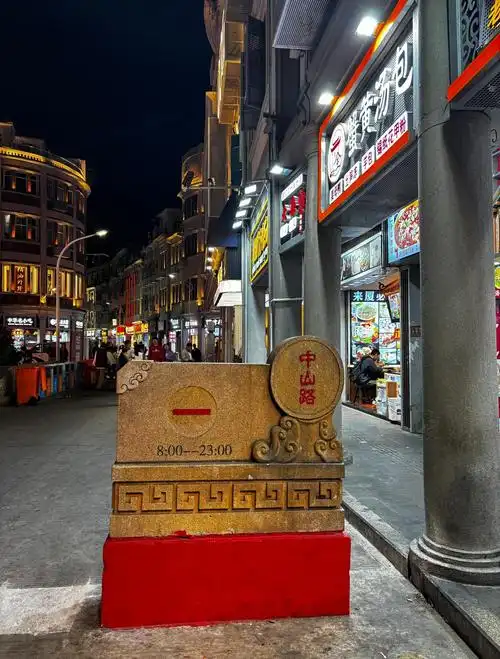 Nanning's Zhongshan Road traces its lineage to the Yongzhou trading port that flourished along the Yong River from the Ming dynasty onward, when the city served as a southern gateway linking inland Guangxi with the maritime Silk Road. Think of it as Nanning's answer to Lisbon's Alfama or Havana's Malecón—a district where centuries of commerce, migration, and street culture layered themselves onto a single thoroughfare. After decades as Guangxi's most legendary night market, the street was closed for comprehensive renewal in the early 2020s and ceremoniously relaunched on February 6, 2026, under a "restore as it was" philosophy that preserves authentic patina while introducing modern visitor comforts.
The 5.51-hectare district showcases a fully restored ensemble of Lingnan arcade buildings, the iconic covered-walkway style found across southern China but particularly expressive in Guangxi. Green-brick facades, carved wooden window lattices, and rhythmic rows of slender columns evoke the merchant quarters of late-19th-century treaty ports like Guangzhou's Shamian Island or even Marseille's Vieux-Port. A faithful reconstruction of a Ming-dynasty bell-and-drum tower now anchors the district, recalling the civic clocktowers of Renaissance Florence that once punctuated European market squares and giving visitors a recognizable orientation point amid the bustling lanes.
Zhongshan Road dovetails with the adjacent Sanjie Liangxiang heritage quarter and the riverside Shui Street to form Guangxi's largest pedestrian cultural zone, an immersive tapestry where Guangxi Cantonese architecture, Zhuang minority traditions, and contemporary street art intersect. The lane functions as a living stage: regular free performances of *Yong* opera, a 300-year-old local variant of Cantonese theater, share the spotlight with buskers, lion dancers, and craft demonstrations. This is not a museum piece but a working neighborhood where elderly tea drinkers, students, and tourists share the same stone-paved courtyards—an atmosphere reminiscent of Istanbul's Grand Bazaar at its most authentic.
The pedestrian street runs north–south from Minzu Avenue to Taoyuan Road, with full-time vehicle restrictions ensuring safe, leisurely strolling. The most convenient approach is via Metro Line 1 to Chaoyang Square Station, whose exits deliver visitors directly into the heart of the district. The street is open 24 hours, but plan your arrival after 6 p.m. when neon signs flicker on, lanterns illuminate the arcades, and the famous night market comes alive. Mobile payment via WeChat Pay and Alipay is accepted at virtually every stall, though carrying a small amount of cash and a translation app is wise for traditional vendors.
For travelers seeking China's regional street culture beyond Shanghai and Chengdu, Zhongshan Road offers an unmatched sensory immersion. Sample signature Guangxi dishes—fiery *laoyou* rice noodles, tangy pickled fruits known as *suan'e*, and honey-glazed skewers—while wandering beneath arcades older than most American downtowns. Pair the visit with a morning exploration of the neighboring Sanjie Liangxiang lanes for a fuller picture of Guangxi's architectural heritage. Zhongshan Road is, in short, the easiest place in southwestern China to taste history one bite at a time.
Nanning's Zhongshan Road traces its lineage to the Yongzhou trading port that flourished along the Yong River from the Ming dynasty onward, when the city served as a southern gateway linking inland Guangxi with the maritime Silk Road. Think of it as Nanning's answer to Lisbon's Alfama or Havana's Malecón—a district where centuries of commerce, migration, and street culture layered themselves onto a single thoroughfare. After decades as Guangxi's most legendary night market, the street was closed for comprehensive renewal in the early 2020s and ceremoniously relaunched on February 6, 2026, under a "restore as it was" philosophy that preserves authentic patina while introducing modern visitor comforts.
The 5.51-hectare district showcases a fully restored ensemble of Lingnan arcade buildings, the iconic covered-walkway style found across southern China but particularly expressive in Guangxi. Green-brick facades, carved wooden window lattices, and rhythmic rows of slender columns evoke the merchant quarters of late-19th-century treaty ports like Guangzhou's Shamian Island or even Marseille's Vieux-Port. A faithful reconstruction of a Ming-dynasty bell-and-drum tower now anchors the district, recalling the civic clocktowers of Renaissance Florence that once punctuated European market squares and giving visitors a recognizable orientation point amid the bustling lanes.
Zhongshan Road dovetails with the adjacent Sanjie Liangxiang heritage quarter and the riverside Shui Street to form Guangxi's largest pedestrian cultural zone, an immersive tapestry where Guangxi Cantonese architecture, Zhuang minority traditions, and contemporary street art intersect. The lane functions as a living stage: regular free performances of *Yong* opera, a 300-year-old local variant of Cantonese theater, share the spotlight with buskers, lion dancers, and craft demonstrations. This is not a museum piece but a working neighborhood where elderly tea drinkers, students, and tourists share the same stone-paved courtyards—an atmosphere reminiscent of Istanbul's Grand Bazaar at its most authentic.
The pedestrian street runs north–south from Minzu Avenue to Taoyuan Road, with full-time vehicle restrictions ensuring safe, leisurely strolling. The most convenient approach is via Metro Line 1 to Chaoyang Square Station, whose exits deliver visitors directly into the heart of the district. The street is open 24 hours, but plan your arrival after 6 p.m. when neon signs flicker on, lanterns illuminate the arcades, and the famous night market comes alive. Mobile payment via WeChat Pay and Alipay is accepted at virtually every stall, though carrying a small amount of cash and a translation app is wise for traditional vendors.
For travelers seeking China's regional street culture beyond Shanghai and Chengdu, Zhongshan Road offers an unmatched sensory immersion. Sample signature Guangxi dishes—fiery *laoyou* rice noodles, tangy pickled fruits known as *suan'e*, and honey-glazed skewers—while wandering beneath arcades older than most American downtowns. Pair the visit with a morning exploration of the neighboring Sanjie Liangxiang lanes for a fuller picture of Guangxi's architectural heritage. Zhongshan Road is, in short, the easiest place in southwestern China to taste history one bite at a time.