Guangxi Museum of Nationalities Scenic Area
⭐ 4.50
No. 11, Qinghuan Road, Qingxiu District, Nanning, Guangxi Zhuang Autonomous Region, China
 Guangxi's bronze drum tradition spans more than two millennia, predating the Roman Empire and echoing the ritual metalwork of Bronze Age Europe. The museum's centerpiece—a colossal cloud-and-thunder patterned drum—dwarfs any bronze artifact in Western collections, fitting for a culture that elevated metalwork to sacred status. Lingnan drums once summoned communities for worship, war, and harvest, much like medieval European church bells gathered the faithful. The "Sound of Drums Through Time" exhibition charts this continuity, displaying drums from the Warring States era through the Qing dynasty alongside ceremonial vessels that reveal a metallurgical heritage largely unknown beyond Asia's borders.
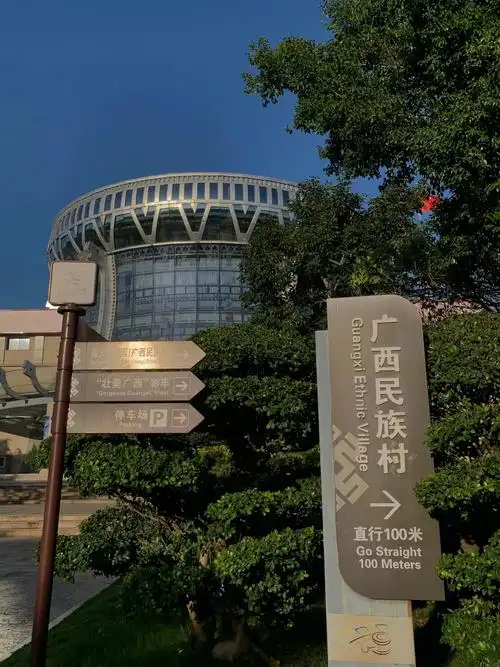
The building itself, completed in 2008, draws direct inspiration from the Zhuang bronze drum, its rounded silhouette crowned with a drum-like roof that announces its purpose from a distance. Much like Frank Lloyd Wright's Guggenheim flows outward from a central concept, the museum's form spirals from the very artifact it celebrates. Architects blended the stilted ganlan building tradition—comparable in spirit to Alpine chalets—with sleek modern museum functionality, creating a structure that bridges heritage and contemporary design. Wide plazas, shaded courtyards, and mountain views give the complex the feel of a cultural retreat rather than a sterile institution.
Beyond bronze, the museum safeguards the living heritage of Guangxi's twelve indigenous peoples, including the Zhuang, Yao, Miao, Dong, and Jing. The "Five Colors of Bagui" gallery immerses visitors in their festivals, costumes, and daily life—a vivid counterpart to Paris's Musée du quai Branly, but rooted firmly in southern Chinese reality. Masterpieces of textile artistry include shimmering Zhuang brocades woven on ancient looms and elaborate Yao silver headdresses rivaling the filigree of Etruscan goldsmiths. A dedicated Zhuang Culture exhibition, rich with embroidered baby carriers, wedding attire, and ritual objects, brings these often-overlooked communities vividly into focus.
Just outside the main halls, an open-air ethnographic park climbs the lower slopes of Qingxiu Mountain, showcasing full-scale reconstructions of regional architecture. A gracefully arched Dong wind-and-rain bridge spans a quiet stream, recalling the covered bridges of medieval Europe, while traditional Zhuang stilt houses stand sentinel among the trees. Visitors can climb inside many dwellings, examining construction techniques and learning how climate shaped vernacular building across southern China. This atmospheric outdoor extension—rare among Chinese museums—turns a simple visit into a half-day walking tour through forested landscape.
Admission is free, though visitors should register in advance with a passport or ID via the museum's official WeChat account or through popular Chinese booking apps. The museum opens Tuesday through Sunday from 9:30 a.m. to 5:00 p.m., closing on Mondays. Free parking is available on-site, and drivers can navigate directly to the entrance. Plan for two and a half to three and a half hours inside, especially if joining a free guided tour or renting the bilingual audio guide. Bring mosquito repellent for the outdoor exhibits and consider pairing your visit with the adjacent Qingxiu Mountain scenic area for a rewarding day of culture and nature.
For Western travelers venturing beyond Beijing's Forbidden City or Shanghai's Bund, this museum offers something genuinely rare: an unhurried encounter with the diversity that defines modern China. Few places make the country's ethnic mosaic so accessible, tangible, and aesthetically rewarding. Air-conditioned galleries provide welcome relief during Nanning's steamy summers, while the airy mountain setting rewards those who linger. Whether you collect world cultures, study ancient metallurgy, or simply seek a richer understanding of China beyond the headlines, the Guangxi National Museum rewards curiosity with discovery.
Guangxi's bronze drum tradition spans more than two millennia, predating the Roman Empire and echoing the ritual metalwork of Bronze Age Europe. The museum's centerpiece—a colossal cloud-and-thunder patterned drum—dwarfs any bronze artifact in Western collections, fitting for a culture that elevated metalwork to sacred status. Lingnan drums once summoned communities for worship, war, and harvest, much like medieval European church bells gathered the faithful. The "Sound of Drums Through Time" exhibition charts this continuity, displaying drums from the Warring States era through the Qing dynasty alongside ceremonial vessels that reveal a metallurgical heritage largely unknown beyond Asia's borders.
The building itself, completed in 2008, draws direct inspiration from the Zhuang bronze drum, its rounded silhouette crowned with a drum-like roof that announces its purpose from a distance. Much like Frank Lloyd Wright's Guggenheim flows outward from a central concept, the museum's form spirals from the very artifact it celebrates. Architects blended the stilted ganlan building tradition—comparable in spirit to Alpine chalets—with sleek modern museum functionality, creating a structure that bridges heritage and contemporary design. Wide plazas, shaded courtyards, and mountain views give the complex the feel of a cultural retreat rather than a sterile institution.
Beyond bronze, the museum safeguards the living heritage of Guangxi's twelve indigenous peoples, including the Zhuang, Yao, Miao, Dong, and Jing. The "Five Colors of Bagui" gallery immerses visitors in their festivals, costumes, and daily life—a vivid counterpart to Paris's Musée du quai Branly, but rooted firmly in southern Chinese reality. Masterpieces of textile artistry include shimmering Zhuang brocades woven on ancient looms and elaborate Yao silver headdresses rivaling the filigree of Etruscan goldsmiths. A dedicated Zhuang Culture exhibition, rich with embroidered baby carriers, wedding attire, and ritual objects, brings these often-overlooked communities vividly into focus.
Just outside the main halls, an open-air ethnographic park climbs the lower slopes of Qingxiu Mountain, showcasing full-scale reconstructions of regional architecture. A gracefully arched Dong wind-and-rain bridge spans a quiet stream, recalling the covered bridges of medieval Europe, while traditional Zhuang stilt houses stand sentinel among the trees. Visitors can climb inside many dwellings, examining construction techniques and learning how climate shaped vernacular building across southern China. This atmospheric outdoor extension—rare among Chinese museums—turns a simple visit into a half-day walking tour through forested landscape.
Admission is free, though visitors should register in advance with a passport or ID via the museum's official WeChat account or through popular Chinese booking apps. The museum opens Tuesday through Sunday from 9:30 a.m. to 5:00 p.m., closing on Mondays. Free parking is available on-site, and drivers can navigate directly to the entrance. Plan for two and a half to three and a half hours inside, especially if joining a free guided tour or renting the bilingual audio guide. Bring mosquito repellent for the outdoor exhibits and consider pairing your visit with the adjacent Qingxiu Mountain scenic area for a rewarding day of culture and nature.
For Western travelers venturing beyond Beijing's Forbidden City or Shanghai's Bund, this museum offers something genuinely rare: an unhurried encounter with the diversity that defines modern China. Few places make the country's ethnic mosaic so accessible, tangible, and aesthetically rewarding. Air-conditioned galleries provide welcome relief during Nanning's steamy summers, while the airy mountain setting rewards those who linger. Whether you collect world cultures, study ancient metallurgy, or simply seek a richer understanding of China beyond the headlines, the Guangxi National Museum rewards curiosity with discovery.