Yellow River Mother Sculpture
⭐ 3.80
Yellow River Mother Sculpture, Chengguan District, Lanzhou City, Gansu Province, China
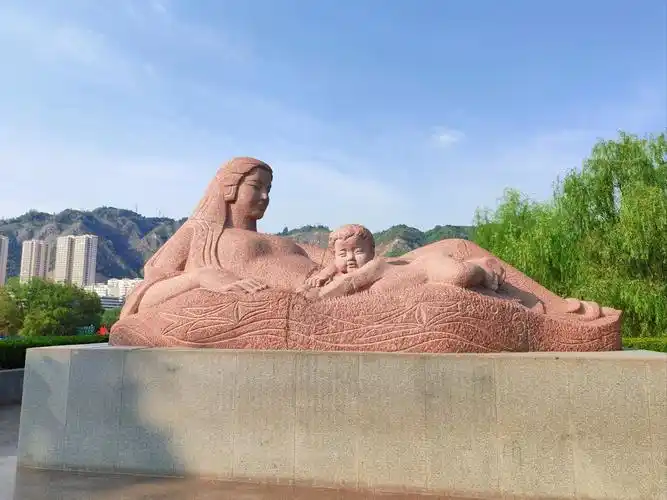 Carved in 1986 during the opening chapter of China's reform era, the Yellow River Mother Sculpture emerged when sculptor He E, one of China's foremost female artists, sought to give tangible form to the nation's deepest geographic metaphor. It won the inaugural National Urban Sculpture Excellence Award and was elevated to a Gansu Provincial Cultural Relic in 2016. To appreciate its emotional pull for visitors from abroad, consider this: while Bernini's fountains capture Rome's baroque grandeur, this monument channels something more elemental—a continent-spanning river that, like the Nile for Egypt or the Tigris for Mesopotamia, cradled an entire civilization. The Yellow River, the world's sixth-longest, gave birth to Chinese society some 5,000 years ago.
The sculpture itself is a masterwork of restraint. Fashioned from a single block of red granite, it measures 6 meters long and 2.6 meters high, with the mother rendered in smooth, flowing lines that balance feminine grace with quiet strength. The infant, head tilted skyward, embodies hope and continuity. Surrounding the figures, the pedestal carries fish and wave motifs borrowed from Majiayao and Dadiwan Neolithic pottery—patterns roughly contemporaneous with the megaliths of Stonehenge or the early cities of Crete. This fusion of primordial symbolism with modernist abstraction gives the work a layered resonance, much as the Parthenon Marbles link ancient ritual to classical aesthetics.
At its core, the monument operates on a simple but universal equation: mother equals river, child equals people. The flowing waves symbolize the Yellow River's relentless course, while the fish—a traditional emblem of abundance in Chinese culture—wish prosperity upon the land. Together with the maternal figure, they compose what locals call a "visual epic" of civilizational origins, fertility, and national resilience. Few riverside statues worldwide manage such directness; you might compare its emotional clarity to Copenhagen's Little Mermaid, though the message here is continental in scope rather than folkloric.
The sculpture is conveniently located in Lanzhou's Qilihe District, along the middle stretch of Binhe Road beside Xiaoxihu Park. Reaching it is straightforward: take Metro Line 1 to Xiaoxihu Station (about a 5–8 minute walk), or ride bus 25 or 142 to the Yellow River Mother stop. Admission is free, with no tickets or reservations required, and the site is open 24 hours a day. Most photographers prefer the golden hour before sunset, when the setting sun ignites the red granite, while evening visitors enjoy the warm glow of floodlights reflected against the river's dark current and the distant rumble of the rapids.
For a fuller experience, weave the sculpture into a riverside "Citywalk" along Lanzhou's celebrated Yellow River Scenic Corridor. From the monument, it's a short 300-meter stroll east to the Waterwheel Exhibition Garden, where you can still see the ancient wooden noria wheels that once irrigated the valley—ingenious devices predating similar Mediterranean hydraulic systems. Continue onward to Zhongshan Bridge, the so-called "First Bridge over the Yellow River," a handsome iron span completed in 1909 by German engineers, comparable in charm to Prague's Charles Bridge though spanning a far mightier river. Cap the day with tea by the river at the foot of White Pagoda Mountain, or brave a ride on a traditional sheepskin raft—a craft listed as national intangible heritage—for a visceral taste of the river's ancient crossing culture. Summer visitors should carry water and sun protection; during flood season, keep well back from the riverbanks. As a protected monument, the sculpture should be admired respectfully—please refrain from climbing or touching it.
Carved in 1986 during the opening chapter of China's reform era, the Yellow River Mother Sculpture emerged when sculptor He E, one of China's foremost female artists, sought to give tangible form to the nation's deepest geographic metaphor. It won the inaugural National Urban Sculpture Excellence Award and was elevated to a Gansu Provincial Cultural Relic in 2016. To appreciate its emotional pull for visitors from abroad, consider this: while Bernini's fountains capture Rome's baroque grandeur, this monument channels something more elemental—a continent-spanning river that, like the Nile for Egypt or the Tigris for Mesopotamia, cradled an entire civilization. The Yellow River, the world's sixth-longest, gave birth to Chinese society some 5,000 years ago.
The sculpture itself is a masterwork of restraint. Fashioned from a single block of red granite, it measures 6 meters long and 2.6 meters high, with the mother rendered in smooth, flowing lines that balance feminine grace with quiet strength. The infant, head tilted skyward, embodies hope and continuity. Surrounding the figures, the pedestal carries fish and wave motifs borrowed from Majiayao and Dadiwan Neolithic pottery—patterns roughly contemporaneous with the megaliths of Stonehenge or the early cities of Crete. This fusion of primordial symbolism with modernist abstraction gives the work a layered resonance, much as the Parthenon Marbles link ancient ritual to classical aesthetics.
At its core, the monument operates on a simple but universal equation: mother equals river, child equals people. The flowing waves symbolize the Yellow River's relentless course, while the fish—a traditional emblem of abundance in Chinese culture—wish prosperity upon the land. Together with the maternal figure, they compose what locals call a "visual epic" of civilizational origins, fertility, and national resilience. Few riverside statues worldwide manage such directness; you might compare its emotional clarity to Copenhagen's Little Mermaid, though the message here is continental in scope rather than folkloric.
The sculpture is conveniently located in Lanzhou's Qilihe District, along the middle stretch of Binhe Road beside Xiaoxihu Park. Reaching it is straightforward: take Metro Line 1 to Xiaoxihu Station (about a 5–8 minute walk), or ride bus 25 or 142 to the Yellow River Mother stop. Admission is free, with no tickets or reservations required, and the site is open 24 hours a day. Most photographers prefer the golden hour before sunset, when the setting sun ignites the red granite, while evening visitors enjoy the warm glow of floodlights reflected against the river's dark current and the distant rumble of the rapids.
For a fuller experience, weave the sculpture into a riverside "Citywalk" along Lanzhou's celebrated Yellow River Scenic Corridor. From the monument, it's a short 300-meter stroll east to the Waterwheel Exhibition Garden, where you can still see the ancient wooden noria wheels that once irrigated the valley—ingenious devices predating similar Mediterranean hydraulic systems. Continue onward to Zhongshan Bridge, the so-called "First Bridge over the Yellow River," a handsome iron span completed in 1909 by German engineers, comparable in charm to Prague's Charles Bridge though spanning a far mightier river. Cap the day with tea by the river at the foot of White Pagoda Mountain, or brave a ride on a traditional sheepskin raft—a craft listed as national intangible heritage—for a visceral taste of the river's ancient crossing culture. Summer visitors should carry water and sun protection; during flood season, keep well back from the riverbanks. As a protected monument, the sculpture should be admired respectfully—please refrain from climbing or touching it.