Qiaogang Style Street
⭐ 4.20
Qiaogang Style Street, Yinhai District, Beihai City, Guangxi Zhuang Autonomous Region, China
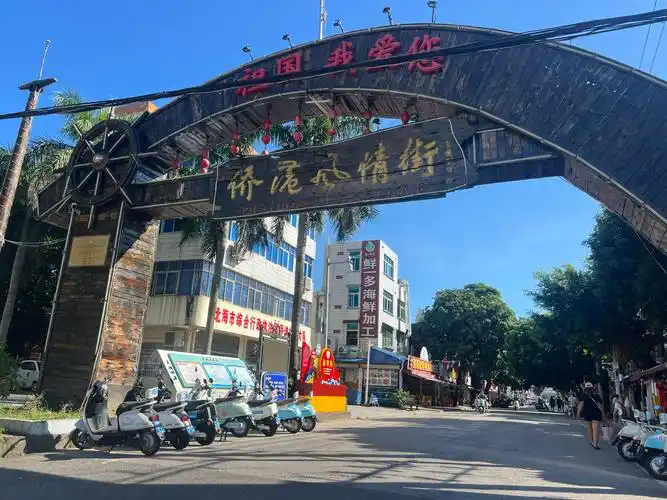 The street's origins trace to 1978–79, when waves of ethnic Chinese refugees fled Vietnam following the Sino-Vietnamese conflict, echoing earlier Southeast Asian migrations comparable to the Vietnamese boat people diaspora that reshaped communities from Hong Kong to Sydney. Settled in a purpose-built enclave south of central Beihai, these returnees gradually blended their homeland flavors with Cantonese techniques and the seafood traditions of the indigenous Tanka boat people. Over four decades, this fusion has crystallized into a singular "overseas-Vietnamese" culinary identity that sets Qiaogang apart from any ordinary food street.
The streetscape itself reflects this layered heritage. Buildings marry Lingnan arcade architecture—the covered walkways familiar in Guangzhou and Shunde—with tropical colonial touches borrowed from French Indochina, producing a low-rise ensemble that recalls a miniature Hoi An transplanted to the South China Sea. Though no single structure rivals the grandeur of European old towns, the continuous arcades, neon signage, and fragrant steam from open kitchens create an immersive atmosphere best appreciated on foot after sunset.
At its core, Qiaogang is a celebration of cross-border taste. Diners move from Vietnamese rice-paper rolls and crab-noodle soup to Cantonese herbal sweet soups and shaved-ice desserts at famed 24 Building, then onward to sizzling stir-fried shellfish and deep-fried shrimp cakes pulled straight from adjacent fishing boats. Most snacks cost between 5 and 25 yuan, with seafood platters and grill-house feasts rarely exceeding 100 yuan per person—an accessible adventure for travelers accustomed to steeper Asian food prices.
Visitors should plan to arrive around 5 p.m., catching Silver Beach's sunset before the market hits its 8 p.m. to midnight peak. Most stalls close during daylight hours, so early morning exploration yields little. Allow three to four hours for a comfortable wander, budgeting extra time during July and August, when domestic tourism pushes crowds to their limits. City buses and ride-hailing apps connect Qiaogang to central Beihai in roughly fifteen minutes; parking is available but tight in peak season.
Travelers should carry small cash alongside mobile payment apps, as some stalls refuse anything but yuan notes. When ordering seafood, always confirm market prices, cooking fees, and weights in advance, and politely decline touts offering suspiciously cheap deals. August temperatures regularly exceed 32°C, so hydration and sun protection during the beach portion of the trip are essential. Despite the crowds, the combination of ocean-front location, living refugee history, and honest flavors makes Qiaogang a rewarding detour from the standard China itinerary.
The street's origins trace to 1978–79, when waves of ethnic Chinese refugees fled Vietnam following the Sino-Vietnamese conflict, echoing earlier Southeast Asian migrations comparable to the Vietnamese boat people diaspora that reshaped communities from Hong Kong to Sydney. Settled in a purpose-built enclave south of central Beihai, these returnees gradually blended their homeland flavors with Cantonese techniques and the seafood traditions of the indigenous Tanka boat people. Over four decades, this fusion has crystallized into a singular "overseas-Vietnamese" culinary identity that sets Qiaogang apart from any ordinary food street.
The streetscape itself reflects this layered heritage. Buildings marry Lingnan arcade architecture—the covered walkways familiar in Guangzhou and Shunde—with tropical colonial touches borrowed from French Indochina, producing a low-rise ensemble that recalls a miniature Hoi An transplanted to the South China Sea. Though no single structure rivals the grandeur of European old towns, the continuous arcades, neon signage, and fragrant steam from open kitchens create an immersive atmosphere best appreciated on foot after sunset.
At its core, Qiaogang is a celebration of cross-border taste. Diners move from Vietnamese rice-paper rolls and crab-noodle soup to Cantonese herbal sweet soups and shaved-ice desserts at famed 24 Building, then onward to sizzling stir-fried shellfish and deep-fried shrimp cakes pulled straight from adjacent fishing boats. Most snacks cost between 5 and 25 yuan, with seafood platters and grill-house feasts rarely exceeding 100 yuan per person—an accessible adventure for travelers accustomed to steeper Asian food prices.
Visitors should plan to arrive around 5 p.m., catching Silver Beach's sunset before the market hits its 8 p.m. to midnight peak. Most stalls close during daylight hours, so early morning exploration yields little. Allow three to four hours for a comfortable wander, budgeting extra time during July and August, when domestic tourism pushes crowds to their limits. City buses and ride-hailing apps connect Qiaogang to central Beihai in roughly fifteen minutes; parking is available but tight in peak season.
Travelers should carry small cash alongside mobile payment apps, as some stalls refuse anything but yuan notes. When ordering seafood, always confirm market prices, cooking fees, and weights in advance, and politely decline touts offering suspiciously cheap deals. August temperatures regularly exceed 32°C, so hydration and sun protection during the beach portion of the trip are essential. Despite the crowds, the combination of ocean-front location, living refugee history, and honest flavors makes Qiaogang a rewarding detour from the standard China itinerary.