Hepu Han Dynasty Cultural Site
⭐ 3.80
South side of Zhongshan Road, Haicheng District, Beihai City, Guangxi Zhuang Autonomous Region, China
 Established as a commandery by Emperor Wu of Han around 111 BCE—just as Rome was consolidating its grip on the Mediterranean—Hepu became Imperial China's forward operating base for the South Seas. While Roman senators debated grain shipments from Egypt, Han merchants in Hepu were loading junks with bolts of silk destined for India's ports and, ultimately, the boudoirs of Roman empresses. This was no provincial backwater: it was the eastern terminus of a trade network as ambitious as anything operated by Venice or the Dutch East India Company sixteen centuries later. The tangible proof lies here, in the soil of Guangxi, where excavations have mapped a sophisticated maritime economy that connected East Asia to the Mediterranean world.
The protected zone bundles three major components into one archaeological landscape. The Hepu Han Tombs themselves comprise more than a thousand earthen burial mounds, of which over a thousand have been scientifically excavated—their scale and density recalling the great Etruscan necropolises of central Italy. Select large tombs, such as the Wangniuling Tomb No. 1, are preserved under protective shelters that allow visitors to stand directly above the burial chambers. Surrounding the necropolis, the Caoxiecun site likely served as the commandery's administrative seat, while the Dalanggu Ancient City formed a combined residential and dock district, its layout clearly tracing the footprint of an early-modern port town.
The artifact haul speaks volumes about Hepu's role as a cosmopolitan hub. Among more than 1,300 imported pieces, Roman glass bowls, Persian pottery ewers, and lake-blue glass cups testify to long-distance trade networks reaching as far as the Mediterranean and the Persian Gulf. Equally impressive are the locally made treasures: bronze phoenix lamps, inlaid glass cups, and delicate gold ornaments that showcase the technical sophistication of Lingnan handicrafts. In 2021, the Hepu Han Tombs earned recognition among China's "100 Great Archaeological Discoveries of the Century," cementing their status as a benchmark for understanding ancient maritime trade.
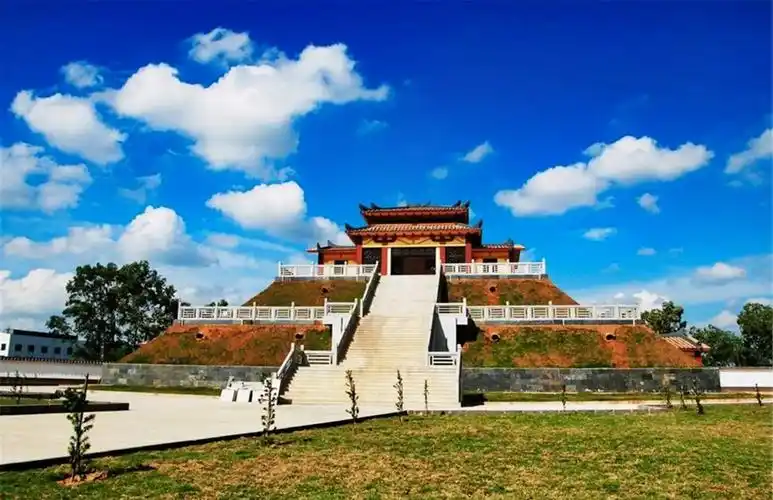
The Hepu Han Dynasty Cultural Museum sits atop the Sifangling tomb cluster and anchors any visit. Entry is free, and the permanent exhibition "Pearl Light and Sailing Shadows" traces the Maritime Silk Road narrative through a curated selection of star objects, including the museum's signature Persian pottery ewer and rare Roman glassware. Guided tours are available and well worth booking in advance for the deeper historical context they provide. The galleries are air-conditioned, but a light layer is advisable since temperatures can run cool indoors.
The site's various components are spread out, and some outdoor zones remain partially closed, so plan the museum as your main stop and combine it with the nearby Hanlu Cultural Park—a reconstructed Han-era marketplace where visitors can rent period costumes for photos. From central Beihai, a taxi ride takes roughly forty to fifty minutes; self-drivers should navigate to the Hanlu Cultural Park parking lot. Confirm opening status by phone before setting out (0779-7285790). The museum closes on Mondays, and the unshaded outdoor areas demand serious sun and rain protection in summer.
Few places on Earth let you walk the same ground where merchants two thousand years ago loaded cargo for Rome. Comparable in historical weight to Ostia Antica—Rome's vanished port, now a haunting ruin outside the city—Hepu offers something rarer still: an ancient harbor that is still being uncovered, layer by layer, by modern archaeologists. For travelers tracing the maritime roots of globalization, or anyone seeking an off-the-beaten-path cultural detour from Beihai's beaches, this site delivers a quietly astonishing window onto the age when Chinese silk first reached the Mediterranean.
Established as a commandery by Emperor Wu of Han around 111 BCE—just as Rome was consolidating its grip on the Mediterranean—Hepu became Imperial China's forward operating base for the South Seas. While Roman senators debated grain shipments from Egypt, Han merchants in Hepu were loading junks with bolts of silk destined for India's ports and, ultimately, the boudoirs of Roman empresses. This was no provincial backwater: it was the eastern terminus of a trade network as ambitious as anything operated by Venice or the Dutch East India Company sixteen centuries later. The tangible proof lies here, in the soil of Guangxi, where excavations have mapped a sophisticated maritime economy that connected East Asia to the Mediterranean world.
The protected zone bundles three major components into one archaeological landscape. The Hepu Han Tombs themselves comprise more than a thousand earthen burial mounds, of which over a thousand have been scientifically excavated—their scale and density recalling the great Etruscan necropolises of central Italy. Select large tombs, such as the Wangniuling Tomb No. 1, are preserved under protective shelters that allow visitors to stand directly above the burial chambers. Surrounding the necropolis, the Caoxiecun site likely served as the commandery's administrative seat, while the Dalanggu Ancient City formed a combined residential and dock district, its layout clearly tracing the footprint of an early-modern port town.
The artifact haul speaks volumes about Hepu's role as a cosmopolitan hub. Among more than 1,300 imported pieces, Roman glass bowls, Persian pottery ewers, and lake-blue glass cups testify to long-distance trade networks reaching as far as the Mediterranean and the Persian Gulf. Equally impressive are the locally made treasures: bronze phoenix lamps, inlaid glass cups, and delicate gold ornaments that showcase the technical sophistication of Lingnan handicrafts. In 2021, the Hepu Han Tombs earned recognition among China's "100 Great Archaeological Discoveries of the Century," cementing their status as a benchmark for understanding ancient maritime trade.
The Hepu Han Dynasty Cultural Museum sits atop the Sifangling tomb cluster and anchors any visit. Entry is free, and the permanent exhibition "Pearl Light and Sailing Shadows" traces the Maritime Silk Road narrative through a curated selection of star objects, including the museum's signature Persian pottery ewer and rare Roman glassware. Guided tours are available and well worth booking in advance for the deeper historical context they provide. The galleries are air-conditioned, but a light layer is advisable since temperatures can run cool indoors.
The site's various components are spread out, and some outdoor zones remain partially closed, so plan the museum as your main stop and combine it with the nearby Hanlu Cultural Park—a reconstructed Han-era marketplace where visitors can rent period costumes for photos. From central Beihai, a taxi ride takes roughly forty to fifty minutes; self-drivers should navigate to the Hanlu Cultural Park parking lot. Confirm opening status by phone before setting out (0779-7285790). The museum closes on Mondays, and the unshaded outdoor areas demand serious sun and rain protection in summer.
Few places on Earth let you walk the same ground where merchants two thousand years ago loaded cargo for Rome. Comparable in historical weight to Ostia Antica—Rome's vanished port, now a haunting ruin outside the city—Hepu offers something rarer still: an ancient harbor that is still being uncovered, layer by layer, by modern archaeologists. For travelers tracing the maritime roots of globalization, or anyone seeking an off-the-beaten-path cultural detour from Beihai's beaches, this site delivers a quietly astonishing window onto the age when Chinese silk first reached the Mediterranean.