East Gate Tower
⭐ 3.80
East Gate Tower, Fenghuang County, Xiangxi Tujia and Miao Autonomous Prefecture, Hunan Province, China
 **Historical Context**
The East Gate Tower was raised in 1715, the fifty-fourth year of the Kangxi Emperor's long reign and just three years before Europe's War of the Spanish Succession concluded at Utrecht. Constructed when Fenghuang transitioned from a brick-walled settlement to a more formidable stone fortress, it served simultaneously as a military outpost and flood barrier guarding this remote Miao-Tujia borderland. Think of it as the Carcassonne of southwest China: a stone-and-brick sentinel whose defensive pedigree has been softened by three centuries of peacetime reverie, yet whose ramparts still echo with the strategic urgency of imperial frontier life.
**Architecture**
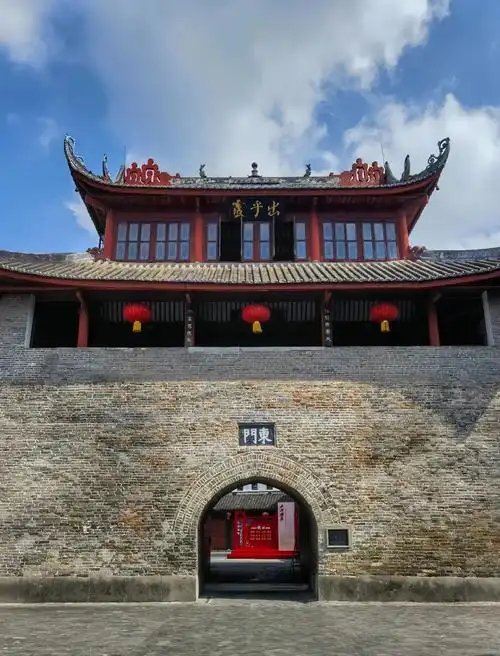
Standing eleven meters high, the tower deliberately echoes the silhouette of Beijing's Qianmen Gate, lending a miniature imperial gravitas to this provincial backwater. Its lower courses are hewn from rust-red sandstone quarried locally, while the upper levels transition to weathered grey brickwork capped by a sweeping hip-and-gable roof with upturned swallowtail eaves. The gate passage itself measures 3.5 meters wide by 4 meters tall, its original iron-sheathed doors studded with hand-forged nails, evoking the heavy medieval portcullises of fortified European towns such as Rhodes or Avila.
**Interior Features**
Within the timber-framed upper chamber, visitors encounter a shrine to Guan Yu, the deified general whose crimson visage and green dragon sabre appear in temples across East Asia. Adjacent displays include a scale model of Ming-era city defenses and replica bronze cannons, recalling a period when this gateway repelled both floodwaters and occasional bandit incursions from the highlands. The interior is modest but atmospheric, offering a tangible sense of how frontier garrisons balanced martial vigilance with spiritual devotion.
**The View**
The real prize awaits on the viewing platform, where the entire sweep of Fenghuang unfolds in a single panorama. Below flows the jade-green Tuojiang River, while the opposite bank rises in stacked terraces of stilted houses, or diaojiaolou, reminiscent of Alpine lake dwellings or Venice's waterside palazzi, though built entirely of timber on stilts. Eastward, the Dongling mountain range dissolves into soft blue layers, particularly magical at dawn when mist threads between the rooftops or at golden hour when the setting sun ignites the river's surface.
**Practical Information**
Admission to the tower is included in the Fenghuang Nine-Sights combined ticket (around 128 yuan), which also covers Shen Congwen's former residence, the Rainbow Bridge, and the Ten-Thousand Pagoda, offering excellent value. Opening hours run 08:00–17:30, occasionally extending to 18:00 in summer. Just below, Dongmen Street buzzes with souvenir vendors, teahouses, and snack stalls selling local specialties like ginger candy and blood duck. Allow only 15 to 30 minutes on the tower itself, but pair it with a Tuojiang riverboat ride and a stroll along the North Gate city wall for a satisfying half-day circuit.
**Visiting Tips**
Arrive between 08:00 and 09:30 or after 16:30 to avoid both midday glare and coach-party crowds; the soft light is also ideal for photography. Wear sturdy non-slip footwear, as the stone steps become treacherous after rain, and bring a light jacket for summer evenings when the river breeze picks up. Those with limited mobility should note that reaching the upper platform requires climbing a steep, narrow staircase with no lift access.
**Historical Context**
The East Gate Tower was raised in 1715, the fifty-fourth year of the Kangxi Emperor's long reign and just three years before Europe's War of the Spanish Succession concluded at Utrecht. Constructed when Fenghuang transitioned from a brick-walled settlement to a more formidable stone fortress, it served simultaneously as a military outpost and flood barrier guarding this remote Miao-Tujia borderland. Think of it as the Carcassonne of southwest China: a stone-and-brick sentinel whose defensive pedigree has been softened by three centuries of peacetime reverie, yet whose ramparts still echo with the strategic urgency of imperial frontier life.
**Architecture**
Standing eleven meters high, the tower deliberately echoes the silhouette of Beijing's Qianmen Gate, lending a miniature imperial gravitas to this provincial backwater. Its lower courses are hewn from rust-red sandstone quarried locally, while the upper levels transition to weathered grey brickwork capped by a sweeping hip-and-gable roof with upturned swallowtail eaves. The gate passage itself measures 3.5 meters wide by 4 meters tall, its original iron-sheathed doors studded with hand-forged nails, evoking the heavy medieval portcullises of fortified European towns such as Rhodes or Avila.
**Interior Features**
Within the timber-framed upper chamber, visitors encounter a shrine to Guan Yu, the deified general whose crimson visage and green dragon sabre appear in temples across East Asia. Adjacent displays include a scale model of Ming-era city defenses and replica bronze cannons, recalling a period when this gateway repelled both floodwaters and occasional bandit incursions from the highlands. The interior is modest but atmospheric, offering a tangible sense of how frontier garrisons balanced martial vigilance with spiritual devotion.
**The View**
The real prize awaits on the viewing platform, where the entire sweep of Fenghuang unfolds in a single panorama. Below flows the jade-green Tuojiang River, while the opposite bank rises in stacked terraces of stilted houses, or diaojiaolou, reminiscent of Alpine lake dwellings or Venice's waterside palazzi, though built entirely of timber on stilts. Eastward, the Dongling mountain range dissolves into soft blue layers, particularly magical at dawn when mist threads between the rooftops or at golden hour when the setting sun ignites the river's surface.
**Practical Information**
Admission to the tower is included in the Fenghuang Nine-Sights combined ticket (around 128 yuan), which also covers Shen Congwen's former residence, the Rainbow Bridge, and the Ten-Thousand Pagoda, offering excellent value. Opening hours run 08:00–17:30, occasionally extending to 18:00 in summer. Just below, Dongmen Street buzzes with souvenir vendors, teahouses, and snack stalls selling local specialties like ginger candy and blood duck. Allow only 15 to 30 minutes on the tower itself, but pair it with a Tuojiang riverboat ride and a stroll along the North Gate city wall for a satisfying half-day circuit.
**Visiting Tips**
Arrive between 08:00 and 09:30 or after 16:30 to avoid both midday glare and coach-party crowds; the soft light is also ideal for photography. Wear sturdy non-slip footwear, as the stone steps become treacherous after rain, and bring a light jacket for summer evenings when the river breeze picks up. Those with limited mobility should note that reaching the upper platform requires climbing a steep, narrow staircase with no lift access.