Jumping Stones
⭐ 4.20
Tuojiang Town, Fenghuang County, Hunan Province, China
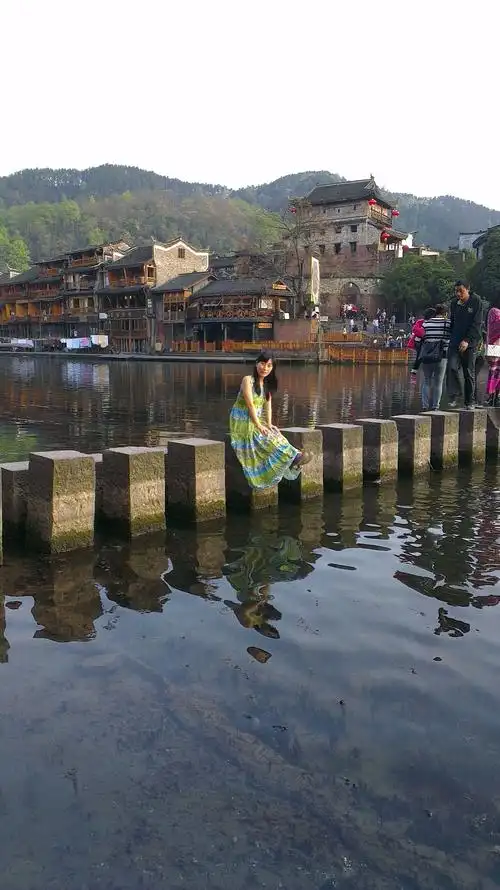 Built in 1704, during the same European era that saw the War of Spanish Succession and Peter the Great's founding of St Petersburg, the Stepping Stones served as the principal northern gateway across the Tuo River for soldiers, traders, and travelers entering Fenghuang. For three centuries, this modest crossing witnessed the ebb and flow of border commerce and military campaigns in the remote highlands of western Hunan, surviving floods, dynastic upheavals, and modernization as the best-preserved Qing-dynasty river crossing in the region. Today, it remains a tangible relic of the ancient Miao and Tujia trading networks.
The structure spans approximately one hundred meters, comprising fifteen equally-spaced red sandstone piers rising directly from the riverbed, each separated by roughly five meters. Weathered wooden planks are lashed together with iron chains to form the walkway bridging these stone bases—an ingenious solution allowing the crossing to flex with seasonal water-level fluctuations that can rise several meters during summer monsoons. The use of locally quarried sandstone and timber reflects the same vernacular engineering principles found in countless European medieval river crossings, where builders worked pragmatically with the materials at hand rather than imposing rigid designs on unpredictable waters.
Fenghuang—literally "Phoenix"—has long drawn literary pilgrims as the romanticized setting of Shen Congwen's celebrated novel *Border Town* (1934), and the Stepping Stones feature prominently in that wistful narrative. The crossing has become inseparable from the town's identity, appearing on countless postcards and inspiring generations of Chinese photographers and painters. Compared to the humpbacked bridges of Bruges or the silent gondola landings of Venice, Fenghuang offers something distinctively Chinese: a riverscape where Tujia stilted houses, centuries-old city walls, and the misty Wuling Mountains converge into a scene both intimate and mythical.
Crossing the Stepping Stones requires visitors to bound from stone pier to wooden plank—essentially an adult version of the childhood game hopscotch, played over flowing water. Balance matters, especially after rain when the sandstone can become treacherously slick, so sturdy non-slip footwear is essential. The stones are freely accessible at all hours, though the most rewarding times are 6:30–8:00 AM, when morning mist blurs river and sky into one ethereal wash, or after 7:00 PM when lantern light transforms the entire waterfront into a shimmering reflection of gold and crimson.
For a satisfying half-day wander, combine the Stepping Stones with a leisurely Tuo River boat ride, a stroll beneath the arched Rainbow Bridge, and visits to the nearby North Gate Tower and Shen Congwen's former residence. Many travelers also rent traditional Miao costumes for riverside photo sessions against the stilted-house backdrop. Allow roughly two hours to absorb the area at an unhurried pace, ideally lingering at a riverside teahouse afterward to watch lanterns flicker across the water—the moment when Fenghuang reveals why it has captivated travelers for three hundred years.
Built in 1704, during the same European era that saw the War of Spanish Succession and Peter the Great's founding of St Petersburg, the Stepping Stones served as the principal northern gateway across the Tuo River for soldiers, traders, and travelers entering Fenghuang. For three centuries, this modest crossing witnessed the ebb and flow of border commerce and military campaigns in the remote highlands of western Hunan, surviving floods, dynastic upheavals, and modernization as the best-preserved Qing-dynasty river crossing in the region. Today, it remains a tangible relic of the ancient Miao and Tujia trading networks.
The structure spans approximately one hundred meters, comprising fifteen equally-spaced red sandstone piers rising directly from the riverbed, each separated by roughly five meters. Weathered wooden planks are lashed together with iron chains to form the walkway bridging these stone bases—an ingenious solution allowing the crossing to flex with seasonal water-level fluctuations that can rise several meters during summer monsoons. The use of locally quarried sandstone and timber reflects the same vernacular engineering principles found in countless European medieval river crossings, where builders worked pragmatically with the materials at hand rather than imposing rigid designs on unpredictable waters.
Fenghuang—literally "Phoenix"—has long drawn literary pilgrims as the romanticized setting of Shen Congwen's celebrated novel *Border Town* (1934), and the Stepping Stones feature prominently in that wistful narrative. The crossing has become inseparable from the town's identity, appearing on countless postcards and inspiring generations of Chinese photographers and painters. Compared to the humpbacked bridges of Bruges or the silent gondola landings of Venice, Fenghuang offers something distinctively Chinese: a riverscape where Tujia stilted houses, centuries-old city walls, and the misty Wuling Mountains converge into a scene both intimate and mythical.
Crossing the Stepping Stones requires visitors to bound from stone pier to wooden plank—essentially an adult version of the childhood game hopscotch, played over flowing water. Balance matters, especially after rain when the sandstone can become treacherously slick, so sturdy non-slip footwear is essential. The stones are freely accessible at all hours, though the most rewarding times are 6:30–8:00 AM, when morning mist blurs river and sky into one ethereal wash, or after 7:00 PM when lantern light transforms the entire waterfront into a shimmering reflection of gold and crimson.
For a satisfying half-day wander, combine the Stepping Stones with a leisurely Tuo River boat ride, a stroll beneath the arched Rainbow Bridge, and visits to the nearby North Gate Tower and Shen Congwen's former residence. Many travelers also rent traditional Miao costumes for riverside photo sessions against the stilted-house backdrop. Allow roughly two hours to absorb the area at an unhurried pace, ideally lingering at a riverside teahouse afterward to watch lanterns flicker across the water—the moment when Fenghuang reveals why it has captivated travelers for three hundred years.