Former Residence of Shen Congwen
⭐ 4.20
No. 15, Dongmen Street, Tuojiang Town, Fenghuang County, Hunan Province, China
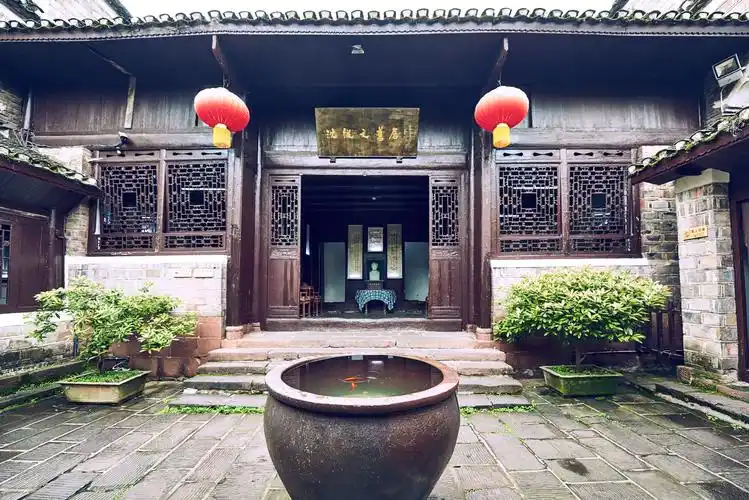 Built in 1866, during the late Qing dynasty—a period when the Taiping Rebellion had recently reshaped the Chinese countryside—Shen Congwen's former residence originally served as the ancestral home of the Shen family. The writer was born here in 1902, just as the Qing dynasty entered its final decade of collapse. He would go on to author "Border Town" and "Recollections of West Hunan," works often compared to Thomas Hardy's Wessex novels for their tender portrayal of rural life. Like visiting Shakespeare's birthplace in Stratford-upon-Avon or Tolstoy's estate at Yasnaya Polyana, walking through these rooms offers direct contact with the landscapes that shaped a literary imagination.
The residence is a classic example of a chuandou-style timber-frame courtyard house, covering roughly 600 square meters across two longitudinal wings linked by a small central courtyard that channels light into the surrounding chambers. Dark grey roof tiles, hand-hewn stone plinths, and intricately carved wooden brackets reveal a fusion of Tujia and Miao building traditions—elements that echo the vernacular architecture found throughout southwestern China. The brick, wood, and tile construction has been carefully preserved, making the house a living artifact of Ming and Qing domestic design in western Hunan.
More than a museum of objects, the residence is the spiritual wellspring of Shen Congwen's literary universe. Visitors wandering the courtyard can almost hear the call of Cuicui, the river-girl heroine of "Border Town," whose longing for her boatman lover has become emblematic of Chinese pastoral romance. Displayed manuscripts, period photographs, a vintage phonograph, and an old Eight Immortals table weave together text and tangible memory, creating an atmosphere of literary pilgrimage akin to retracing Hemingway's footsteps in Havana. For Western readers encountering "Border Town" in translation, the house anchors the novel's dreamlike river scenes in real geography.
The former residence is located at No. 10 Zhongying Street (some navigation systems list it as No. 21 or No. 24) in Fenghuang Ancient Town, Xiangxi Tujia and Miao Autonomous Prefecture. It is open daily from 8:30 a.m. to 5:30 p.m., year-round. Admission is typically bundled with the Fenghuang Ancient Town nine-site combo ticket (approximately 128 yuan), or available separately for roughly 20 to 45 yuan. Discounts apply for seniors, students, and military personnel with valid identification. Allow forty minutes to one hour for a relaxed visit.
The early morning and late afternoon offer the best light for photography and the smallest crowds, with golden tones washing over the wooden eaves. Readers who finish "Border Town" or "Recollections of West Hunan" before arriving will find their experience richly amplified, as familiar scenes materialize around them. The on-site shop sells books and commemorative stamps worth collecting, while neighboring highlights—the rainbow-shaped Hong Bridge over the Tuo River, the riverside boardwalks, and the former home of Xiong Xiling—combine effortlessly into a leisurely day-long circuit through one of China's most enchanting historic towns.
Built in 1866, during the late Qing dynasty—a period when the Taiping Rebellion had recently reshaped the Chinese countryside—Shen Congwen's former residence originally served as the ancestral home of the Shen family. The writer was born here in 1902, just as the Qing dynasty entered its final decade of collapse. He would go on to author "Border Town" and "Recollections of West Hunan," works often compared to Thomas Hardy's Wessex novels for their tender portrayal of rural life. Like visiting Shakespeare's birthplace in Stratford-upon-Avon or Tolstoy's estate at Yasnaya Polyana, walking through these rooms offers direct contact with the landscapes that shaped a literary imagination.
The residence is a classic example of a chuandou-style timber-frame courtyard house, covering roughly 600 square meters across two longitudinal wings linked by a small central courtyard that channels light into the surrounding chambers. Dark grey roof tiles, hand-hewn stone plinths, and intricately carved wooden brackets reveal a fusion of Tujia and Miao building traditions—elements that echo the vernacular architecture found throughout southwestern China. The brick, wood, and tile construction has been carefully preserved, making the house a living artifact of Ming and Qing domestic design in western Hunan.
More than a museum of objects, the residence is the spiritual wellspring of Shen Congwen's literary universe. Visitors wandering the courtyard can almost hear the call of Cuicui, the river-girl heroine of "Border Town," whose longing for her boatman lover has become emblematic of Chinese pastoral romance. Displayed manuscripts, period photographs, a vintage phonograph, and an old Eight Immortals table weave together text and tangible memory, creating an atmosphere of literary pilgrimage akin to retracing Hemingway's footsteps in Havana. For Western readers encountering "Border Town" in translation, the house anchors the novel's dreamlike river scenes in real geography.
The former residence is located at No. 10 Zhongying Street (some navigation systems list it as No. 21 or No. 24) in Fenghuang Ancient Town, Xiangxi Tujia and Miao Autonomous Prefecture. It is open daily from 8:30 a.m. to 5:30 p.m., year-round. Admission is typically bundled with the Fenghuang Ancient Town nine-site combo ticket (approximately 128 yuan), or available separately for roughly 20 to 45 yuan. Discounts apply for seniors, students, and military personnel with valid identification. Allow forty minutes to one hour for a relaxed visit.
The early morning and late afternoon offer the best light for photography and the smallest crowds, with golden tones washing over the wooden eaves. Readers who finish "Border Town" or "Recollections of West Hunan" before arriving will find their experience richly amplified, as familiar scenes materialize around them. The on-site shop sells books and commemorative stamps worth collecting, while neighboring highlights—the rainbow-shaped Hong Bridge over the Tuo River, the riverside boardwalks, and the former home of Xiong Xiling—combine effortlessly into a leisurely day-long circuit through one of China's most enchanting historic towns.