Fenghuang Ancient City
⭐ 4.30
Fenghuang Ancient City, Fenghuang County, Xiangxi Tujia and Miao Autonomous Prefecture, Hunan Province, China
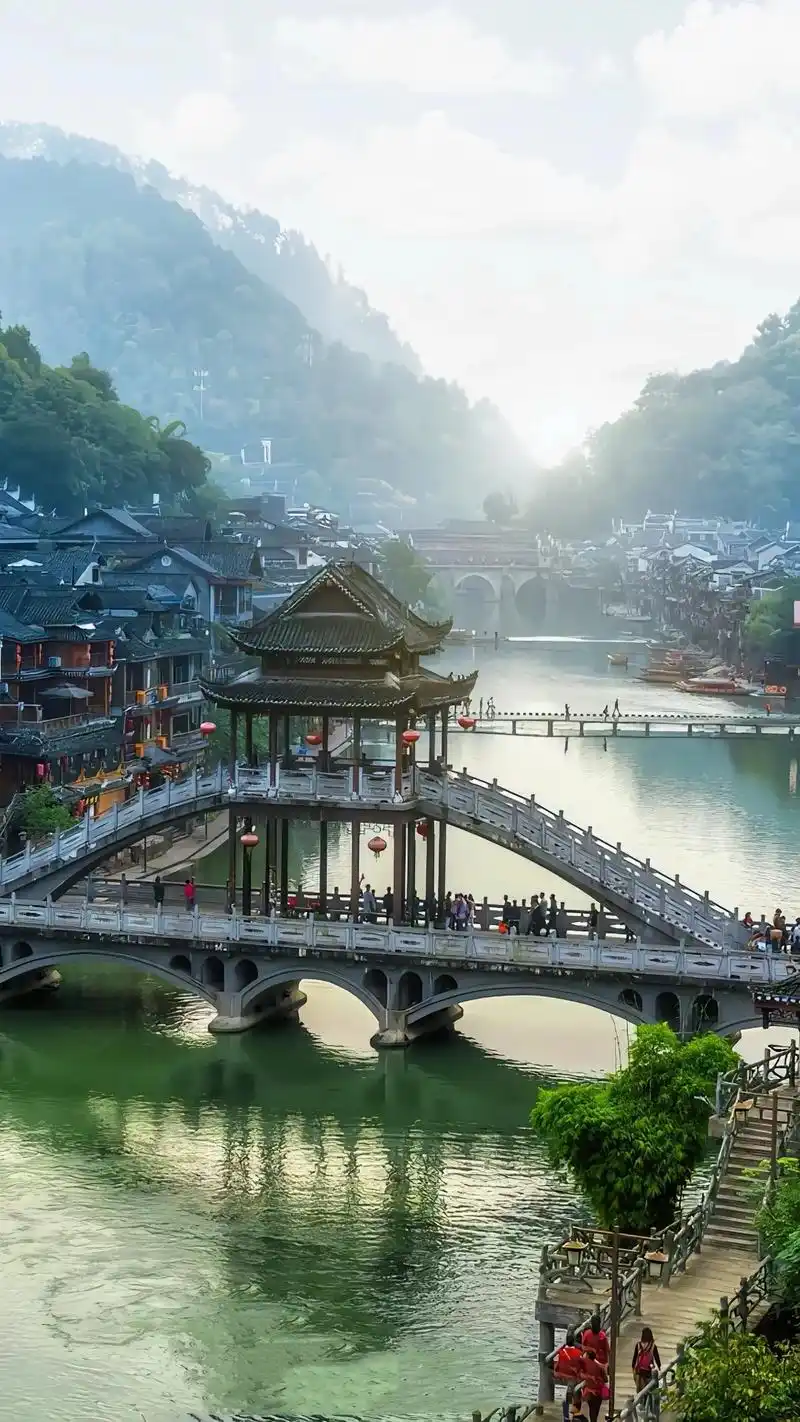 Fenghuang was founded in 1704, during the reign of the Kangxi Emperor—the same year as the Battle of Blenheim and the opening campaigns of the War of Spanish Succession unfolding across Europe. Originally a garrison town called Zhenguan, it took its poetic name from a phoenix-shaped ridge to its west. Three centuries later, the Ming-Qing street grid, city walls, and gate towers remain remarkably intact, offering a rare glimpse into Qing-era urban China comparable to the preserved medieval cores of Dubrovnik or Salzburg. Few Chinese towns of this scale have escaped the waves of demolition that swept twentieth-century China.
The city's defining feature is its ribbon of diaojiaolou—stilted wooden houses that cantilever over the Tuojiang's banks, their tiered balconies reflected in the green water below. This pile-dwelling tradition, shared with the Miao and Tujia minorities, echoes Norway's stave churches and Alpine lake houses in its ingenious adaptation to mountainous terrain. Inside the walls, flagstone alleys radiate from the central crossroads, linking nine landmark sites: Shen Congwen's former home, Xiong Xiling's mansion, the Yang clan ancestral hall, the Wanshou Palace—now the Huang Yongyu Art Museum—and the surviving East and North Gate towers.
For Chinese readers, Fenghuang is inseparable from Shen Congwen (1902–1988), whose novella *Border Town* cast the town as an idyll of innocence on the empire's ethnic frontier—China's answer to Hardy's Wessex or Faulkner's Yoknapatawpha. The writer's modest courtyard home remains a literary pilgrimage stop. Equally vital is living Miao heritage: silversmiths still hammer intricate headdresses by hand, indigo batik clings to workshop walls, and song-and-dance festivals erupt in spring and autumn. The result is a town that reads as both literary shrine and ethnographic living museum.
The old town's main streets are free to wander; a combined ticket covering the nine historic sites runs roughly 100–150 RMB depending on season, while Tuojiang boat rides are sold separately. Plan one to two full days—arrive before 8 a.m. or after 8 p.m. to dodge tour-bus crowds and catch the famous Rainbow Bridge at dusk. Spring (March–May) and autumn (September–November) bring mild weather and golden light; summer delivers the most spectacular lantern-lit nights, while winter offers quiet lanes and frost-tipped rooftops.
Stay in a riverside guesthouse to watch fishermen pole their bamboo rafts at dawn, or in a tucked-away courtyard inn for quiet nights behind wooden screens. Riverside stone steps turn treacherous after rain, so pack flat shoes. Buy silver jewelry and herbal medicines only from licensed shops and keep receipts—informal vendors and freelance "wild" photographers are a common source of tourist complaints. Step off the main lantern street and you'll find old tea houses, Miao embroidery stalls, and weathered doorways where the phoenix city still earns its name.
Fenghuang was founded in 1704, during the reign of the Kangxi Emperor—the same year as the Battle of Blenheim and the opening campaigns of the War of Spanish Succession unfolding across Europe. Originally a garrison town called Zhenguan, it took its poetic name from a phoenix-shaped ridge to its west. Three centuries later, the Ming-Qing street grid, city walls, and gate towers remain remarkably intact, offering a rare glimpse into Qing-era urban China comparable to the preserved medieval cores of Dubrovnik or Salzburg. Few Chinese towns of this scale have escaped the waves of demolition that swept twentieth-century China.
The city's defining feature is its ribbon of diaojiaolou—stilted wooden houses that cantilever over the Tuojiang's banks, their tiered balconies reflected in the green water below. This pile-dwelling tradition, shared with the Miao and Tujia minorities, echoes Norway's stave churches and Alpine lake houses in its ingenious adaptation to mountainous terrain. Inside the walls, flagstone alleys radiate from the central crossroads, linking nine landmark sites: Shen Congwen's former home, Xiong Xiling's mansion, the Yang clan ancestral hall, the Wanshou Palace—now the Huang Yongyu Art Museum—and the surviving East and North Gate towers.
For Chinese readers, Fenghuang is inseparable from Shen Congwen (1902–1988), whose novella *Border Town* cast the town as an idyll of innocence on the empire's ethnic frontier—China's answer to Hardy's Wessex or Faulkner's Yoknapatawpha. The writer's modest courtyard home remains a literary pilgrimage stop. Equally vital is living Miao heritage: silversmiths still hammer intricate headdresses by hand, indigo batik clings to workshop walls, and song-and-dance festivals erupt in spring and autumn. The result is a town that reads as both literary shrine and ethnographic living museum.
The old town's main streets are free to wander; a combined ticket covering the nine historic sites runs roughly 100–150 RMB depending on season, while Tuojiang boat rides are sold separately. Plan one to two full days—arrive before 8 a.m. or after 8 p.m. to dodge tour-bus crowds and catch the famous Rainbow Bridge at dusk. Spring (March–May) and autumn (September–November) bring mild weather and golden light; summer delivers the most spectacular lantern-lit nights, while winter offers quiet lanes and frost-tipped rooftops.
Stay in a riverside guesthouse to watch fishermen pole their bamboo rafts at dawn, or in a tucked-away courtyard inn for quiet nights behind wooden screens. Riverside stone steps turn treacherous after rain, so pack flat shoes. Buy silver jewelry and herbal medicines only from licensed shops and keep receipts—informal vendors and freelance "wild" photographers are a common source of tourist complaints. Step off the main lantern street and you'll find old tea houses, Miao embroidery stalls, and weathered doorways where the phoenix city still earns its name.