Gansu Provincial Museum
⭐ 4.60
Gansu Provincial Museum, Chengguan District, Lanzhou City, Gansu Province, China
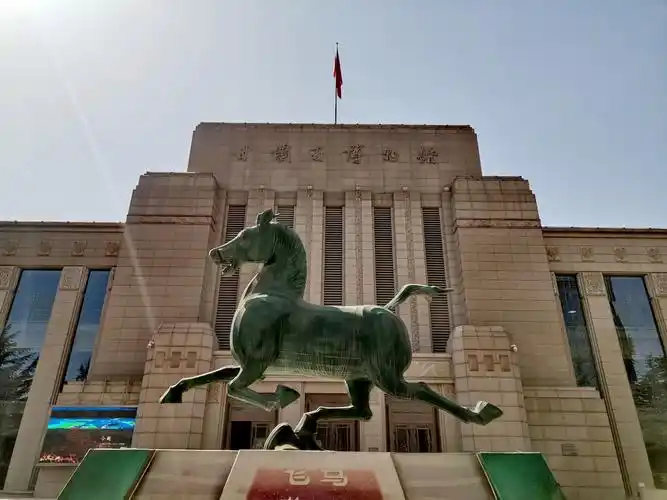 Founded in 1956, the Gansu Provincial Museum ranks among China's earliest provincial comprehensive museums and holds a collection exceeding 350,000 artifacts. Its holdings span an extraordinary chronological range, from远古 fossils to modern revolutionary archives. Specialists particularly prize its prehistoric painted ceramics, Han Dynasty bamboo and wooden slips (the paper's ancient ancestor), Silk Road relics, and Buddhist bronze sculptures. Scholars have dubbed it "The Key to Chinese Civilization," placing it in the same league as London's British Museum or Paris's Musée Guimet for Asian antiquities—a fitting comparison given that Gansu once stood at the crossroads where Mediterranean, Central Asian, and Chinese cultures met along the caravan routes described by Marco Polo and earlier travelers.
The museum's architecture is striking: a 43,000-square-meter complex whose footprint forms a distinctive "mountain" character (山). This contemporary design pays homage to the Han Dynasty watchtower tradition while embracing modernist lines. Inside, exhibition halls occupy the second and third floors, where carefully calibrated lighting and generous gallery spaces create an atmosphere that balances scholarly gravitas with visitor accessibility—reminiscent of how the Louvre's newer wings reconcile historic grandeur with contemporary display needs.
Permanent exhibitions include the Silk Road Civilization Gallery, the Gansu Painted Pottery Gallery, Buddhist Art, Paleo-zoology, and Revolutionary Gansu. The undisputed star is the Bronze Galloping Horse, a Han Dynasty masterpiece depicting a horse mid-gallop atop a flying swallow—an icon so beloved it became China's official tourism logo in 1983. The painted pottery gallery traces cultural evolution from the Dadiwan to Majiayao cultures (roughly 6000 BCE onward), with swirling geometric patterns that feel remarkably modern, prefiguring designs like those of William Morris by some four millennia. The Silk Road exhibition brilliantly contextualizes how Buddhism traveled from India through Gandhara (modern Pakistan/Afghanistan) into China, much like how Roman glassmaking techniques diffused across the empire.
Admission is free, but visitors must reserve tickets in advance through the museum's official WeChat account using their real name. The museum closes on Mondays and operates from 9:00 AM to 5:00 PM, with last entry at 4:30 PM. Plan three to four hours for an in-depth visit, or at minimum two hours for highlights. Weekday mornings offer a quieter, more contemplative experience. A QR-code audio guide is available in English, and the official gift shop sells delightfully kitsch "ugly-cute" plush replicas of the Bronze Galloping Horse that have become social media sensations.
Upon entering, head straight to the second floor to see the actual Bronze Galloping Horse (note that originals rotate periodically with replicas), then proceed through the Silk Road, Painted Pottery, and Buddhist Art galleries in that order. After your visit, stroll five minutes to the Yellow River scenic corridor and the historic Zhongshan Bridge—an iron bridge completed in 1909 that once carried the route of the legendary Silk Road caravan trade. This pairing creates a perfect half-day cultural walk bridging ancient history and early modern engineering.
The museum is conveniently accessed via Metro Line 1, exiting at Qilihe Station (Exit C), about 500 meters on foot. Pack a light jacket, as air-conditioning runs cool indoors. Large luggage must be checked, and flash photography plus food or drinks are prohibited in exhibition halls. Should reservations be fully booked, the nearby Gansu Bamboo and Wooden Slips Museum and the Lanzhou City Museum offer excellent alternatives for Silk Road enthusiasts.
Founded in 1956, the Gansu Provincial Museum ranks among China's earliest provincial comprehensive museums and holds a collection exceeding 350,000 artifacts. Its holdings span an extraordinary chronological range, from远古 fossils to modern revolutionary archives. Specialists particularly prize its prehistoric painted ceramics, Han Dynasty bamboo and wooden slips (the paper's ancient ancestor), Silk Road relics, and Buddhist bronze sculptures. Scholars have dubbed it "The Key to Chinese Civilization," placing it in the same league as London's British Museum or Paris's Musée Guimet for Asian antiquities—a fitting comparison given that Gansu once stood at the crossroads where Mediterranean, Central Asian, and Chinese cultures met along the caravan routes described by Marco Polo and earlier travelers.
The museum's architecture is striking: a 43,000-square-meter complex whose footprint forms a distinctive "mountain" character (山). This contemporary design pays homage to the Han Dynasty watchtower tradition while embracing modernist lines. Inside, exhibition halls occupy the second and third floors, where carefully calibrated lighting and generous gallery spaces create an atmosphere that balances scholarly gravitas with visitor accessibility—reminiscent of how the Louvre's newer wings reconcile historic grandeur with contemporary display needs.
Permanent exhibitions include the Silk Road Civilization Gallery, the Gansu Painted Pottery Gallery, Buddhist Art, Paleo-zoology, and Revolutionary Gansu. The undisputed star is the Bronze Galloping Horse, a Han Dynasty masterpiece depicting a horse mid-gallop atop a flying swallow—an icon so beloved it became China's official tourism logo in 1983. The painted pottery gallery traces cultural evolution from the Dadiwan to Majiayao cultures (roughly 6000 BCE onward), with swirling geometric patterns that feel remarkably modern, prefiguring designs like those of William Morris by some four millennia. The Silk Road exhibition brilliantly contextualizes how Buddhism traveled from India through Gandhara (modern Pakistan/Afghanistan) into China, much like how Roman glassmaking techniques diffused across the empire.
Admission is free, but visitors must reserve tickets in advance through the museum's official WeChat account using their real name. The museum closes on Mondays and operates from 9:00 AM to 5:00 PM, with last entry at 4:30 PM. Plan three to four hours for an in-depth visit, or at minimum two hours for highlights. Weekday mornings offer a quieter, more contemplative experience. A QR-code audio guide is available in English, and the official gift shop sells delightfully kitsch "ugly-cute" plush replicas of the Bronze Galloping Horse that have become social media sensations.
Upon entering, head straight to the second floor to see the actual Bronze Galloping Horse (note that originals rotate periodically with replicas), then proceed through the Silk Road, Painted Pottery, and Buddhist Art galleries in that order. After your visit, stroll five minutes to the Yellow River scenic corridor and the historic Zhongshan Bridge—an iron bridge completed in 1909 that once carried the route of the legendary Silk Road caravan trade. This pairing creates a perfect half-day cultural walk bridging ancient history and early modern engineering.
The museum is conveniently accessed via Metro Line 1, exiting at Qilihe Station (Exit C), about 500 meters on foot. Pack a light jacket, as air-conditioning runs cool indoors. Large luggage must be checked, and flash photography plus food or drinks are prohibited in exhibition halls. Should reservations be fully booked, the nearby Gansu Bamboo and Wooden Slips Museum and the Lanzhou City Museum offer excellent alternatives for Silk Road enthusiasts.