Ka'erdun Folk Village
⭐ 3.60
Ka'erdun Township, Nilka County, Ili Kazakh Autonomous Prefecture, Xinjiang Uygur Autonomous Region, China
 Yining sits at the western edge of the Ili Valley, a fertile corridor that for two millennia funneled Silk Road caravans between China, Central Asia, and the Mediterranean. The city's patchwork of Uyghur, Kazakh, Hui, and Han residents echoes similar crossroads such as Samarkand or the Ottoman quarters of Istanbul, where merchants and migrants have layered cultures atop one another for centuries. Kaerdun's recent transformation under China's rural-revitalization program earned it recognition as both a Chinese Ethnic Minority Characteristic Village and a National Rural Governance Model Village, a modern echo of the valley's ancient role as a meeting point of civilizations.
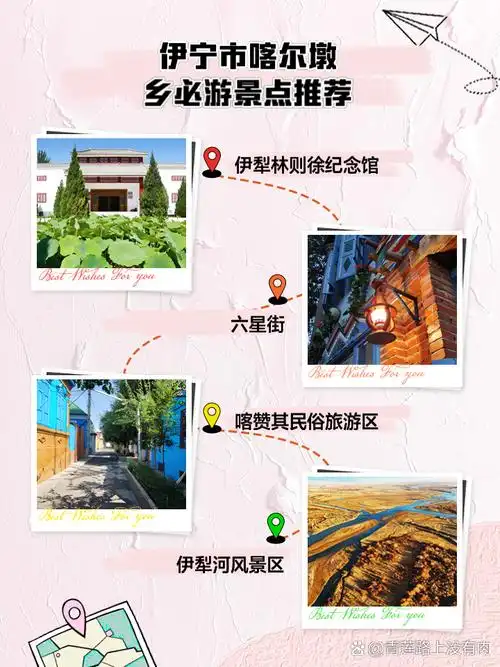
The lane's visual signature is a deep, lacquered red set off by carved wooden lintels, wrought-iron grilles, and stained-glass windows reminiscent of an Andalusian patio or a Samarkand madrasah entrance. Along the walls, brightly painted murals blend Uyghur geometric motifs with traditional Chinese cloud patterns, while red lanterns and timber shop signs recreate the lantern-lit alleys of an old silk-route bazaar. After dark, warm lighting softens the brickwork and turns the whole lane into a cinematic stage that has become a favorite subject for travel photographers and casual phone shooters alike.
What distinguishes Kaerdun from a heritage theme park is its everyday authenticity: residents still live above their shops, children cycle through the alley, and the call to prayer drifts from a neighborhood mosque. A small sand-painting gallery transforms fine grains from the Ili River into miniature landscapes, an art form unique to the valley, and visitors are welcome to try their hand at creating their own. Family-run homestays make it possible to spend the night within the community, an intimacy closer to a Carpathian village stay than a typical Chinese tourist stop.
The food alone justifies a visit: naren, the Uyghur classic of hand-pulled noodles served over chunks of boiled mutton, alongside roasted buns, yogurt-soaked dumplings, and fruit-rich homemade ice cream churned at curbside stalls. Many vendors are grandmothers who have prepared the same recipes for decades, and a brief chat over tea usually yields the most memorable part of the trip. Plan a half-day and bring an appetite rather than a schedule.
There is no entrance fee to walk the lane; only the sand-painting studio and a few craft workshops charge separately. From central Yining, a taxi covers the fifteen-to-twenty-minute ride easily, with a small parking area at the alley mouth, though the lane itself is closed to cars. Public transport is limited, so self-driving or a ride-hailing app is the most practical option. Summer afternoons can be punishingly hot, so arrive in the late afternoon to catch the lanterns glow and the cooler evening breeze that drifts down from the Tian Shan foothills.
Pair Kaerdun with the neighboring Kazanchi Folk District, a Uyghur neighborhood of painted blue-and-white homes, and the Russian-influenced Liuxing Street for a fuller picture of Yining's multicultural past. Together the three districts recall the layered quarters of Baku or Tbilisi, where a single afternoon can move from a Uyghur teahouse to a Slavic bakery to a Chinese courtyard. For travelers seeking Xinjiang beyond desert highways and dramatic landscapes, Kaerdun offers the unhurried, human-scale encounter that has become rare in modern tourism.
Yining sits at the western edge of the Ili Valley, a fertile corridor that for two millennia funneled Silk Road caravans between China, Central Asia, and the Mediterranean. The city's patchwork of Uyghur, Kazakh, Hui, and Han residents echoes similar crossroads such as Samarkand or the Ottoman quarters of Istanbul, where merchants and migrants have layered cultures atop one another for centuries. Kaerdun's recent transformation under China's rural-revitalization program earned it recognition as both a Chinese Ethnic Minority Characteristic Village and a National Rural Governance Model Village, a modern echo of the valley's ancient role as a meeting point of civilizations.
The lane's visual signature is a deep, lacquered red set off by carved wooden lintels, wrought-iron grilles, and stained-glass windows reminiscent of an Andalusian patio or a Samarkand madrasah entrance. Along the walls, brightly painted murals blend Uyghur geometric motifs with traditional Chinese cloud patterns, while red lanterns and timber shop signs recreate the lantern-lit alleys of an old silk-route bazaar. After dark, warm lighting softens the brickwork and turns the whole lane into a cinematic stage that has become a favorite subject for travel photographers and casual phone shooters alike.
What distinguishes Kaerdun from a heritage theme park is its everyday authenticity: residents still live above their shops, children cycle through the alley, and the call to prayer drifts from a neighborhood mosque. A small sand-painting gallery transforms fine grains from the Ili River into miniature landscapes, an art form unique to the valley, and visitors are welcome to try their hand at creating their own. Family-run homestays make it possible to spend the night within the community, an intimacy closer to a Carpathian village stay than a typical Chinese tourist stop.
The food alone justifies a visit: naren, the Uyghur classic of hand-pulled noodles served over chunks of boiled mutton, alongside roasted buns, yogurt-soaked dumplings, and fruit-rich homemade ice cream churned at curbside stalls. Many vendors are grandmothers who have prepared the same recipes for decades, and a brief chat over tea usually yields the most memorable part of the trip. Plan a half-day and bring an appetite rather than a schedule.
There is no entrance fee to walk the lane; only the sand-painting studio and a few craft workshops charge separately. From central Yining, a taxi covers the fifteen-to-twenty-minute ride easily, with a small parking area at the alley mouth, though the lane itself is closed to cars. Public transport is limited, so self-driving or a ride-hailing app is the most practical option. Summer afternoons can be punishingly hot, so arrive in the late afternoon to catch the lanterns glow and the cooler evening breeze that drifts down from the Tian Shan foothills.
Pair Kaerdun with the neighboring Kazanchi Folk District, a Uyghur neighborhood of painted blue-and-white homes, and the Russian-influenced Liuxing Street for a fuller picture of Yining's multicultural past. Together the three districts recall the layered quarters of Baku or Tbilisi, where a single afternoon can move from a Uyghur teahouse to a Slavic bakery to a Chinese courtyard. For travelers seeking Xinjiang beyond desert highways and dramatic landscapes, Kaerdun offers the unhurried, human-scale encounter that has become rare in modern tourism.