Shangganling Stream Valley
⭐ 3.80
Shangganling District, Yichun City, Heilongjiang Province, China
 **An Ancient Forest Sanctuary**
Shangganling Stream Valley lies deep within the Lesser Khingan range, a relatively intact low-mountain temperate ecosystem where Korean pines have stood for millennia. Comparable in ecological significance to Poland's Białowieża Forest—one of Europe's last primeval woodlands—this park preserves one of China's finest stands of Korean pine, a species once widespread across northeast Asia but now reduced to fragmented old-growth strongholds. With over 96% forest cover, the reserve functions as a vital carbon sink while sheltering sika deer, red squirrels, and dozens of resident bird species.
**Streams, Boardwalks, and Towering Pines**
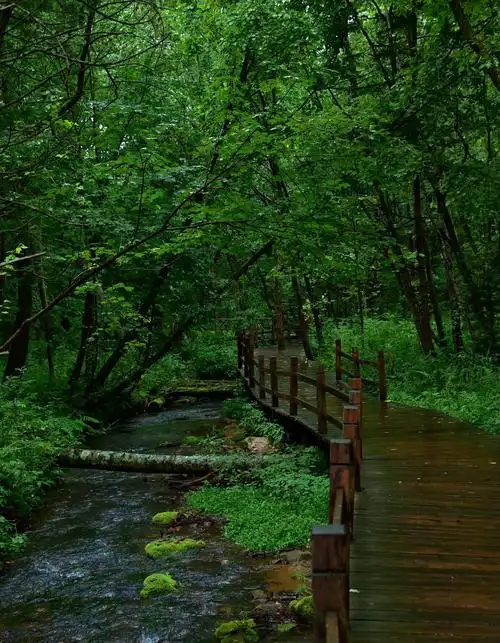
The lifeblood of the park is its network of crystalline streams, threaded by elevated wooden walkways and suspension bridges that invite visitors to wade barefoot into chilly mountain water at the Hundred Qin Creek wading platforms. The undisputed star is the legendary "Longevity Pine," a venerable Korean pine exceeding a thousand years in age, its gnarled branches reaching skyward like a living monument. For a true bird's-eye perspective, ride the sightseeing shuttle uphill to the Guantao Observation Tower, where a 360-degree panorama reveals an undulating sea of pine canopy stretching to the horizon.
**Echoes of Wartime Resistance**
Beyond its natural splendor, the park preserves a poignant chapter of twentieth-century history. Hidden among these dense forests once stood the "Old Qiangui" base camp of the Northeast Anti-Japanese United Army—the Communist-led guerrilla force that, much like the French Maquis or the Polish Home Army, waged a stubborn resistance against Japanese occupation from 1931 to 1945. Walking these same forested trails today, visitors gain a rare glimpse into the harsh mountain campaigns fought by partisan fighters, transforming a simple nature outing into a contemplative journey through one of Asia's most turbulent eras.
**Wildlife Encounters and Russian Flair**
Families will delight in the Squirrel Creek Ranch, where gentle sika deer, chipmunks, and red squirrels eagerly accept food from visitors' hands—a charming interactive experience reminiscent of the famous deer parks of Nara, Japan, or the Beaulieu estate in England. Adding an unexpected cultural twist, the park features a Russian-style village complete with folk performances and regional cuisine, a nod to Heilongjiang's proximity to the Russian Far East. Gentle wooden pathways meander past mossy boulders and wildflower patches, offering easy hiking suitable for all ages and fitness levels.
**Planning Your Visit**
Entry tickets run 45–60 RMB during peak season, with sightseeing shuttles available for 10 RMB—well worth the modest fee given the park's considerable scale. Gates open daily from 8:00 to 17:00, with last admission at 15:30. August delivers the most pleasant summer escape, though early-morning arrivals before 8:00 reward visitors with ethereal forest mist and dramatic Tyndall light rays piercing the canopy. Pack sturdy non-slip shoes, strong insect repellent, and a light jacket, as boardwalks can be slick with morning dew.
**An Ancient Forest Sanctuary**
Shangganling Stream Valley lies deep within the Lesser Khingan range, a relatively intact low-mountain temperate ecosystem where Korean pines have stood for millennia. Comparable in ecological significance to Poland's Białowieża Forest—one of Europe's last primeval woodlands—this park preserves one of China's finest stands of Korean pine, a species once widespread across northeast Asia but now reduced to fragmented old-growth strongholds. With over 96% forest cover, the reserve functions as a vital carbon sink while sheltering sika deer, red squirrels, and dozens of resident bird species.
**Streams, Boardwalks, and Towering Pines**
The lifeblood of the park is its network of crystalline streams, threaded by elevated wooden walkways and suspension bridges that invite visitors to wade barefoot into chilly mountain water at the Hundred Qin Creek wading platforms. The undisputed star is the legendary "Longevity Pine," a venerable Korean pine exceeding a thousand years in age, its gnarled branches reaching skyward like a living monument. For a true bird's-eye perspective, ride the sightseeing shuttle uphill to the Guantao Observation Tower, where a 360-degree panorama reveals an undulating sea of pine canopy stretching to the horizon.
**Echoes of Wartime Resistance**
Beyond its natural splendor, the park preserves a poignant chapter of twentieth-century history. Hidden among these dense forests once stood the "Old Qiangui" base camp of the Northeast Anti-Japanese United Army—the Communist-led guerrilla force that, much like the French Maquis or the Polish Home Army, waged a stubborn resistance against Japanese occupation from 1931 to 1945. Walking these same forested trails today, visitors gain a rare glimpse into the harsh mountain campaigns fought by partisan fighters, transforming a simple nature outing into a contemplative journey through one of Asia's most turbulent eras.
**Wildlife Encounters and Russian Flair**
Families will delight in the Squirrel Creek Ranch, where gentle sika deer, chipmunks, and red squirrels eagerly accept food from visitors' hands—a charming interactive experience reminiscent of the famous deer parks of Nara, Japan, or the Beaulieu estate in England. Adding an unexpected cultural twist, the park features a Russian-style village complete with folk performances and regional cuisine, a nod to Heilongjiang's proximity to the Russian Far East. Gentle wooden pathways meander past mossy boulders and wildflower patches, offering easy hiking suitable for all ages and fitness levels.
**Planning Your Visit**
Entry tickets run 45–60 RMB during peak season, with sightseeing shuttles available for 10 RMB—well worth the modest fee given the park's considerable scale. Gates open daily from 8:00 to 17:00, with last admission at 15:30. August delivers the most pleasant summer escape, though early-morning arrivals before 8:00 reward visitors with ethereal forest mist and dramatic Tyndall light rays piercing the canopy. Pack sturdy non-slip shoes, strong insect repellent, and a light jacket, as boardwalks can be slick with morning dew.