Old Street Historic District
⭐ 3.50
Old Street Historic District, Wumahe District, Yichun City, Heilongjiang Province, China
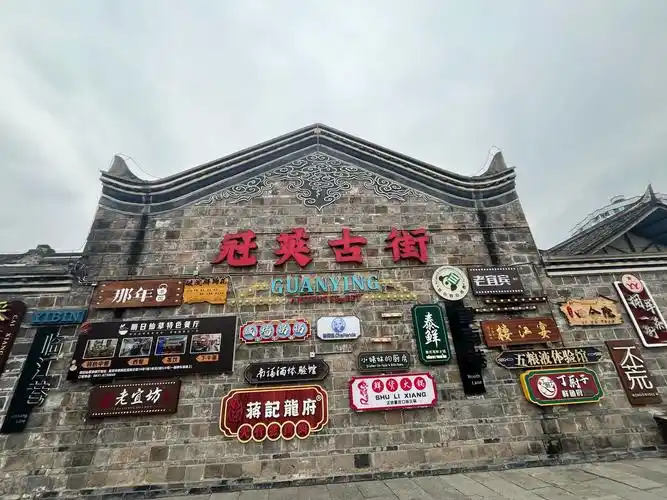 Yichun is young by Chinese standards, founded in the 1950s during the state-led push to harvest timber from the Lesser Khingan Mountains. It belongs to the same planned-economy tradition that produced Norilsk in the Soviet Arctic or Sweden's northern timber towns, cities born of industrial policy rather than organic growth. The grid layout and utilitarian housing reflect this top-down planning era. In this context, "Old Street" is "old" only relative to newer shopping developments. Visitors expecting the carved wooden temples of Lijiang or Pingyao's merchant courtyards will be disappointed; what awaits is a snapshot of a post-industrial forestry town still finding its post-timber identity.
The pedestrian street is flanked by fairly generic modern commercial buildings, unified in style but lacking distinctive character. A handful of older low-rise blocks retain hints of Soviet influence in the form of squat proportions, plain render, and decorative cornices, echoing the era when the USSR was China's main trading and design partner. These fragments hint at Yichun's earliest urban fabric. Colored lighting animates the street at night, but the architecture itself doesn't really shine after dark. Compared to Beijing's lantern-lit hutongs or Harbin's baroque Central Street, this is humble architecture: honest, functional, and unpretentious.
What Old Street lacks in architectural heritage, it compensates for in everyday cultural texture. Locals buy winter coats here, share plates of guo bao rou and dumplings, and gather in the cooler evenings. There is no museum, no calligraphy demonstrations, and no craft stalls, just the rhythm of a northeastern Chinese city going about its business. For travelers seeking contemporary Chinese urban life beyond the polished tourist zones of Beijing and Shanghai, this unvarnished authenticity is genuinely valuable. It is the kind of place where you can hear regional accents, observe family outings, and sense how forestry workers and retirees spend their leisure hours.
The street sits at the heart of Yimei District and is easily reached by local buses from central Yichun. Entry is free, the area is open 24 hours, and shops typically run from about 9 a.m. until 10 p.m. Most vendors accept WeChat Pay and Alipay, but cash is rarely accepted and English signage is virtually nonexistent. International visitors should download a translation app and ideally travel with a Chinese-speaking companion. The pedestrianized, flat street is easy to wander, though access to individual shops can be uneven. A modest selection of restaurants serves northeastern fare alongside basic retail and pharmacies.
The honest verdict is that Old Street is not a destination in itself but a pleasant 60-to-90-minute interlude between Yichun's far more impressive natural attractions. The Lesser Khingan forests, particularly Wuying National Forest Park and the granite formations of Tangwang River, offer scenery no urban sight can match. Visit in the early evening when residents fill the pavement. Summer temperatures hover around 20°C with notable day-night swings, so dress in layers. Mosquitoes are aggressive in forested Yichun, so bring repellent and download offline maps, since mobile signal can be patchy in the surrounding hills. Two hours is plenty.
Yichun is young by Chinese standards, founded in the 1950s during the state-led push to harvest timber from the Lesser Khingan Mountains. It belongs to the same planned-economy tradition that produced Norilsk in the Soviet Arctic or Sweden's northern timber towns, cities born of industrial policy rather than organic growth. The grid layout and utilitarian housing reflect this top-down planning era. In this context, "Old Street" is "old" only relative to newer shopping developments. Visitors expecting the carved wooden temples of Lijiang or Pingyao's merchant courtyards will be disappointed; what awaits is a snapshot of a post-industrial forestry town still finding its post-timber identity.
The pedestrian street is flanked by fairly generic modern commercial buildings, unified in style but lacking distinctive character. A handful of older low-rise blocks retain hints of Soviet influence in the form of squat proportions, plain render, and decorative cornices, echoing the era when the USSR was China's main trading and design partner. These fragments hint at Yichun's earliest urban fabric. Colored lighting animates the street at night, but the architecture itself doesn't really shine after dark. Compared to Beijing's lantern-lit hutongs or Harbin's baroque Central Street, this is humble architecture: honest, functional, and unpretentious.
What Old Street lacks in architectural heritage, it compensates for in everyday cultural texture. Locals buy winter coats here, share plates of guo bao rou and dumplings, and gather in the cooler evenings. There is no museum, no calligraphy demonstrations, and no craft stalls, just the rhythm of a northeastern Chinese city going about its business. For travelers seeking contemporary Chinese urban life beyond the polished tourist zones of Beijing and Shanghai, this unvarnished authenticity is genuinely valuable. It is the kind of place where you can hear regional accents, observe family outings, and sense how forestry workers and retirees spend their leisure hours.
The street sits at the heart of Yimei District and is easily reached by local buses from central Yichun. Entry is free, the area is open 24 hours, and shops typically run from about 9 a.m. until 10 p.m. Most vendors accept WeChat Pay and Alipay, but cash is rarely accepted and English signage is virtually nonexistent. International visitors should download a translation app and ideally travel with a Chinese-speaking companion. The pedestrianized, flat street is easy to wander, though access to individual shops can be uneven. A modest selection of restaurants serves northeastern fare alongside basic retail and pharmacies.
The honest verdict is that Old Street is not a destination in itself but a pleasant 60-to-90-minute interlude between Yichun's far more impressive natural attractions. The Lesser Khingan forests, particularly Wuying National Forest Park and the granite formations of Tangwang River, offer scenery no urban sight can match. Visit in the early evening when residents fill the pavement. Summer temperatures hover around 20°C with notable day-night swings, so dress in layers. Mosquitoes are aggressive in forested Yichun, so bring repellent and download offline maps, since mobile signal can be patchy in the surrounding hills. Two hours is plenty.