Yellow River Scenic Line
⭐ 4.60
Yellow River Scenic Line Grand Scenic Area, Chengguan District, Lanzhou City, Gansu Province, China
 Lanzhou owes its very existence to the Yellow River, which slices the city in two as it courses east toward the sea. For millennia, this stretch served as the gateway between the Central Asian steppe and the heartland of China—the last major crossing before caravans tackled the Hexi Corridor toward Dunhuang and beyond. Imagine a riverside boulevard meeting the strategic importance of a confluence like that of Lyon and the Rhône, yet set against the raw drama of loess hills and desert light. This scenic line distills two thousand years of that journey into a single walkable ribbon.
The undisputed heart of the promenade is the Zhongshan Bridge, a riveted iron span completed in 1907 with German engineering and Chinese labor. It was the first permanent road bridge ever built across the Yellow River, and remarkably, more than a century later, it still carries pedestrians free of charge. Its four stone piers and gunmetal trusses recall the Eiffel-era ironwork of Budapest's Liberty Bridge, but with an unmistakably frontier feel—sunset sets its latticework ablaze, and after dark, discreet lighting traces every arch.
Just north of the bridge rises White Pagoda Hill, a terraced park crowned by a Yuan-dynasty Buddhist pagoda. The summit commands a sweeping view of the river's famous S-bend carving through the city, with the bridge below and the snow-tipped peaks of the Qilian Range hazy on the horizon. For those who would rather skip the 400-odd steps, a cable car glides silently across the water, offering a bird's-eye perspective akin to crossing the Thames via the Emirates Air Line, but with much wilder scenery.
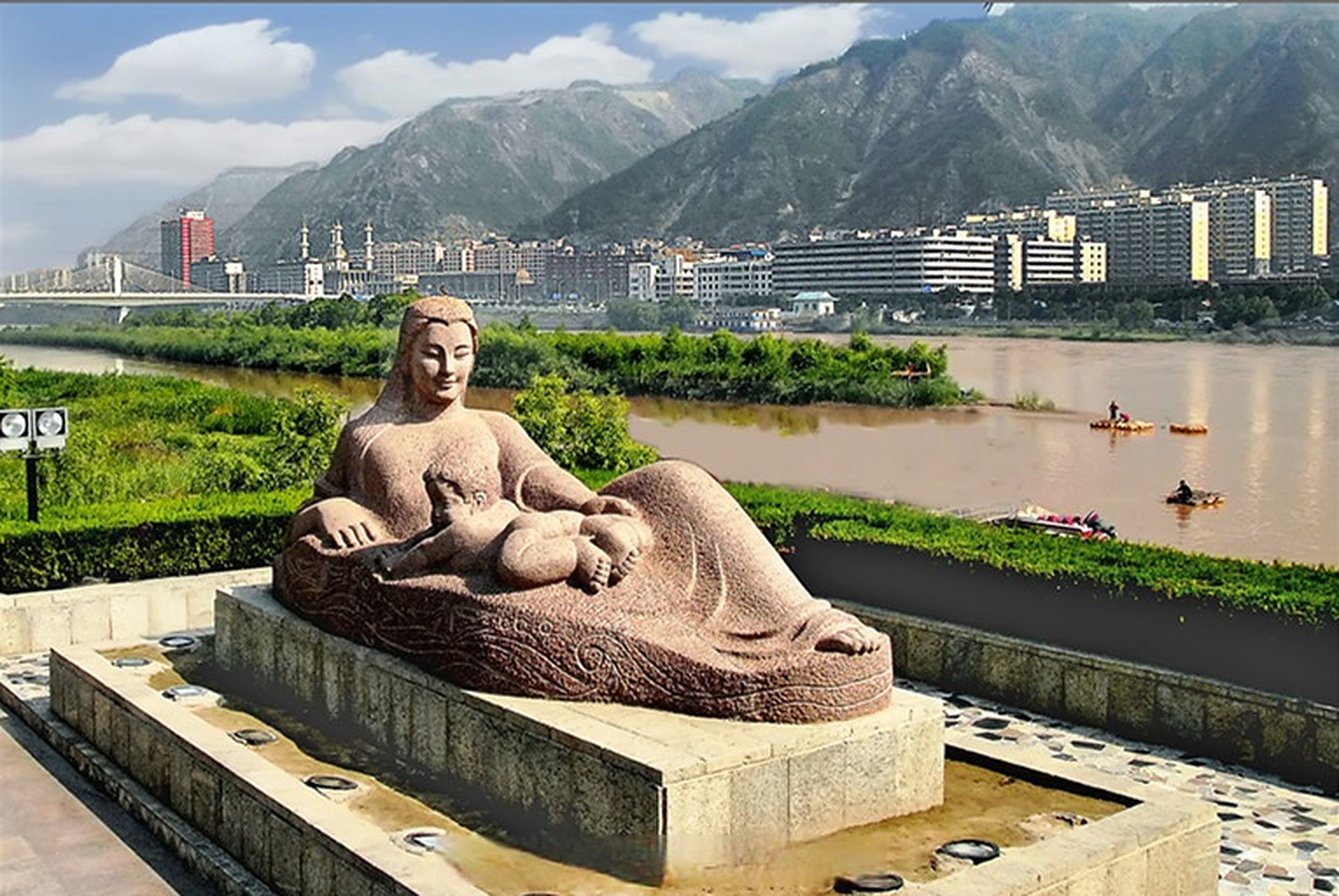
Down on the south bank, the Mother of the Yellow River sculpture—an elegantly simple granite figure cradling an infant—has become Lanzhou's emotional emblem, much as Copenhagen's Little Mermaid anchors Danish identity. A short walk east brings you to the Water Wheel Expo Park, where massive wooden noria wheels, replicas of Ming and Qing-era irrigation machines, still creak and splash along diversion channels. Together they evoke the agricultural civilization that made this arid valley bloom.
The line is not just for looking. Visitors can bounce across the current on a traditional sheepskin raft—a craft still practiced as living heritage—then settle at a riverside tea stall for a Three-Points tea served in lidded porcelain bowls, accompanied by local folk songs drifting from a nearby pavilion. Come evening, illuminated cruise boats glide past, their reflections shimmering on the water, while the Yellow River Tower hosts a multimedia light show. With subway Line 1's Zhongshan Bridge station as your base, the entire stretch unfolds on foot with minimal effort.
Plan your visit for late afternoon: arrive at Zhongshan Bridge for golden hour, cross to White Pagoda Hill for sunset and city lights, then descend for tea and sculpture-gazing on the south bank. Summer brings strong sun and cool river breezes after dark, so pack sunscreen and a light jacket. Allow a full day if you also want to include the Yintan Wetlands or the Jincheng Pass cultural zone further downstream.
Lanzhou owes its very existence to the Yellow River, which slices the city in two as it courses east toward the sea. For millennia, this stretch served as the gateway between the Central Asian steppe and the heartland of China—the last major crossing before caravans tackled the Hexi Corridor toward Dunhuang and beyond. Imagine a riverside boulevard meeting the strategic importance of a confluence like that of Lyon and the Rhône, yet set against the raw drama of loess hills and desert light. This scenic line distills two thousand years of that journey into a single walkable ribbon.
The undisputed heart of the promenade is the Zhongshan Bridge, a riveted iron span completed in 1907 with German engineering and Chinese labor. It was the first permanent road bridge ever built across the Yellow River, and remarkably, more than a century later, it still carries pedestrians free of charge. Its four stone piers and gunmetal trusses recall the Eiffel-era ironwork of Budapest's Liberty Bridge, but with an unmistakably frontier feel—sunset sets its latticework ablaze, and after dark, discreet lighting traces every arch.
Just north of the bridge rises White Pagoda Hill, a terraced park crowned by a Yuan-dynasty Buddhist pagoda. The summit commands a sweeping view of the river's famous S-bend carving through the city, with the bridge below and the snow-tipped peaks of the Qilian Range hazy on the horizon. For those who would rather skip the 400-odd steps, a cable car glides silently across the water, offering a bird's-eye perspective akin to crossing the Thames via the Emirates Air Line, but with much wilder scenery.
Down on the south bank, the Mother of the Yellow River sculpture—an elegantly simple granite figure cradling an infant—has become Lanzhou's emotional emblem, much as Copenhagen's Little Mermaid anchors Danish identity. A short walk east brings you to the Water Wheel Expo Park, where massive wooden noria wheels, replicas of Ming and Qing-era irrigation machines, still creak and splash along diversion channels. Together they evoke the agricultural civilization that made this arid valley bloom.
The line is not just for looking. Visitors can bounce across the current on a traditional sheepskin raft—a craft still practiced as living heritage—then settle at a riverside tea stall for a Three-Points tea served in lidded porcelain bowls, accompanied by local folk songs drifting from a nearby pavilion. Come evening, illuminated cruise boats glide past, their reflections shimmering on the water, while the Yellow River Tower hosts a multimedia light show. With subway Line 1's Zhongshan Bridge station as your base, the entire stretch unfolds on foot with minimal effort.
Plan your visit for late afternoon: arrive at Zhongshan Bridge for golden hour, cross to White Pagoda Hill for sunset and city lights, then descend for tea and sculpture-gazing on the south bank. Summer brings strong sun and cool river breezes after dark, so pack sunscreen and a light jacket. Allow a full day if you also want to include the Yintan Wetlands or the Jincheng Pass cultural zone further downstream.