Jinggangshan National Nature Reserve
⭐ 4.60
North of Xiaogang Village, Xiaying Town, Jizhou District, Tianjin, China
 Jinggangshan holds a singular place in both ecological and political history. The mountains became a refuge in 1927 when Mao Zedong established China's first rural revolutionary base here, an event as transformative for twentieth-century Asia as the storming of the Bastille was for eighteenth-century Europe. Today the reserve, formally designated in 2000, protects what scientists consider an irreplaceable natural laboratory: a complete vertical vegetation spectrum climbing from river valleys to alpine summits, supporting over 3,400 plant species, 400 vertebrates, and 3,000 insect species. The forest canopy generates extraordinary concentrations of negative air ions—comparable to the crisp atmosphere hikers seek in the Swiss Alps.
The reserve's botanical treasures rival those of any European national park. Towering specimens of dawn metasequoia, rare Chinese yews, and ancient camphor trees form a multi-layered canopy that filters sunlight into cathedral-like shafts of green. Wildlife spotters may glimpse the elusive clouded leopard or hear the distinctive call of the Yellow-bellied Tragopan, while the shimmering Golden Swallowtail butterfly—one of China's most protected insects—drifts through forest clearings like a living jewel.
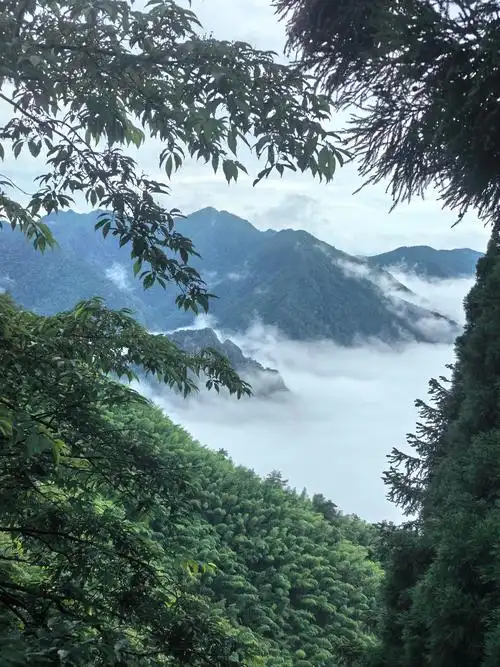
The area's hydrology is equally dramatic. Cascading waterfalls plunge through fern-clad gorges at Longtan (Dragon Pool), where waters tumble over granite steps reminiscent of Scotland's Falls of Bruar but on a far grander scale. From the Huangyangjie pass, visitors can gaze across a sea of clouds that swallows entire ridgelines—a panorama often compared to the cloud-wrapped peaks of Madeira or the Scottish Highlands, yet steeped in the gravity of revolutionary history, where sentry posts and trenches still dot the ridgeline.
Visitors should plan around seasonal highlights. April and May bring the legendary Rhododendron Festival, when the Bijia Mountain slopes blaze with ten miles of flowering shrubs—an Asian rival to the azalea displays of Cornwall's Heligan gardens. Summer offers cool refuge from China's lowland heat, while October paints the forests in scarlet and gold. Note that the reserve's strict core zones permit only approved scientific visits; tourists must explore the overlapping scenic area instead. A combined ticket runs 156 RMB plus 50 RMB for the mandatory shuttle bus (private cars are restricted), and Ciping Town serves as the comfortable base for overnight stays.
Above all, Jinggangshan rewards those who come seeking more than pretty views. It is a place where moss-furred stone paths lead past revolutionary memorials, where the same mist that cloaked Red Army lookouts still rolls through bamboo groves at dawn, and where every waterfall echoes with both natural splendor and the weight of history. Hiring a licensed guide—Chinese or English-speaking—is strongly recommended to unlock the stories behind these layered landscapes, from the heroic Long March origins to the patient work of modern conservation that keeps this "natural oxygen bar" breathing for future generations.
Jinggangshan holds a singular place in both ecological and political history. The mountains became a refuge in 1927 when Mao Zedong established China's first rural revolutionary base here, an event as transformative for twentieth-century Asia as the storming of the Bastille was for eighteenth-century Europe. Today the reserve, formally designated in 2000, protects what scientists consider an irreplaceable natural laboratory: a complete vertical vegetation spectrum climbing from river valleys to alpine summits, supporting over 3,400 plant species, 400 vertebrates, and 3,000 insect species. The forest canopy generates extraordinary concentrations of negative air ions—comparable to the crisp atmosphere hikers seek in the Swiss Alps.
The reserve's botanical treasures rival those of any European national park. Towering specimens of dawn metasequoia, rare Chinese yews, and ancient camphor trees form a multi-layered canopy that filters sunlight into cathedral-like shafts of green. Wildlife spotters may glimpse the elusive clouded leopard or hear the distinctive call of the Yellow-bellied Tragopan, while the shimmering Golden Swallowtail butterfly—one of China's most protected insects—drifts through forest clearings like a living jewel.
The area's hydrology is equally dramatic. Cascading waterfalls plunge through fern-clad gorges at Longtan (Dragon Pool), where waters tumble over granite steps reminiscent of Scotland's Falls of Bruar but on a far grander scale. From the Huangyangjie pass, visitors can gaze across a sea of clouds that swallows entire ridgelines—a panorama often compared to the cloud-wrapped peaks of Madeira or the Scottish Highlands, yet steeped in the gravity of revolutionary history, where sentry posts and trenches still dot the ridgeline.
Visitors should plan around seasonal highlights. April and May bring the legendary Rhododendron Festival, when the Bijia Mountain slopes blaze with ten miles of flowering shrubs—an Asian rival to the azalea displays of Cornwall's Heligan gardens. Summer offers cool refuge from China's lowland heat, while October paints the forests in scarlet and gold. Note that the reserve's strict core zones permit only approved scientific visits; tourists must explore the overlapping scenic area instead. A combined ticket runs 156 RMB plus 50 RMB for the mandatory shuttle bus (private cars are restricted), and Ciping Town serves as the comfortable base for overnight stays.
Above all, Jinggangshan rewards those who come seeking more than pretty views. It is a place where moss-furred stone paths lead past revolutionary memorials, where the same mist that cloaked Red Army lookouts still rolls through bamboo groves at dawn, and where every waterfall echoes with both natural splendor and the weight of history. Hiring a licensed guide—Chinese or English-speaking—is strongly recommended to unlock the stories behind these layered landscapes, from the heroic Long March origins to the patient work of modern conservation that keeps this "natural oxygen bar" breathing for future generations.