Wuzhi Peak
⭐ 3.80
Wuzhi Peak Scenic Area, Ciping Town, Jinggangshan City, Jiangxi Province, China
 Standing 1,586 metres above sea level in the central Luoxiao Range, Wuzhi Peak forms the symbolic heart of Jinggangshan—a mountain system often called the "Cradle of the Chinese Revolution." The Communist Red Army established its first rural base here in 1927 under Mao Zedong, making these misty peaks as foundational to modern China as the Appennines were to the Roman Republic or the Sierra de Guadarrama to the Spanish Resistance. That the range later lent its silhouette to the nation's currency reveals how thoroughly landscape and ideology intertwined in 20th-century Chinese identity.
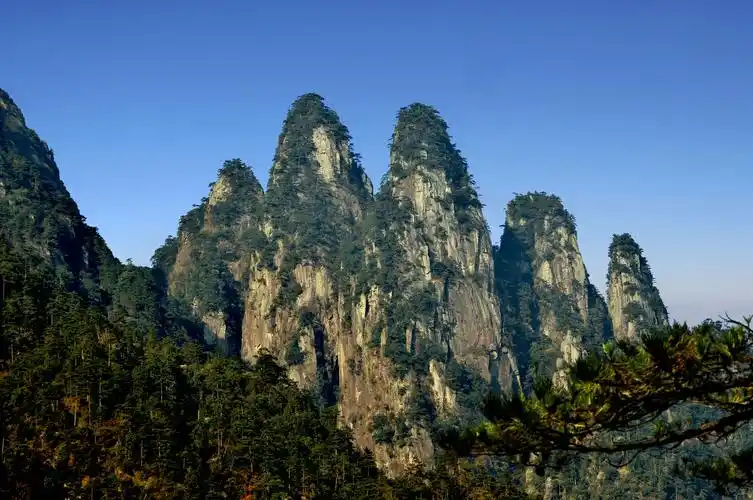
Geologically, Wuzhi Peak belongs to a family of jagged, forest-clad massifs that Western travellers may find reminiscent of Italy's Dolomites or Scotland's Cuillin Hills—five summits arranged in a row like fingers spread across a granite palm, perpetually wreathed in cloud. The viewing platform on the opposite ridge allows visitors to take in the full panorama: soaring forested pinnacles, sheer cliffs plunging into the Longqing River gorge, and the Longqing Waterfall dropping some 200 metres—the tallest in the Jinggangshan preserve. After rain or at dawn, a spectacular sea of cloud swallows the valley, leaving only the fingertips emerging above the mist.
What makes Wuzhi Peak uniquely memorable for many Chinese visitors is its role as the prototype for the 100-yuan note of the Fourth Series of the renminbi, issued in 1999. The familiar image of layered peaks and a cascading fall can be matched, frame by frame, against the real landscape from the dedicated observation deck—a kind of "walking into your wallet" experience that draws countless selfie-toting tourists. For international visitors, the appeal is equally tangible: here is one of the world's most-circulated banknotes brought vividly to life.
Beyond its scenic fame, Wuzhi Peak anchors a thick layer of revolutionary memory. Soldiers of the Red Army reportedly sheltered in nearby caves such as Longqing and Tianjun, and the entire Jinggangshan region now functions as a national-level education site, where school groups and party members retrace the early struggles of Chinese communism. The seamless pairing of dramatic wilderness with patriotic pilgrimage gives the area a resonance akin to touring the trenches of Verdun or the partisans' hideouts in the Slovenian Karst—a place where natural grandeur and human history are inseparable.
Practically speaking, Wuzhi Peak is a viewing destination rather than a climbing one: no trails lead to the summit, and the protected core is off-limits. From the township of Ciping, a scenic shuttle bus reaches the viewing platform in roughly 20 minutes, and most visitors spend 30 to 60 minutes enjoying the panorama. The best windows for photography are early morning or just after rainfall, when the cloud seas are most likely to form. Sturdy, non-slip footwear and a windproof jacket are essential, and the peak combines well with neighbouring sites such as the historic Huangyangjie pass and the Jinggangshan Revolutionary Museum for a fuller day of exploration.
Standing 1,586 metres above sea level in the central Luoxiao Range, Wuzhi Peak forms the symbolic heart of Jinggangshan—a mountain system often called the "Cradle of the Chinese Revolution." The Communist Red Army established its first rural base here in 1927 under Mao Zedong, making these misty peaks as foundational to modern China as the Appennines were to the Roman Republic or the Sierra de Guadarrama to the Spanish Resistance. That the range later lent its silhouette to the nation's currency reveals how thoroughly landscape and ideology intertwined in 20th-century Chinese identity.
Geologically, Wuzhi Peak belongs to a family of jagged, forest-clad massifs that Western travellers may find reminiscent of Italy's Dolomites or Scotland's Cuillin Hills—five summits arranged in a row like fingers spread across a granite palm, perpetually wreathed in cloud. The viewing platform on the opposite ridge allows visitors to take in the full panorama: soaring forested pinnacles, sheer cliffs plunging into the Longqing River gorge, and the Longqing Waterfall dropping some 200 metres—the tallest in the Jinggangshan preserve. After rain or at dawn, a spectacular sea of cloud swallows the valley, leaving only the fingertips emerging above the mist.
What makes Wuzhi Peak uniquely memorable for many Chinese visitors is its role as the prototype for the 100-yuan note of the Fourth Series of the renminbi, issued in 1999. The familiar image of layered peaks and a cascading fall can be matched, frame by frame, against the real landscape from the dedicated observation deck—a kind of "walking into your wallet" experience that draws countless selfie-toting tourists. For international visitors, the appeal is equally tangible: here is one of the world's most-circulated banknotes brought vividly to life.
Beyond its scenic fame, Wuzhi Peak anchors a thick layer of revolutionary memory. Soldiers of the Red Army reportedly sheltered in nearby caves such as Longqing and Tianjun, and the entire Jinggangshan region now functions as a national-level education site, where school groups and party members retrace the early struggles of Chinese communism. The seamless pairing of dramatic wilderness with patriotic pilgrimage gives the area a resonance akin to touring the trenches of Verdun or the partisans' hideouts in the Slovenian Karst—a place where natural grandeur and human history are inseparable.
Practically speaking, Wuzhi Peak is a viewing destination rather than a climbing one: no trails lead to the summit, and the protected core is off-limits. From the township of Ciping, a scenic shuttle bus reaches the viewing platform in roughly 20 minutes, and most visitors spend 30 to 60 minutes enjoying the panorama. The best windows for photography are early morning or just after rainfall, when the cloud seas are most likely to form. Sturdy, non-slip footwear and a windproof jacket are essential, and the peak combines well with neighbouring sites such as the historic Huangyangjie pass and the Jinggangshan Revolutionary Museum for a fuller day of exploration.