Longtan Scenic Area
⭐ 3.80
Longtan Scenic Area, Jinggangshan City, Jiangxi Province, China
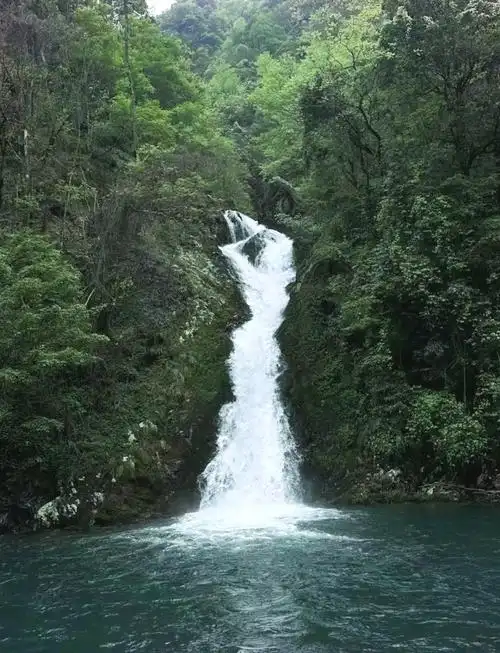 Xiufeng Dragon Pool sits within Mount Lu's celebrated Xiufeng Scenic Area, the very cascade that Tang Dynasty poet Li Bai—often called China's answer to Homer or Shakespeare—praised in his immortal 725 AD verse: "Its flight of three thousand feet straight down, as if the Milky Way were falling from the ninth heaven." Li's poem made this waterfall as iconic in Chinese imagination as Byron made the Rhine or Virgil immortalised Italian landscapes. The pool itself, formed where the Horse-tail Water cascades into a jade-green basin, was once believed by locals to connect directly to the Eastern Sea—hence its name. To stand here is to read the same view that has stirred Chinese literati for thirteen centuries.
Surrounding the pool, the cliffs carry a remarkable gallery of stone inscriptions spanning the Tang, Song, Yuan, Ming, and Qing dynasties—China's five great imperial eras. Calligraphic works by masters including Tang calligrapher Yan Zhenqing, whose style shaped East Asian writing for centuries, sit side-by-side with poems by Tang luminaries. Imagine the Rosetta Stone meeting Roman graffiti along an Alpine gorge: each character is both art and history, etched into granite by hands that shaped a civilisation. The neighbouring Hanyang Temple, founded in the Jin Dynasty, anchors the spiritual dimension, while the Three Precious Trees—a trio of ancient Chinese firs planted during the same era—stand as living witnesses to thirteen centuries of Buddhist devotion.
A short drive north, on the southern flanks of Guling—the Victorian-era mountain resort town comparable to Bavaria's Garmisch—lie the quieter Yellow Dragon and Black Dragon Pools, each named for legendary serpent spirits said to dwell in their depths. Yellow Dragon Pool falls in a silent, brooding cascade from high above; Black Dragon Pool tumbles more briskly, its sound likened by old writers to a lute's resonance. Both pools rest beneath ancient cryptomeria and camphor trees, some exceeding a thousand years in age. Summer temperatures here run 3–5°C cooler than the lowlands, making the path a natural retreat—much as English travellers once sought spa towns in the Pyrenees or Dolomites.
The pools reveal different personalities by season. From June to August, the summer monsoon feeds the falls into thunderous, foam-flecked torrents that recall Niagara's midsummer fury compressed into a mountain frame; the dry months of autumn and early spring turn the water silkier, the pools glassier, allowing the eye to trace every swirl and pebble. The gorges shelter exceptionally high concentrations of negative ions and a complete forest canopy, making them natural "oxygen bars" beloved by urban Chinese weekenders. Please note: swimming is strictly forbidden—the currents are deceptive—and visitors must remain on designated walkways. The finest light for photography falls between 8 and 10 a.m., when mist catches the morning sun.
Xiufeng Dragon Pool requires a separate ticket (roughly 40–70 yuan, around £5–£8) and is generally open 7:30 a.m. to 5:30 p.m.; Yellow and Black Dragon Pools are covered by the main Mount Lu entrance ticket. Allow half a day for the area: around 2.5 hours for Xiufeng and 2 hours for the Guling pool walk. Mount Lu itself uses a real-name reservation system with three-day tickets allowing re-entry—book via the official Lushan One-Code Pass mini-program. Wear non-slip hiking shoes, bring sunscreen, insect repellent, and a light raincoat; mobile signal is patchy in the gorges, so download offline maps. Before setting out, check the official WeChat account for closure notices and flood warnings. Emergency line: 0792-8281111.
Xiufeng Dragon Pool sits within Mount Lu's celebrated Xiufeng Scenic Area, the very cascade that Tang Dynasty poet Li Bai—often called China's answer to Homer or Shakespeare—praised in his immortal 725 AD verse: "Its flight of three thousand feet straight down, as if the Milky Way were falling from the ninth heaven." Li's poem made this waterfall as iconic in Chinese imagination as Byron made the Rhine or Virgil immortalised Italian landscapes. The pool itself, formed where the Horse-tail Water cascades into a jade-green basin, was once believed by locals to connect directly to the Eastern Sea—hence its name. To stand here is to read the same view that has stirred Chinese literati for thirteen centuries.
Surrounding the pool, the cliffs carry a remarkable gallery of stone inscriptions spanning the Tang, Song, Yuan, Ming, and Qing dynasties—China's five great imperial eras. Calligraphic works by masters including Tang calligrapher Yan Zhenqing, whose style shaped East Asian writing for centuries, sit side-by-side with poems by Tang luminaries. Imagine the Rosetta Stone meeting Roman graffiti along an Alpine gorge: each character is both art and history, etched into granite by hands that shaped a civilisation. The neighbouring Hanyang Temple, founded in the Jin Dynasty, anchors the spiritual dimension, while the Three Precious Trees—a trio of ancient Chinese firs planted during the same era—stand as living witnesses to thirteen centuries of Buddhist devotion.
A short drive north, on the southern flanks of Guling—the Victorian-era mountain resort town comparable to Bavaria's Garmisch—lie the quieter Yellow Dragon and Black Dragon Pools, each named for legendary serpent spirits said to dwell in their depths. Yellow Dragon Pool falls in a silent, brooding cascade from high above; Black Dragon Pool tumbles more briskly, its sound likened by old writers to a lute's resonance. Both pools rest beneath ancient cryptomeria and camphor trees, some exceeding a thousand years in age. Summer temperatures here run 3–5°C cooler than the lowlands, making the path a natural retreat—much as English travellers once sought spa towns in the Pyrenees or Dolomites.
The pools reveal different personalities by season. From June to August, the summer monsoon feeds the falls into thunderous, foam-flecked torrents that recall Niagara's midsummer fury compressed into a mountain frame; the dry months of autumn and early spring turn the water silkier, the pools glassier, allowing the eye to trace every swirl and pebble. The gorges shelter exceptionally high concentrations of negative ions and a complete forest canopy, making them natural "oxygen bars" beloved by urban Chinese weekenders. Please note: swimming is strictly forbidden—the currents are deceptive—and visitors must remain on designated walkways. The finest light for photography falls between 8 and 10 a.m., when mist catches the morning sun.
Xiufeng Dragon Pool requires a separate ticket (roughly 40–70 yuan, around £5–£8) and is generally open 7:30 a.m. to 5:30 p.m.; Yellow and Black Dragon Pools are covered by the main Mount Lu entrance ticket. Allow half a day for the area: around 2.5 hours for Xiufeng and 2 hours for the Guling pool walk. Mount Lu itself uses a real-name reservation system with three-day tickets allowing re-entry—book via the official Lushan One-Code Pass mini-program. Wear non-slip hiking shoes, bring sunscreen, insect repellent, and a light raincoat; mobile signal is patchy in the gorges, so download offline maps. Before setting out, check the official WeChat account for closure notices and flood warnings. Emergency line: 0792-8281111.