Maoping Octagonal Tower
⭐ 3.50
Maoping Octagonal Tower, Maoping Town, Jinggangshan City, Jiangxi Province, China
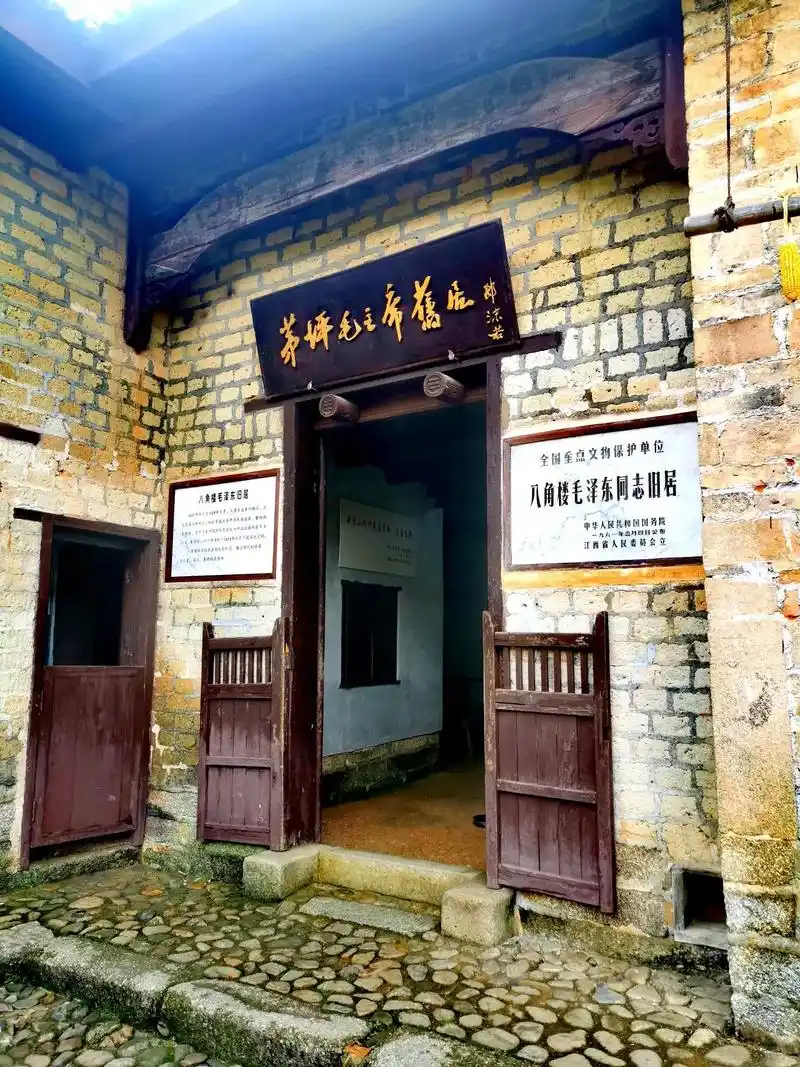 PARAGRAPH 1: Historical Context
The Octagonal Tower occupies the same epoch-defining place in Chinese Communist history as Lenin's modest flat on St. Petersburg's Fontanka River does for Russian revolutionaries, or the prison cell of Antonio Gramsci for European Marxism. Between October 1927 and January 1929, Mao Zedong—then a relatively unknown guerrilla leader in his mid-thirties—used this cramped upstairs room as his command post while his Red Army held the surrounding highlands against Nationalist encirclement. Cut off from electricity, paper, and even adequate food by Chiang Kai-shek's blockade, Mao composed two of his most consequential essays here. Together they argued that revolutionary power could survive in remote rural enclaves, a thesis that would later ignite Mao's famous metaphor of "a single spark can start a prairie fire" and directly shape the eventual victory of 1949.
PARAGRAPH 2: Architecture
The building itself is a humble Qing-dynasty timber-and-masonry structure, roughly comparable in scale to a small English coaching inn or a Tuscan farmer's villa of the same era. What makes it distinctive is the ingenious octagonal skylight cut into the second-floor ceiling above the bed alcove—hence the name Bajiaolou, or "Eight-Angle Tower." This clever ventilation-and-light solution transforms a windowless interior into a luminous working space while creating the building's instantly recognizable silhouette. Earth-pressed brick walls, grey-tile eaves, and plain wooden beams reflect the austere aesthetic shared with other vernacular dwellings of southern Jiangxi, making the structure feel inseparable from the rugged terrain that sustained the early Soviet experiment.
PARAGRAPH 3: Inside the Tower
A visit is essentially a step into Mao's preserved study. The single-wick brass oil lamp still sits on the wooden desk, and it is impossible to look at it without recalling the writer himself hunched over manuscripts in cold mountain winters. Also preserved are his wooden-framed bed, writing desk, inkstone, and a collection of Red Army slogans still visible on the original plaster walls—graffiti that any Western visitor familiar with wartime European cellars will recognize as the authentic voice of soldiers speaking directly to the future. Interpretive panels in Chinese describe the room's literary significance; English-speaking guides can be booked in advance through the Jinggangshan scenic area office.
PARAGRAPH 4: Cultural Significance
For Chinese visitors, the Octagonal Tower ranks alongside the Yanan caves, the Jinggangshan martyrs' cemetery, and the Xibaipo village as one of the founding shrines of the People's Republic, places where the communist story is taught the way cathedrals teach Christian history. For foreign travelers, it offers something rarer: an intimate encounter with the material conditions under which twentieth-century revolution was actually written. The enduring image of "one lamp as small as a bean illuminating mighty words" has entered Chinese literature as a secular equivalent of Diogenes' lantern searching for truth—proof that the most consequential ideas can be born in the dimmest light.
PARAGRAPH 5: Practical Visit Information
The tower sits in Maoping Village, about 36 kilometers from the main Ciping town and scenic-area hub. Travelers without a driver should take the regular scenic-area shuttle bus toward the Maoping revolutionary-site group; ride-hailing and self-drive are the easiest alternatives. Admission is free, opening hours run from 08:00 to 17:00, and most visitors allow two to three hours for the Octagonal Tower and its companion sites in the village, including the former Hunan-Jiangxi border party congress venue, Red Army martyrs' cemetery, and the Buyun Mountain training ground. Facilities are minimal: bring your own water, snacks, insect repellent in summer, and modest clothing appropriate to a memorial site.
PARAGRAPH 6: Why Visit
Western tourists will find the Octagonal Tower deeply rewarding when paired with the natural drama of surrounding Jinggangshan—the misty battlements of Huangyangjie and the waterfalls of Longtan—creating a "red plus green" circuit that balances ideological history with landscape wonder. Families with younger children may find the experience visually sparse, but anyone with an interest in twentieth-century world history, military strategy, or the literature of revolution will leave with one of the more memorable impressions of their China journey: the sight of a single brass lamp, a wooden bed, and the small room where modern China was first imagined.
PARAGRAPH 1: Historical Context
The Octagonal Tower occupies the same epoch-defining place in Chinese Communist history as Lenin's modest flat on St. Petersburg's Fontanka River does for Russian revolutionaries, or the prison cell of Antonio Gramsci for European Marxism. Between October 1927 and January 1929, Mao Zedong—then a relatively unknown guerrilla leader in his mid-thirties—used this cramped upstairs room as his command post while his Red Army held the surrounding highlands against Nationalist encirclement. Cut off from electricity, paper, and even adequate food by Chiang Kai-shek's blockade, Mao composed two of his most consequential essays here. Together they argued that revolutionary power could survive in remote rural enclaves, a thesis that would later ignite Mao's famous metaphor of "a single spark can start a prairie fire" and directly shape the eventual victory of 1949.
PARAGRAPH 2: Architecture
The building itself is a humble Qing-dynasty timber-and-masonry structure, roughly comparable in scale to a small English coaching inn or a Tuscan farmer's villa of the same era. What makes it distinctive is the ingenious octagonal skylight cut into the second-floor ceiling above the bed alcove—hence the name Bajiaolou, or "Eight-Angle Tower." This clever ventilation-and-light solution transforms a windowless interior into a luminous working space while creating the building's instantly recognizable silhouette. Earth-pressed brick walls, grey-tile eaves, and plain wooden beams reflect the austere aesthetic shared with other vernacular dwellings of southern Jiangxi, making the structure feel inseparable from the rugged terrain that sustained the early Soviet experiment.
PARAGRAPH 3: Inside the Tower
A visit is essentially a step into Mao's preserved study. The single-wick brass oil lamp still sits on the wooden desk, and it is impossible to look at it without recalling the writer himself hunched over manuscripts in cold mountain winters. Also preserved are his wooden-framed bed, writing desk, inkstone, and a collection of Red Army slogans still visible on the original plaster walls—graffiti that any Western visitor familiar with wartime European cellars will recognize as the authentic voice of soldiers speaking directly to the future. Interpretive panels in Chinese describe the room's literary significance; English-speaking guides can be booked in advance through the Jinggangshan scenic area office.
PARAGRAPH 4: Cultural Significance
For Chinese visitors, the Octagonal Tower ranks alongside the Yanan caves, the Jinggangshan martyrs' cemetery, and the Xibaipo village as one of the founding shrines of the People's Republic, places where the communist story is taught the way cathedrals teach Christian history. For foreign travelers, it offers something rarer: an intimate encounter with the material conditions under which twentieth-century revolution was actually written. The enduring image of "one lamp as small as a bean illuminating mighty words" has entered Chinese literature as a secular equivalent of Diogenes' lantern searching for truth—proof that the most consequential ideas can be born in the dimmest light.
PARAGRAPH 5: Practical Visit Information
The tower sits in Maoping Village, about 36 kilometers from the main Ciping town and scenic-area hub. Travelers without a driver should take the regular scenic-area shuttle bus toward the Maoping revolutionary-site group; ride-hailing and self-drive are the easiest alternatives. Admission is free, opening hours run from 08:00 to 17:00, and most visitors allow two to three hours for the Octagonal Tower and its companion sites in the village, including the former Hunan-Jiangxi border party congress venue, Red Army martyrs' cemetery, and the Buyun Mountain training ground. Facilities are minimal: bring your own water, snacks, insect repellent in summer, and modest clothing appropriate to a memorial site.
PARAGRAPH 6: Why Visit
Western tourists will find the Octagonal Tower deeply rewarding when paired with the natural drama of surrounding Jinggangshan—the misty battlements of Huangyangjie and the waterfalls of Longtan—creating a "red plus green" circuit that balances ideological history with landscape wonder. Families with younger children may find the experience visually sparse, but anyone with an interest in twentieth-century world history, military strategy, or the literature of revolution will leave with one of the more memorable impressions of their China journey: the sight of a single brass lamp, a wooden bed, and the small room where modern China was first imagined.