Jinggangshan Revolutionary Museum
⭐ 4.60
No. 1, Red Army Avenue, Ciping Town, Jinggangshan City, Jiangxi Province, China
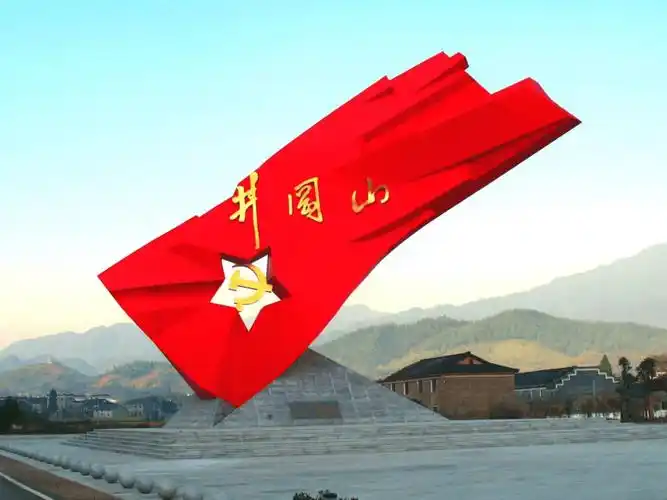 The Jinggangshan Revolutionary Museum commemorates one of the twentieth century's most consequential uprisings. Between 1927 and 1930, Mao Zedong and Zhu De forged China's first rural soviet base here—roughly contemporary with Stalin's consolidation of power in the Soviet Union and the Spanish Civil War's opening salvos. For travelers familiar with how the French Revolution reshaped Europe or how Gettysburg memorializes America's defining conflict, Jinggangshan offers an equivalent pilgrimage to the origins of contemporary China. It stands as the spiritual birthplace of the "encircling cities from the countryside" strategy that ultimately reshaped Asia's geopolitical map.
The museum building rises from the mountainside in dignified granite and sweeping rooflines that echo traditional Chinese palace architecture while asserting modern ambition. Zhu De himself inscribed the museum's calligraphy name, lending gravitas from the very top of the entrance. Inside, six sequential halls—Introduction, The Arduous Search, Founding the Base, Its Development, A New Chapter, and Carrying Forward the Jinggangshan Spirit—guide visitors through nineteen immersive scenes. Highlights include a 45-second kinetic "Zhu-Mao Meeting" tableau and a sound-and-light reconstruction of the Battle of Huangyangjie, where farmers armed with bamboo spears repelled a vastly superior enemy force.
Nearly 3,000 genuine artifacts anchor the narrative in human scale: Mao's octagonal lamp and inkstone, Zhu De's shoulder pole worn smooth from hauling rice up steep trails, and iron pickaxes recovered from Huangyangjie's defensive trenches. The "Jinggangshan Spirit" of daring to fight and daring to win became foundational to Chinese Communist Party ideology, comparable in cultural weight to how Bastille Day defines French republican identity or how the Alamo shapes Texan self-understanding. Visiting feels less like browsing a museum than stepping into a national shrine, where every object reinforces the sacrifices that founded the People's Republic.
Admission is free, but visitors must reserve timed entry tickets online in advance through the official website and present a passport at the gate. Hours run Tuesday through Sunday, 8:00 to 17:00, with last admission at 16:30; the museum closes Mondays. The one-way route takes roughly 1.5 to 2 hours. English guided tours can be booked ahead, or licensed bilingual guides hired on site for deeper context. Strict rules prohibit flash photography, touching artifacts, and filming in certain halls. The on-site gift shop offers a break, though no restaurant is available—sample a "Red Army meal" of rustic mountain dishes nearby.
Allocate at least half a day for a meaningful visit, and pair the museum with the Ciping revolutionary houses and the Beishan Martyrs' Cemetery to create a coherent historical loop. Mountain weather shifts quickly, so pack a light jacket and sturdy non-slip shoes for the cobbled approaches. Allow extra time to linger over the multimedia installations, which reward patience with surprisingly emotional payoffs—particularly the luminous reconstruction of Mao writing by lamplight in the Octagonal Tower. For travelers tracing the roots of modern China, the museum offers the same pivotal insight visitors find at Moscow's State Historical Museum or London's Imperial War Museum, making it an essential stop in any serious itinerary through Jiangxi.
The Jinggangshan Revolutionary Museum commemorates one of the twentieth century's most consequential uprisings. Between 1927 and 1930, Mao Zedong and Zhu De forged China's first rural soviet base here—roughly contemporary with Stalin's consolidation of power in the Soviet Union and the Spanish Civil War's opening salvos. For travelers familiar with how the French Revolution reshaped Europe or how Gettysburg memorializes America's defining conflict, Jinggangshan offers an equivalent pilgrimage to the origins of contemporary China. It stands as the spiritual birthplace of the "encircling cities from the countryside" strategy that ultimately reshaped Asia's geopolitical map.
The museum building rises from the mountainside in dignified granite and sweeping rooflines that echo traditional Chinese palace architecture while asserting modern ambition. Zhu De himself inscribed the museum's calligraphy name, lending gravitas from the very top of the entrance. Inside, six sequential halls—Introduction, The Arduous Search, Founding the Base, Its Development, A New Chapter, and Carrying Forward the Jinggangshan Spirit—guide visitors through nineteen immersive scenes. Highlights include a 45-second kinetic "Zhu-Mao Meeting" tableau and a sound-and-light reconstruction of the Battle of Huangyangjie, where farmers armed with bamboo spears repelled a vastly superior enemy force.
Nearly 3,000 genuine artifacts anchor the narrative in human scale: Mao's octagonal lamp and inkstone, Zhu De's shoulder pole worn smooth from hauling rice up steep trails, and iron pickaxes recovered from Huangyangjie's defensive trenches. The "Jinggangshan Spirit" of daring to fight and daring to win became foundational to Chinese Communist Party ideology, comparable in cultural weight to how Bastille Day defines French republican identity or how the Alamo shapes Texan self-understanding. Visiting feels less like browsing a museum than stepping into a national shrine, where every object reinforces the sacrifices that founded the People's Republic.
Admission is free, but visitors must reserve timed entry tickets online in advance through the official website and present a passport at the gate. Hours run Tuesday through Sunday, 8:00 to 17:00, with last admission at 16:30; the museum closes Mondays. The one-way route takes roughly 1.5 to 2 hours. English guided tours can be booked ahead, or licensed bilingual guides hired on site for deeper context. Strict rules prohibit flash photography, touching artifacts, and filming in certain halls. The on-site gift shop offers a break, though no restaurant is available—sample a "Red Army meal" of rustic mountain dishes nearby.
Allocate at least half a day for a meaningful visit, and pair the museum with the Ciping revolutionary houses and the Beishan Martyrs' Cemetery to create a coherent historical loop. Mountain weather shifts quickly, so pack a light jacket and sturdy non-slip shoes for the cobbled approaches. Allow extra time to linger over the multimedia installations, which reward patience with surprisingly emotional payoffs—particularly the luminous reconstruction of Mao writing by lamplight in the Octagonal Tower. For travelers tracing the roots of modern China, the museum offers the same pivotal insight visitors find at Moscow's State Historical Museum or London's Imperial War Museum, making it an essential stop in any serious itinerary through Jiangxi.